Clear Sky Science · en
Differential enrichment of key bacterial taxa in the rhizosphere of naturally growing and artificially restored Kandelia obovata forests
Why tiny life around mangrove roots matters
Mangrove forests protect coasts from storms, store large amounts of carbon, and shelter fish and crustaceans. As many mangroves are destroyed and then replanted, some restored forests thrive while others struggle, even when they stand side by side in similar water and soil. This study looks below the surface, into the thin zone of soil clinging to mangrove roots, to ask whether invisible communities of bacteria help explain why some young mangrove stands grow well and others falter.
Coastal forests under pressure and repair
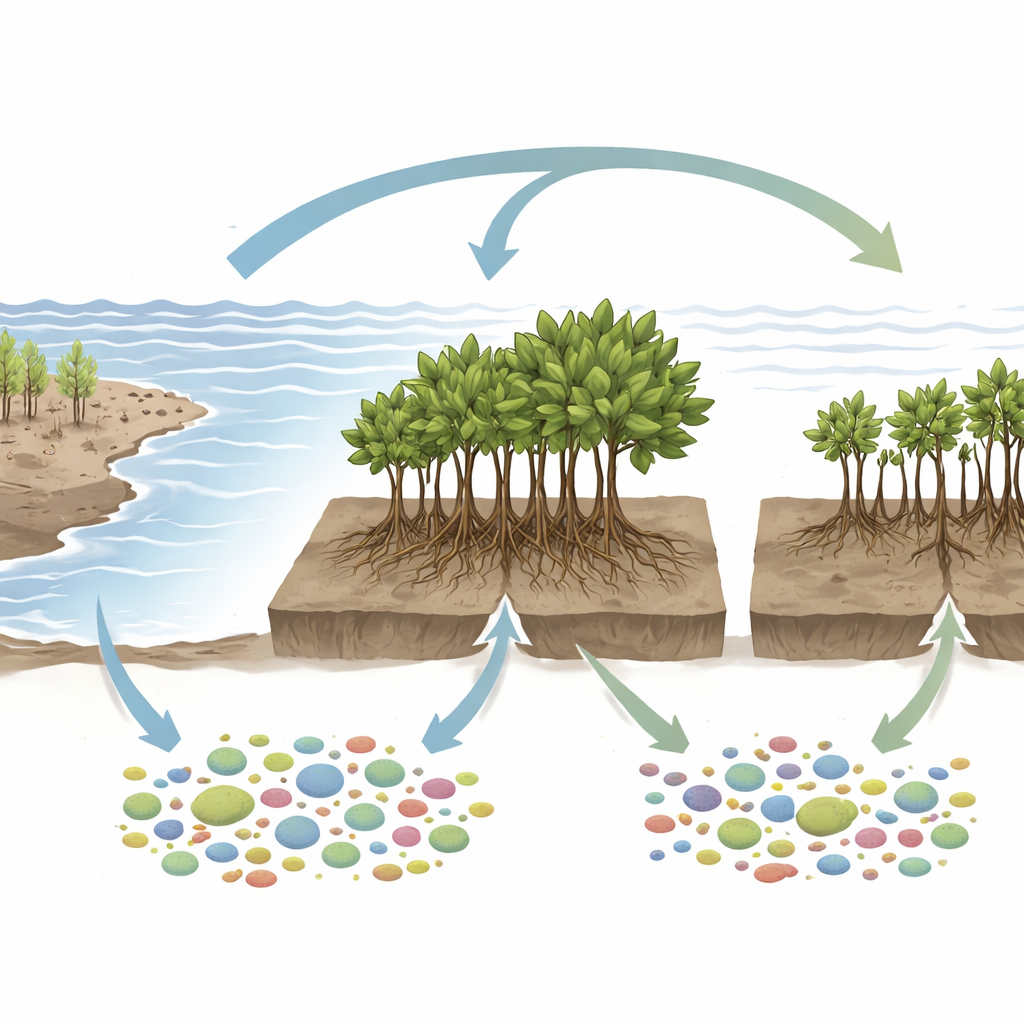
Mangrove forests grow in tidal zones of tropical and subtropical coasts, where they buffer waves, trap sediment, and lock away carbon. Yet development, aquaculture, and climate change have removed mangroves worldwide. Planting mangrove seedlings has become a common repair strategy, but success is uneven. The authors focus on Kandelia obovata, a key mangrove tree along China’s south coast that is widely used in restoration projects. They compare three nearby forests: a natural stand, a restored site where seedlings are growing strongly, and another restored site where seedlings remain short and sparse despite similar climate and broad soil conditions.
Peering into the hidden world around roots
The team dug up seedlings and collected the thin layer of sediment stuck to their roots, known as the rhizosphere. Using high-throughput DNA sequencing, they cataloged which bacteria were present and how abundant they were. They then used several types of statistical analysis to compare the richness and diversity of bacterial communities among the three sites. They also built interaction networks to see which bacterial groups tend to appear together and used computational tools to predict what kinds of chemical processes these microbes might be carrying out, especially those linked to sulfur, a key element in waterlogged coastal mud.
Same overall community, different key players
At first glance, the three forests looked surprisingly similar from a microbial point of view. Overall bacterial diversity and broad community structure did not change dramatically between natural and restored sites. However, when the authors zoomed in on particular groups, important differences emerged. Each forest type was marked by its own set of dominant bacterial genera. The well-performing restored forest and the natural forest both featured relatively high levels of bacteria such as Sulfurovum, Actibacter, and Desulfatiglans, which are known to take part in breaking down sulfur compounds and organic matter in marine sediments. In contrast, the poorly growing restored forest was enriched in other groups, including Ignavibacterium and Prolixibacter, that signal a different style of microbial community and may reflect more stressed or altered conditions around the roots.
Microbial jobs and the sulfur cycle
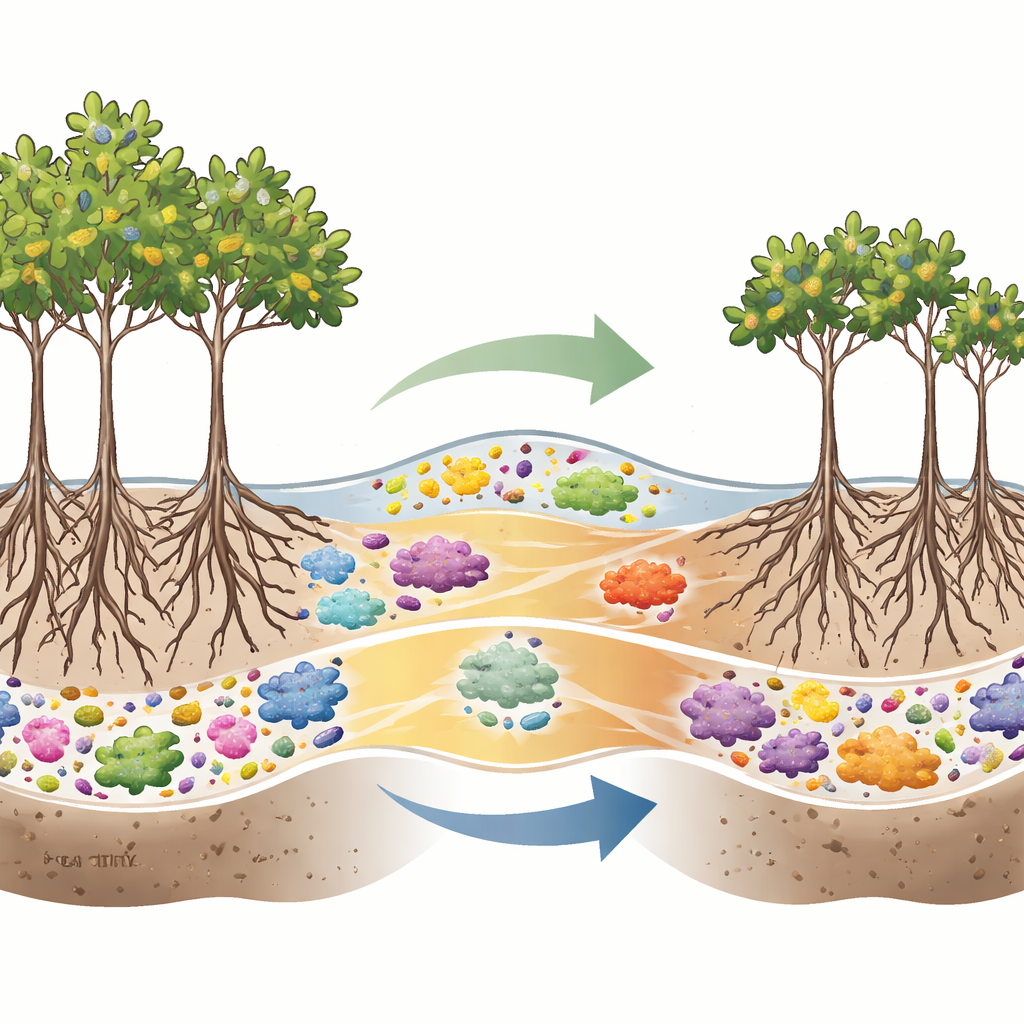
Because many bacteria in the samples could not be identified in detail, the researchers used gene-based predictions to infer what the communities were likely doing. Across all sites, most predicted functions were tied to metabolism, but differences emerged in the pathways associated with sulfur cycling. In the healthy natural forest and the well-growing restored site, bacteria that oxidize and reduce sulfur were relatively abundant, pointing to a balanced sulfur cycle that can detoxify harmful compounds like sulfides. The poorly growing site showed a mismatch: genes linked to sulfur metabolism appeared highly active, but the known sulfur-processing bacteria were less abundant. The authors suggest that a mixture of stress responses, contributions from unclassified bacteria, and functional redundancy may be propping up sulfur cycling in this struggling forest, indicating a less stable and more strained root environment.
What this means for restoring mangroves
Taken together, the findings suggest that simply replanting seedlings is not enough to guarantee a thriving mangrove forest. While artificial restoration did not overhaul the entire bacterial community, it did selectively favor certain bacterial groups over others, and these shifts lined up with how well the young trees were growing. In practical terms, particular bacteria linked to sulfur and pollutant processing may serve as early warning signals of whether a new mangrove forest is on a healthy trajectory. In the long run, paying attention to the underground partners of mangrove roots could help managers design restoration projects that support not just the trees we see, but also the microscopic life that quietly keeps these coastal ecosystems functioning.
Citation: Gong, S., Wang, R., Xie, X. et al. Differential enrichment of key bacterial taxa in the rhizosphere of naturally growing and artificially restored Kandelia obovata forests. Sci Rep 16, 11506 (2026). https://doi.org/10.1038/s41598-026-39157-4
Keywords: mangrove restoration, soil microbiome, rhizosphere bacteria, Kandelia obovata, sulfur cycling