Clear Sky Science · en
A dual limb attention based deep learning network for multipath classification of millimetre wave signals in intelligent transportation system
Why road signals can get confused
As cars, buses, and trucks become smarter and more connected, they rely on high‑frequency wireless signals to talk to each other and to roadside equipment. But in real streets filled with buildings, trees, and other vehicles, these signals bounce around, creating many echoes that can confuse onboard systems. This paper introduces a new way to teach computers to separate the useful signal paths from the harmful echoes, helping future intelligent transportation systems stay reliable even in cluttered city and highway environments.
The problem of signal echoes on the road
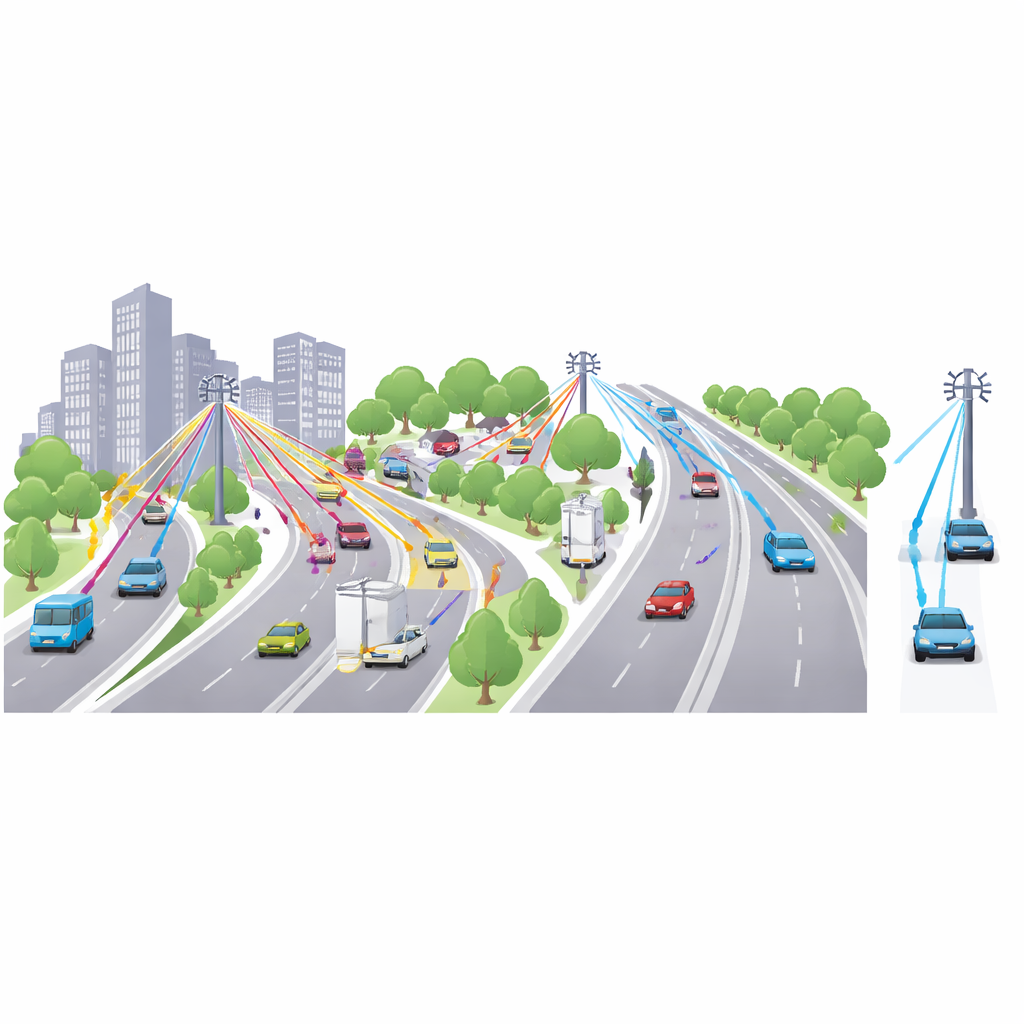
When a wireless signal travels between a roadside base station and a moving vehicle, it rarely takes just one straight path. Instead, it reflects, scatters, and diffracts off buildings, cars, and the road surface, creating many delayed copies known as multipath components. A direct line‑of‑sight path and the first few reflections are usually helpful, but higher‑order echoes arrive late, from odd angles, and with distorted strength. These unwanted echoes can blur timing and direction estimates, increase errors, and disrupt tasks such as precise positioning, autonomous navigation, parking guidance, and traffic monitoring. Traditional mathematical methods that try to classify and filter these paths struggle in such fast‑changing environments, require heavy calibration, and often top out at around 90% accuracy—too low for safety‑critical systems.
Teaching a network to read messy road signals
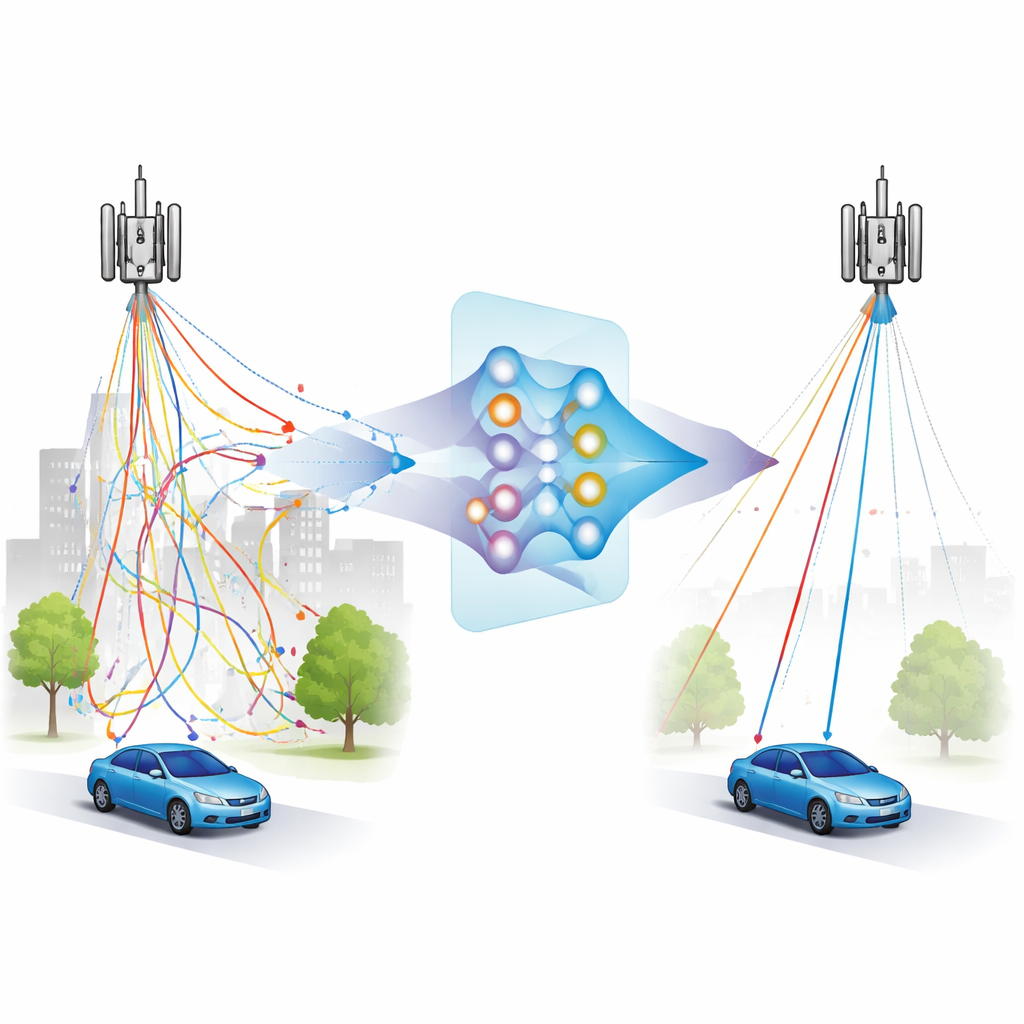
To tackle this, the authors propose a new deep learning model called MOVENetx64, designed specifically for the one‑dimensional time‑series data produced by modern wireless channels. Instead of relying on manually cleaned or heavily processed inputs, MOVENetx64 ingests raw information about when each path arrives, how strong it is, and from which directions it comes, along with its phase. Inside the model, stacks of convolutional layers first pick out local patterns, and then long short‑term memory units track how these patterns evolve over time. This combination captures both the instantaneous and sequential structure hidden in the jumble of echoes.
A dual focus mechanism for tricky echoes
The most distinctive part of MOVENetx64 is a new "dual limb attention" block. In simple terms, this module looks at the channel data through two parallel views. It splits the internal signals into two parts, processes each along its own branch, and then applies an attention mechanism that learns which bits of each branch matter most for deciding whether a path is useful or harmful. By weighting important features more heavily and suppressing noise, the dual limb attention helps the network zero in on subtle differences between desirable first‑order paths and confusing higher‑order echoes, even when they overlap in time or direction.
Training on realistic virtual roads
To test the approach, the researchers generated large, realistic datasets using a ray‑tracing simulator for three types of driving environments: dense city streets, mixed suburban areas, and highways with moving traffic. For each setting, they extracted timing, power, angle, and phase features for every signal path and grouped them into two classes: direct plus first‑order paths, and higher‑order multipath. A key challenge was that harmful echoes were much more common than clean paths, which can mislead standard training. To address this, the authors designed an "alternating loss" strategy that switches between two different training objectives—one better at handling imbalance, the other better at overall accuracy—whenever progress stalls, helping the network learn both rare and common cases well.
How well does the new method work?
Across all three road types, MOVENetx64 achieved very high classification accuracy, above 98% in suburban settings and above 96% even on highways, while keeping the error in predicting higher‑order echoes as low as 0.17–2.28%. It consistently outperformed a wide range of popular deep learning models, from classic convolutional networks to advanced residual networks and bidirectional recurrent models, as well as earlier multipath classifiers from the literature. Importantly, it did so with a relatively modest number of parameters and without requiring expensive pre‑processing steps such as reconstructing detailed channel impulse responses or applying complex transforms.
What this means for future smart transport
For non‑experts, the takeaway is straightforward: MOVENetx64 is a specialized "filtering brain" that learns to tell good signal paths from bad echoes in busy wireless environments. By working directly on raw data and handling heavily imbalanced conditions, it can help future vehicle‑to‑infrastructure systems maintain strong, reliable links even in crowded cities. Better separation of useful paths from interference means more accurate location estimates, fewer communication dropouts, and more dependable support for autonomous driving and other advanced transport services.
Citation: Menon, A.G., Krishnan, P., Lal, S. et al. A dual limb attention based deep learning network for multipath classification of millimetre wave signals in intelligent transportation system. Sci Rep 16, 12266 (2026). https://doi.org/10.1038/s41598-026-39131-0
Keywords: intelligent transportation systems, millimeter wave communication, multipath echoes, deep learning, vehicular localization