Clear Sky Science · en
First principles investigation of arsenic functionalized MgO nanoribbons
Why tiny ribbons of rock matter
As we shrink our electronics down to the nanoscale, today’s materials are starting to hit hard limits: transistors leak, heat builds up, and signals get noisy. This study explores an unusual candidate for tomorrow’s nano-sized wires and sensor electrodes—ultra-thin ribbons of magnesium oxide, a simple compound better known from geology and ceramics, whose behavior changes dramatically when its edges are decorated with arsenic atoms.
From flat sheets to narrow strips
Modern nanoelectronics increasingly relies on two-dimensional materials only an atom or two thick. When these thin sheets are sliced into long, narrow strips called nanoribbons, electrons are squeezed into moving along a single direction. That confinement can boost conductivity and make electrical properties highly sensitive to whatever sits on the ribbon edges. The authors focus on nanoribbons made from a two-dimensional form of magnesium oxide (MgO), asking whether fine-tuning their edges could turn this humble oxide into a useful ingredient for future devices.
Adding a new edge partner
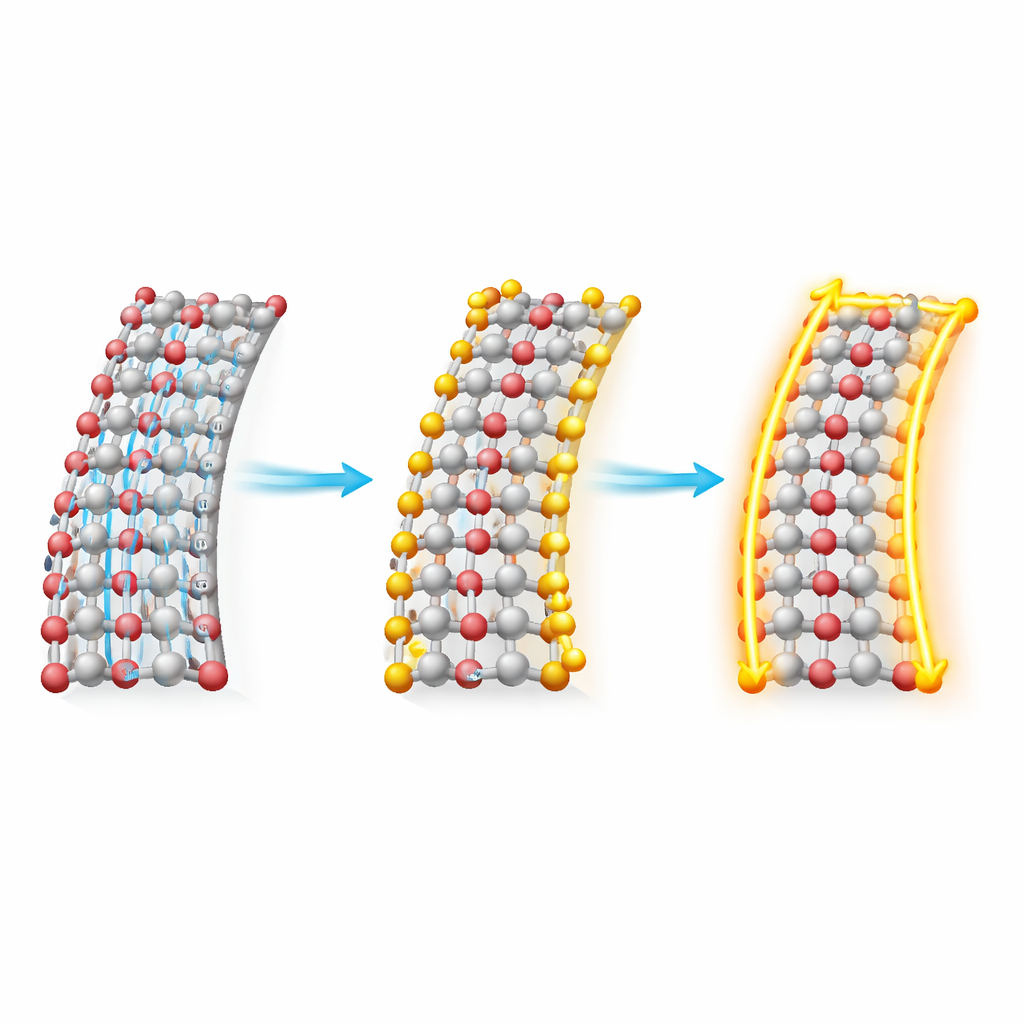
To probe this question, the team used advanced quantum-mechanical simulations rather than laboratory experiments. They compared two versions of MgO nanoribbons: one whose edges are capped with hydrogen atoms, and another whose edges are bonded to arsenic atoms. Their calculations show that attaching arsenic makes the ribbons slightly more tightly bound and therefore more stable overall. In energy terms, the arsenic-decorated structure sits in a deeper, more comfortable valley than the hydrogen version, suggesting it should be easier to form and more robust once made.
How electrons rearrange and flow
The researchers next examined how electrons are arranged in these atomic-scale wires. Both types of ribbons behave like metals, with electronic states available right at the energy level where current flows. Yet the arsenic edges reshape the pattern of these states, especially near the ribbon boundaries. Charge-density maps reveal that electrons tend to shift from magnesium atoms toward oxygen atoms, with arsenic acting as either a giver or taker of charge depending on which edge it sits on. This rearrangement strengthens the bonds at the edges and creates rich channels for electrons to move along, particularly near the magnesium-rich side.
Better current through edge highways
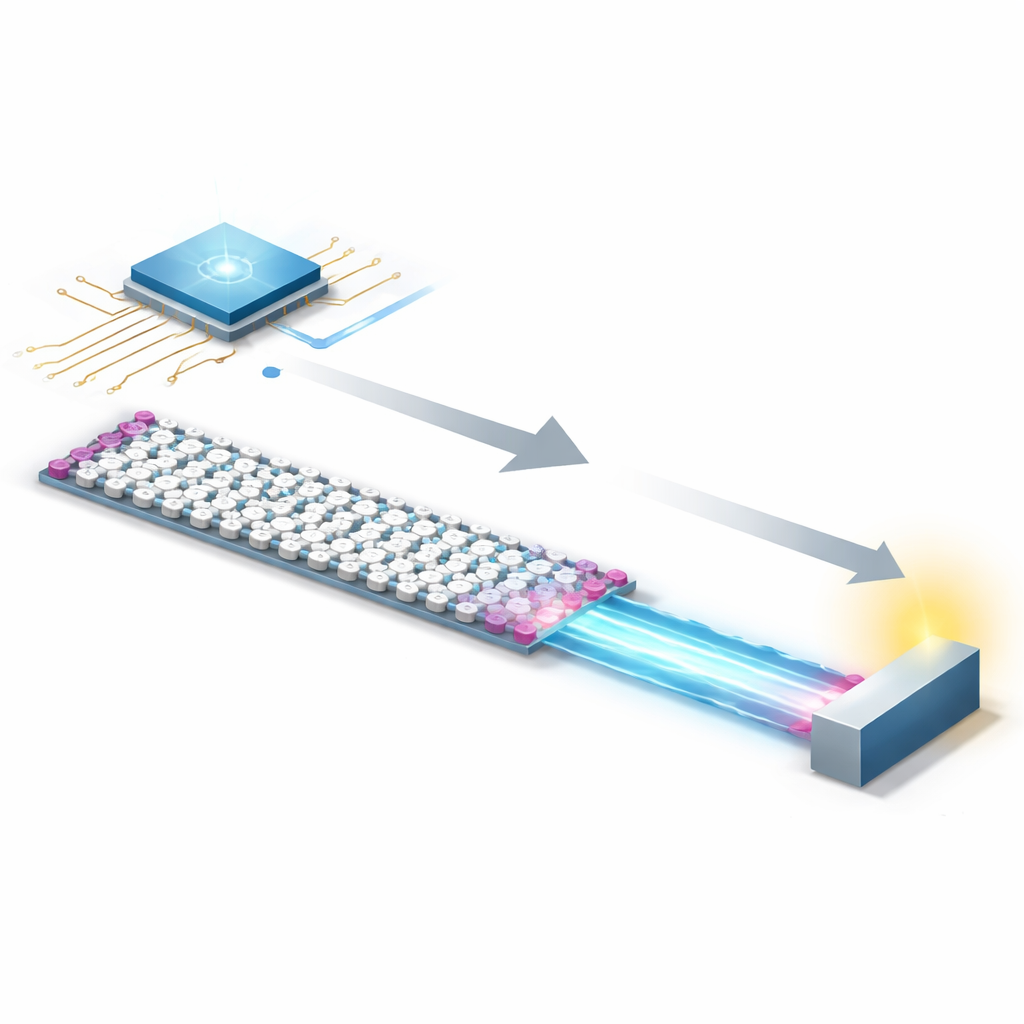
To see what this means for performance, the team simulated complete devices in which a short ribbon connects two electrodes, like a nano-sized wire linking larger metal contacts. They calculated how easily electrons cross the ribbon under different applied voltages. The arsenic-decorated ribbons show transmission peaks more than twice as large as the hydrogen-capped ones, a sign that electrons can pass through much more readily. When the current–voltage curves are computed, the arsenic version carries far higher current, and at higher voltages its current continues to grow while the hydrogen version begins to lag or even diminish.
Where the action really happens
By mapping out where, inside the device, electrons prefer to travel, the authors find that the most active regions are right along the edges, with the arsenic-modified ribbons showing especially dense electron pathways there. In other words, the edges act as high-speed highways for charge, and adding arsenic turns those highways from lightly used roads into busy express lanes. This edge-dominated behavior is precisely what makes nanoribbons appealing for sensing: any molecule or ion that binds at the edge can strongly disturb the traffic and therefore be detected as a change in current.
What this means for future devices
Although these results are purely theoretical and do not yet account for real-world imperfections, they suggest that arsenic-functionalized MgO nanoribbons could serve as stable, highly conductive building blocks in next-generation nanoelectronics. Their strong edge-driven response to arsenic hints at a broader role as sensitive electrodes for detecting heavy metals and other contaminants. In practical terms, the work points to a path where carefully engineered oxide nanoribbons might help create smaller, faster electronic circuits and miniature sensors that can spot dangerous substances at extremely low levels.
Citation: Krishna, M.S., Kumar, A.S., Kankanala, S. et al. First principles investigation of arsenic functionalized MgO nanoribbons. Sci Rep 16, 10017 (2026). https://doi.org/10.1038/s41598-026-39119-w
Keywords: MgO nanoribbons, nanoelectronics, arsenic sensing, 2D materials, heavy metal detection