Clear Sky Science · en
Anomaly detection of fermi surface morphology in Co2MnGaxGe1-x via interpretable machine learning
Why this matters for future electronics
Modern devices increasingly rely on materials whose electrons behave in unusual ways, giving rise to ultra-efficient data storage, low‑power sensors, and powerful quantum technologies. These behaviors are often controlled by subtle patterns on the “Fermi surface,” an abstract map of how electrons move inside a solid. In this study, researchers show how a simple, interpretable form of machine learning can automatically spot unusual changes in these patterns, helping scientists sift through huge data sets and uncover promising new electronic states more quickly. 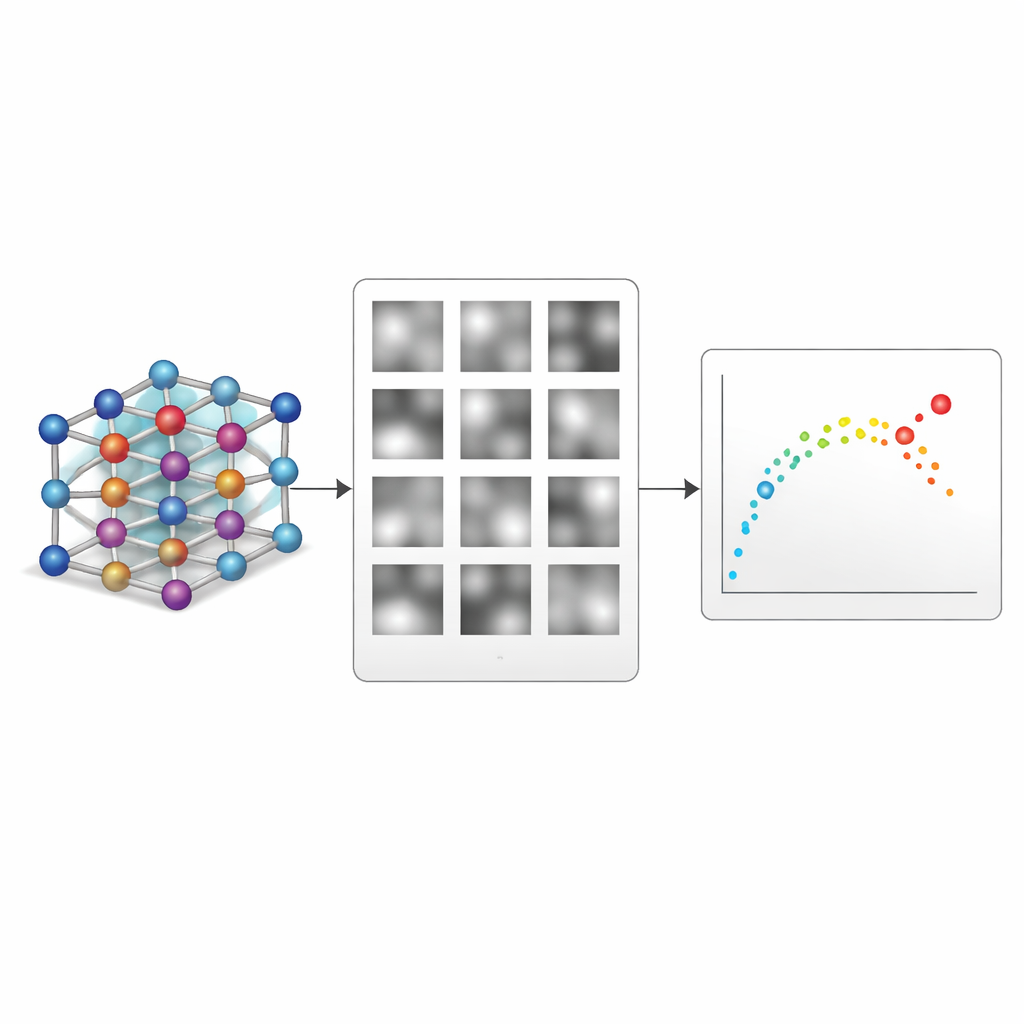
Tracing the hidden landscape of electrons
Inside a metal or semiconductor, electrons occupy allowed energy levels that can be visualized as a surface in momentum space, called the Fermi surface. Its shape governs key properties such as how well a material conducts electricity, how strongly it is magnetic, and how its electrons respond to heat or magnetic fields. In certain materials used for spintronics and topological electronics, the Fermi surface can host exotic features known as nodal lines—continuous lines where energy bands cross. These features can produce large thermoelectric responses and nearly fully polarized electron spins, both attractive for next‑generation sensors and memory devices. However, identifying exactly when and where such features appear has traditionally required painstaking manual inspection of measurement images.
Teaching a computer to see important changes
The team focused on a well‑known magnetic alloy, Co₂MnGaxGe1‑x, in which gallium gradually replaces germanium. This change in composition smoothly shifts the electronic structure but, at certain points, triggers abrupt changes in behavior. Using quantum‑mechanical calculations, the researchers generated detailed Fermi surface images for 101 slightly different compositions, mimicking the images obtained by angle‑resolved photoemission spectroscopy (ARPES), a key tool for mapping electronic states. They then converted each image into a long list of numbers and fed these into principal component analysis (PCA), a classic unsupervised machine‑learning method that compresses complex data into a small number of coordinates while preserving the main patterns of variation.
Spotting jumps that signal new physics
When the compressed data were plotted in a two‑dimensional PCA map, the points traced out a mostly smooth curve as the gallium content increased. Superimposed on this smooth trend, however, were several clear “jumps” between neighboring compositions. Because distance in this map reflects how much the underlying images differ, each jump marks a sudden transformation in the Fermi surface shape. By comparing with independent calculations of spin polarization—a measure of how strongly the electrons’ spins favor one direction—the authors found that these jumps lined up with peaks, valleys, or bends in the spin‑polarization curve. In other words, the machine‑learning view of the images automatically highlighted the same compositions that a physicist would single out as special based on more traditional analysis.
Revealing nodal lines and their fingerprints
One particularly large jump occurred when the gallium fraction was around 0.94–0.95. Previous work had suggested that, in this range, nodal lines in the alloy’s band structure move close to the Fermi level and strongly influence its transport properties. By subtracting neighboring Fermi surface images and examining where the differences were largest, the researchers could pinpoint the regions in momentum space where new features emerged. These bright patches matched the expected locations of nodal lines and regions of intense “Berry curvature,” a quantity linked to unusual electrical and thermal responses. Thus, without any prior labeling, the PCA‑based method homed in on the very compositions and momentum‑space regions where this special topology appears. 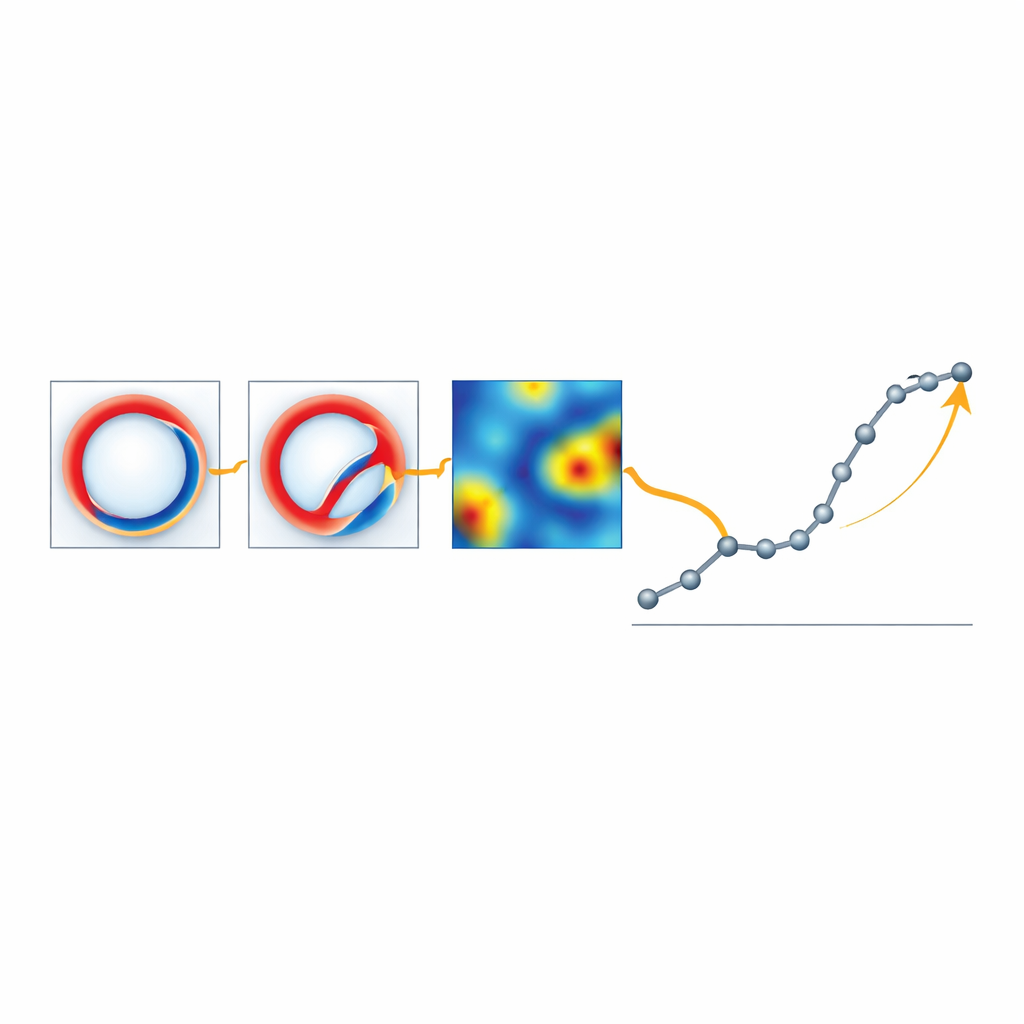
Working even with blurry and noisy data
Real ARPES experiments are often plagued by blurred features and strong noise, especially when measurement times are short or signals are weak. To test whether their approach would remain useful under such conditions, the authors deliberately smeared out the calculated Fermi surface images and added heavy random noise. Although the fine details were degraded, the PCA map still showed recognizable jumps at nearly the same compositions. By adjusting a simple numerical threshold that defines what counts as a jump, they could continue to extract the key points where spin polarization changes or nodal lines appear. This robustness suggests that the method can help prioritize interesting samples even when experimental data are far from perfect.
What the study shows in simple terms
The work demonstrates that a straightforward, transparent machine‑learning tool can act as an automatic “change detector” for complex electronic images. In the Co₂MnGaxGe1‑x alloy, the top 1% of jumps in the PCA map reliably pick out the compositions where nodal lines cross the Fermi level, while the top 10% correspond to strong shifts in spin polarization. Because the approach does not require pre‑labeled data and is designed to flag non‑systematic deviations from an overall trend, it is well suited to scanning large collections of spectra from composition‑gradient films or high‑throughput ARPES studies. With human experts interpreting the highlighted samples, this framework could accelerate the discovery of materials with unusual electronic states and guide the design of future spintronic and topological devices.
Citation: Ishikawa, D., Fuku, K., Miura, Y. et al. Anomaly detection of fermi surface morphology in Co2MnGaxGe1-x via interpretable machine learning. Sci Rep 16, 12698 (2026). https://doi.org/10.1038/s41598-026-39115-0
Keywords: Fermi surface, Heusler alloy, machine learning, spintronics, ARPES