Why tiny batteries matter for big health questions
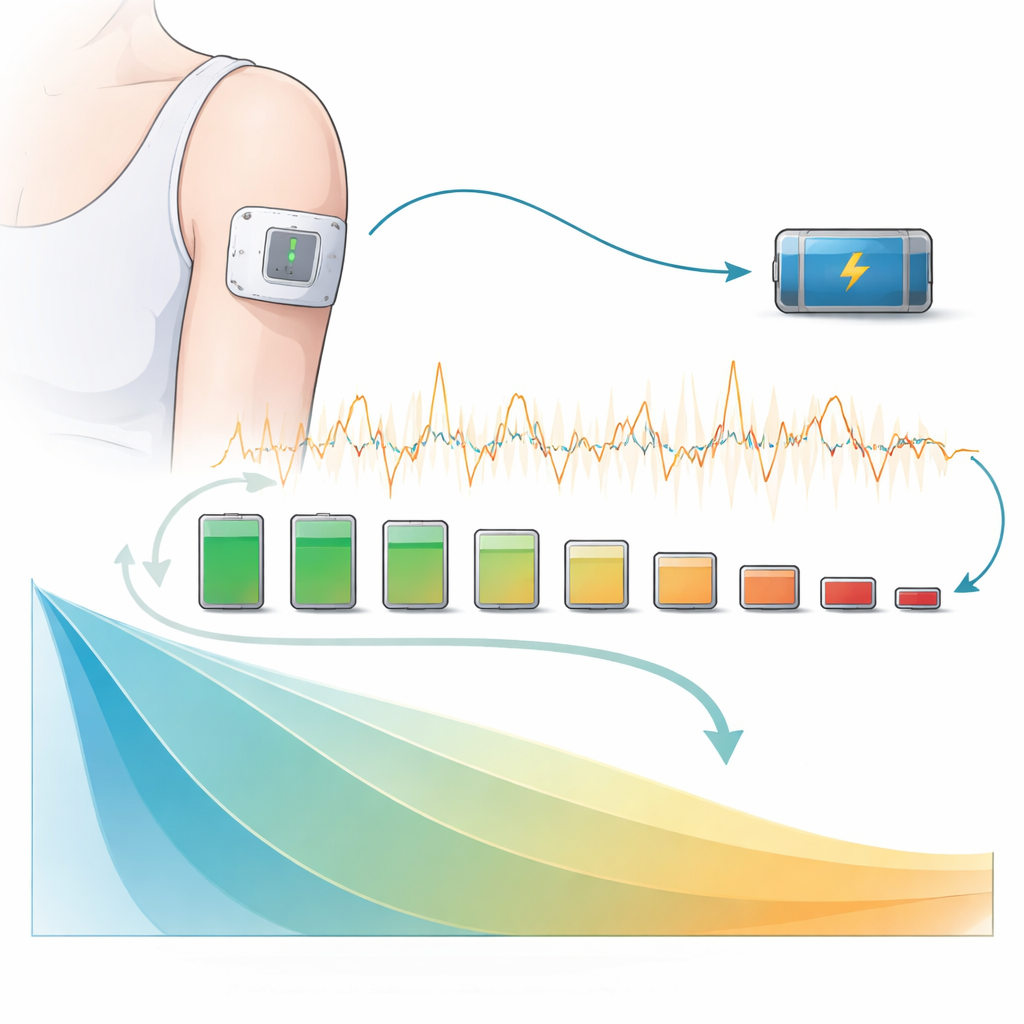
Wearable medical gadgets—such as heart monitors, glucose sensors, and rehabilitation trackers—depend on tiny rechargeable batteries. If these batteries fade faster than expected, a device can shut down in the middle of monitoring, or in rare cases overheat dangerously. This paper explores how to predict, far in advance, how these batteries will lose capacity over their lifetimes. Smarter prediction could help doctors, engineers, and patients trust that critical wearables will keep running when they are needed most.
How wearable batteries quietly wear out
In everyday use, a battery inside a wearable device faces an unpredictable life: short top‑ups, long charges, bursts of high power when wireless radios turn on, and periods of rest. Over hundreds of cycles, this history shapes how quickly the battery’s maximum capacity shrinks. Engineers call the resulting curve a degradation trajectory. Existing tools often estimate only the final "time of death" of a battery—its remaining useful life—without describing the full path of decline. For medical wearables, however, knowing how fast capacity will drop in the coming weeks or months is just as important as knowing the final endpoint, because it determines whether the device can reliably collect data and alert caregivers.
Why simple prediction falls short
Predicting battery decline is harder than drawing a straight line between "full" and "empty." Real batteries show complex behavior: their capacity can briefly bounce back after rest, jump at inflection points, or degrade faster late in life. Many current data‑driven methods treat the battery’s past as a simple time series and ask the model to repeat short‑term predictions again and again until the end of life. Each step introduces a small error, and these errors accumulate, especially when the signal is noisy or when the battery’s behavior changes abruptly. As a result, models that look accurate a few cycles ahead may drift badly when asked to forecast months into the future.
Peeling apart long‑term drift and short‑term noise Figure 1.
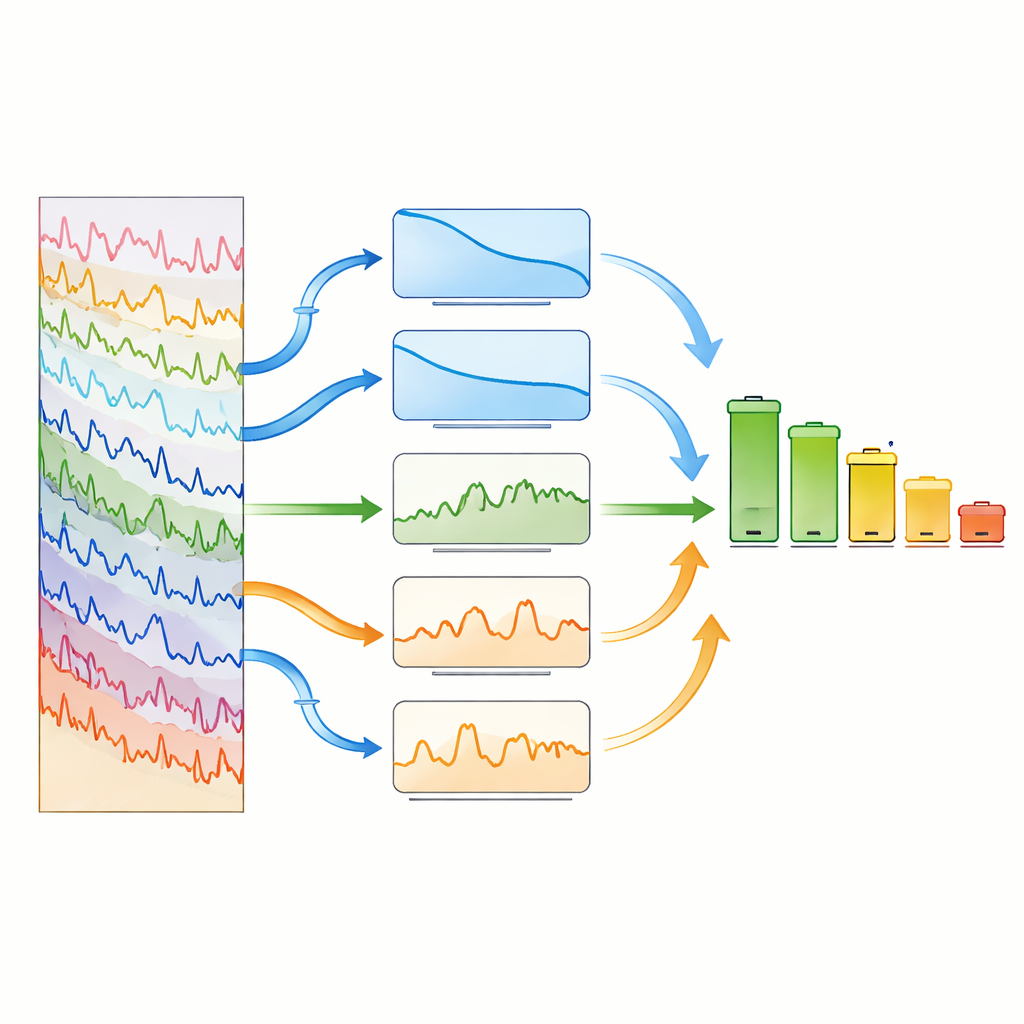
The authors propose a deep learning framework that tackles this challenge by explicitly separating the slow drift of aging from the rapid wiggles of day‑to‑day use. First, a moving average filter smooths each slice of battery history into a trend component and a residual component. The trend is fed into a recurrent neural network designed to track how capacity evolves over time. The residual—those small up‑and‑down fluctuations—is handled by a second path that uses a simple linear layer and an attention mechanism aware of time order, so the model can recognize patterns such as temporary recovery after rest. By stacking several of these twin‑path modules, the network progressively refines its view of what is true aging and what is merely noise.
Teaching the model to think ahead like a wearable Figure 2.
To make the forecasts realistic over long horizons, the team adds an "autoregressive" fine‑tuning step. After the network is first trained on short chunks of battery data, it is then asked to use its own predictions as fresh input and keep forecasting further into the future, much like a real device would do during daily operation. A correction mechanism compares these chained predictions with the true degradation curves and nudges the model to reduce the bias that creeps in over many steps. This process encourages the network not just to fit the recent past, but to learn patterns that stay reliable across dozens or even hundreds of cycles.
Putting the method to the test
The authors evaluate their framework on three well‑known lithium‑ion battery datasets, each representing different cathode materials and aging behaviors. One dataset shows a mostly smooth, super‑linear decline; another includes frequent capacity recovery events; the third combines strong noise with sharp changes in slope. These scenarios resemble the diverse and imperfect data that wearable devices would generate in the real world. Across a range of forecasting settings, the deep temporal decomposition model consistently matches or beats several strong baselines, including linear models, recurrent neural networks, temporal convolutional networks, Transformers, and a sophisticated hybrid approach. In particular, it maintains mean‑squared prediction errors at levels corresponding to within roughly 20% relative error across conditions while tracking both smooth trends and sudden bends in the degradation curves.
What this means for future medical wearables
For non‑specialists, the key takeaway is that the study offers a more reliable "weather forecast" for the health of tiny batteries inside medical wearables. By disentangling long‑term aging from short‑term jitters and training the model to live with its own predictions, the method can anticipate when a device’s battery will dip below safe capacity well before it happens. Although the work is based on controlled laboratory datasets and will need further validation on real patient data, it points toward wearable devices that can schedule maintenance intelligently, warn clinicians before a battery‑related failure, and ultimately provide safer, more continuous care.
Citation: Hu, Y., Liu, Y., Li, H. et al. Battery capacity degradation trajectory prediction for wearable medical devices with deep temporal decomposition.
Sci Rep16, 10383 (2026). https://doi.org/10.1038/s41598-026-39087-1
Keywords: wearable medical devices, battery health, capacity degradation, deep learning prediction, remaining useful life