Clear Sky Science · en
Analytical solutions and dynamic behavior of conformable fractional reaction-diffusion systems
Why slow spreading can reveal hidden memory
Many processes around us—how chemicals mix, how heat spreads, or how a disease moves through tissue—are described by equations of “reaction” and “diffusion.” In real materials, however, spreading is often slower and more history‑dependent than standard models predict. This paper explores a new mathematical tool that lets scientists tune how strongly the past influences the present, revealing how “memory” in a medium can reshape waves, patterns, and transport in space.
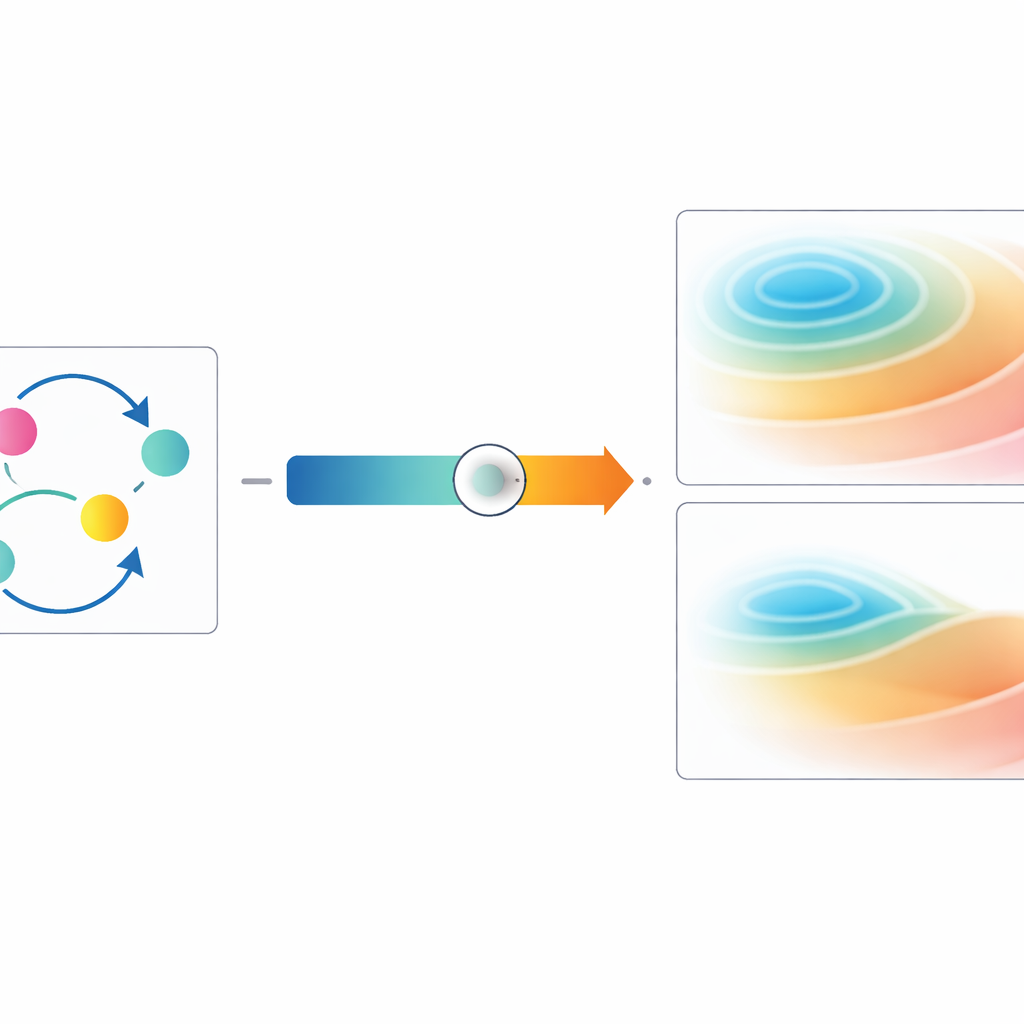
A gentler way to add memory to familiar equations
Traditional calculus assumes that the rate of change at a point depends only on what happens right now. Fractional calculus loosens this rule by allowing derivatives of non‑integer order, so that the evolution of a system can depend on its entire history. While powerful, common fractional tools often make equations hard to handle analytically. The authors focus on a newer option, the conformable fractional operator, which keeps many of the nice, simple features of standard derivatives while still encoding memory effects. They embed this operator into classic reaction–diffusion equations, building models that smoothly bridge between ordinary diffusion (no memory) and anomalous, history‑rich spreading.
From many variables to solvable forms
The study considers one‑, two‑, and three‑dimensional systems describing how two interacting quantities—think of two reacting chemicals or two biological populations—spread and react over time. Directly solving these space‑and‑time equations is difficult, so the authors apply similarity transformations that reduce the original partial differential equations to ordinary ones written with conformable derivatives. To extract practical formulas, they use two semi‑analytical techniques: a conformable version of the new iterative method (CNIM) and a conformable residual power series approach (CRPS). Both methods build up the solution as a converging series, term by term, without resorting to crude numerical gridding or heavy approximations.
Testing two solution tools against a known benchmark
To judge how well their approaches perform, the authors compare CNIM and CRPS solutions with results from the widely used Homotopy Perturbation Method. They do this across several test problems and in multiple spatial dimensions. For both the case where the fractional order equals one (the classical limit) and cases where it is less than one (fractional behavior), all three methods give nearly identical values for the two fields being modeled. CNIM tends to produce smoother profiles with fast convergence, while CRPS can reach slightly higher accuracy but may show small oscillations if only a few terms are kept. Overall, the close agreement with the benchmark method indicates that the conformable framework is both reliable and efficient.
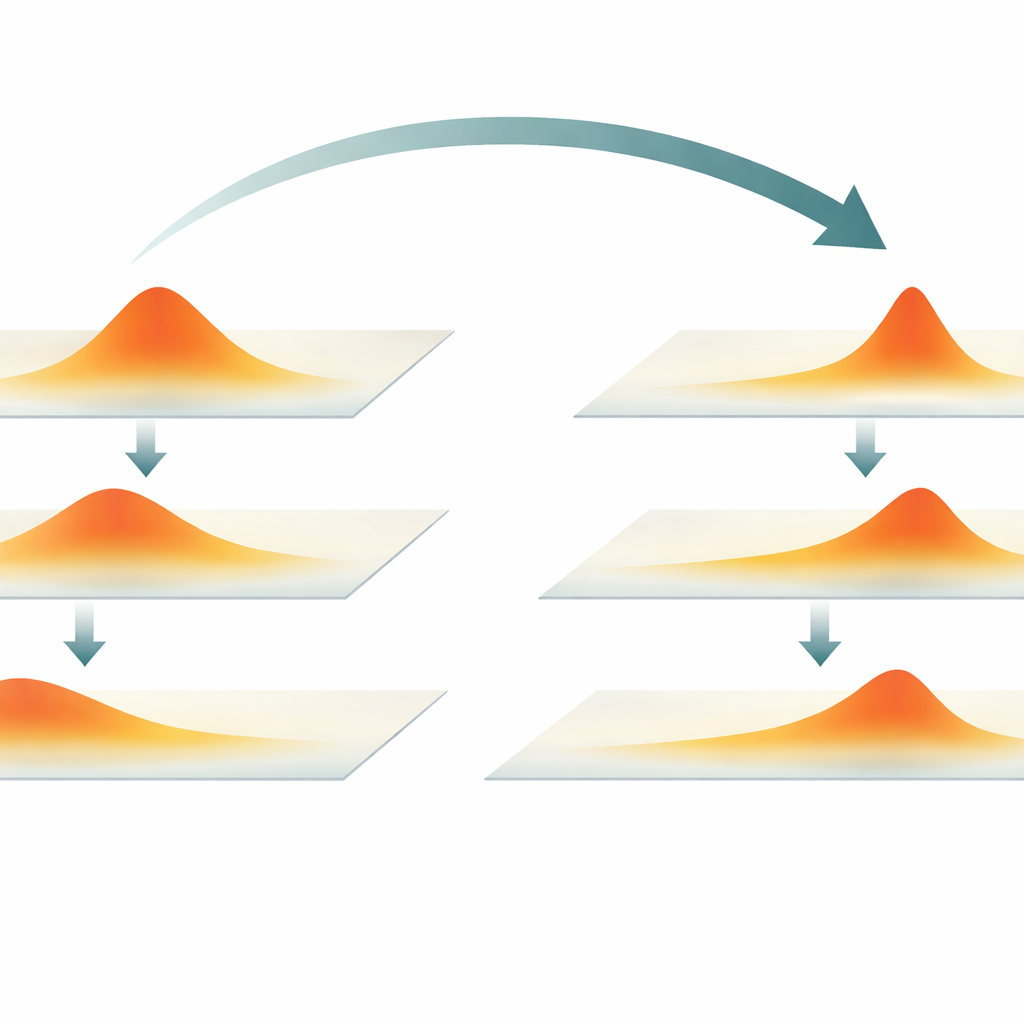
How tuning memory reshapes waves and patterns
The heart of the paper is a systematic exploration of how the fractional order—denoted by a symbol between zero and one—changes diffusion, reaction intensity, and wave propagation. When this order is set to one, the system behaves like a standard reaction–diffusion medium with familiar Brownian spreading: waves move quickly, and concentration peaks can grow strongly. As the order is reduced below one, the model increasingly “remembers” its past. The resulting diffusion becomes slower and more nonlocal, wave fronts advance more gently, and the profiles of the reacting quantities become smoother and less amplified. This behavior appears consistently in one‑, two‑, and three‑dimensional examples and is confirmed by detailed numerical tables and surface plots.
Promises, caveats, and future directions
Because the conformable operator keeps the equations relatively simple, it opens the door to analytical studies of systems that would otherwise require heavy computation. The authors show that their series solutions converge well and remain stable under small changes in parameters, suggesting that the methods are robust for practical modeling. At the same time, they acknowledge that conformable derivatives do not capture every type of long‑range memory and that the work assumes smooth initial conditions and uniform media. Future research directions include allowing the fractional order itself to vary in time or space, incorporating randomness and heterogeneity, and blending these analytical tools with data‑driven or machine‑learning methods to model complex biological, chemical, and engineering systems more realistically.
What this means in everyday terms
In simple language, the paper shows that there is a mathematically neat “dial” that lets researchers slide continuously between ordinary diffusion and slower, memory‑rich spreading, while still keeping the equations solvable. Turning this dial down slows the spread of signals or substances and softens sharp fronts, reflecting the way many real materials remember where particles have been. The conformable approach and the two solution techniques provide a practical, trustworthy way to explore such behavior in higher‑dimensional systems, offering a foundation for better models of tissues, porous materials, and complex reacting media.
Citation: Alshehry, A.S., Shah, R. & Alqahtani, A.M. Analytical solutions and dynamic behavior of conformable fractional reaction-diffusion systems. Sci Rep 16, 9854 (2026). https://doi.org/10.1038/s41598-026-39044-y
Keywords: fractional reaction diffusion, conformable derivative, anomalous diffusion, semi-analytical methods, pattern formation