Clear Sky Science · en
Investigating synergistic effects in Co-prolysis of groundnut shell and waste tyres on product distribution under different blend ratios
Turning Trash into Treasure
Every year, mountains of discarded tyres and heaps of farm leftovers like groundnut shells pile up, creating fire hazards, pollution, and wasted energy. This study explores a way to tackle both problems at once: heating these two kinds of waste together to turn them into useful fuels. By carefully tuning how much tyre rubber is mixed with the shells, the researchers show that the combination can produce better-quality oil, gas, and char than either material can on its own—offering a cleaner fuel source and a smarter way to manage waste.
Why These Wastes Matter
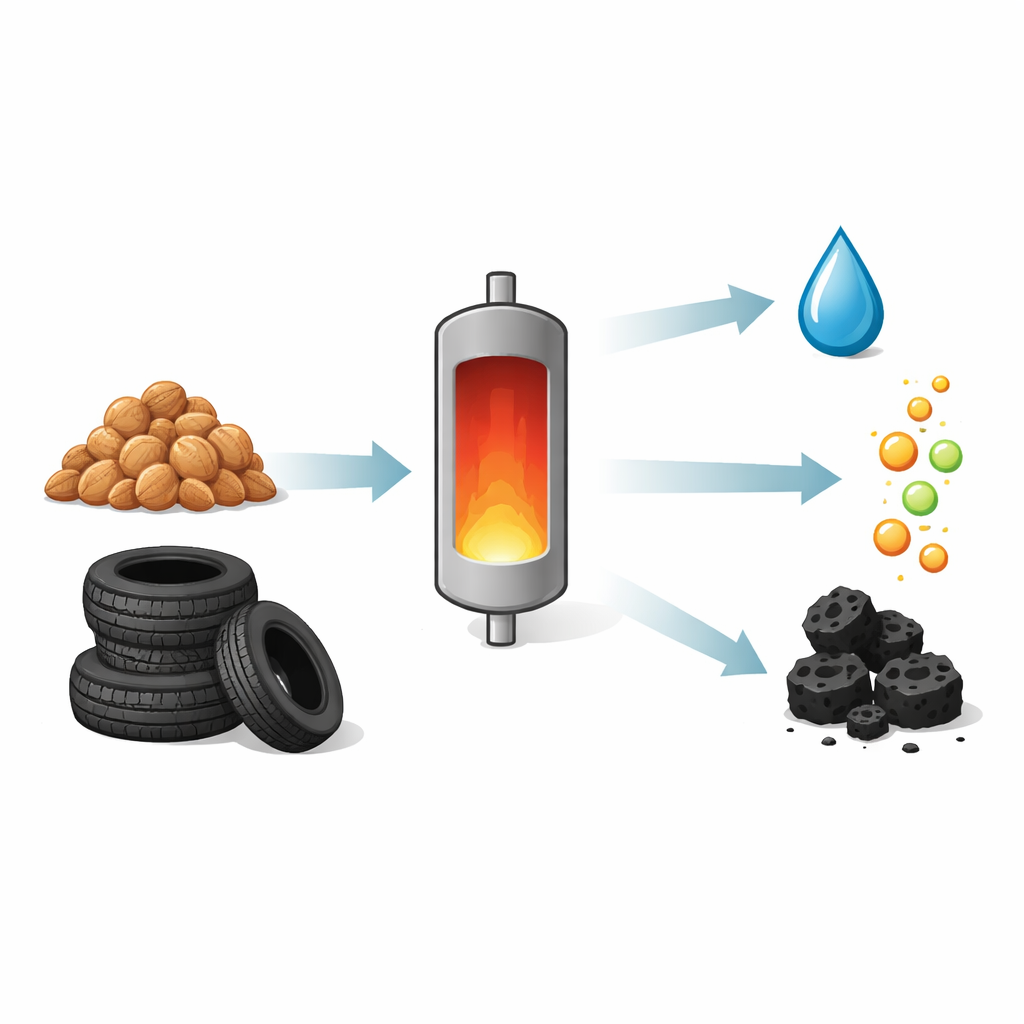
Groundnut shells are an abundant agricultural residue that usually has little value beyond low-grade burning or disposal. They are rich in plant material but also contain a lot of oxygen, which makes the oil produced from them acidic and relatively low in energy. Scrap tyres are the opposite: they are packed with energy-rich carbon and hydrogen but are difficult to get rid of, lasting for decades in landfills and posing serious fire and pollution risks. When heated alone, tyres yield high-energy oil and gas but also produce sulphur-rich char and problematic emissions. The idea behind this research is that mixing these two very different wastes might let the strengths of one cancel out the weaknesses of the other.
Cooking Waste Without Flames
The team used a process called pyrolysis, which is essentially cooking the materials in the absence of oxygen so they break down instead of burning. In a laboratory reactor, they first heated groundnut shells and tyres separately between about 350 and 600 °C, tracking how much solid char, liquid oil, and gas each produced at different temperatures. Both materials gave the most liquid around 500 °C, so the researchers chose this temperature for joint experiments. They then mixed the two feeds in different proportions, from mostly shells with a little tyre to mostly tyre with a little shell, and repeated the heating while measuring the products and analyzing their properties.
When the Whole Beats the Sum of Its Parts
A key question was whether the mixture simply behaved like a weighted average of the two ingredients or whether there were true “synergies” where the blend performed better than expected. By comparing actual product yields with calculated averages, the researchers found clear signs of synergy. At a blend containing 40% tyre, the liquid output was noticeably higher than the expected value, and its quality improved: it carried more energy per kilogram, less oxygen, and more balanced density and thickness than oil from shells alone. At the same time, the solid char from the mixture had more fixed carbon and less sulphur than char from tyres alone, and the gas contained more hydrogen and methane but less carbon dioxide than gas from pure biomass. These patterns suggest that hydrogen-rich fragments from the tyre help strip oxygen from biomass vapors, upgrading them into more energy-dense fuels.
Inside the Reactor: How the Upgrade Happens
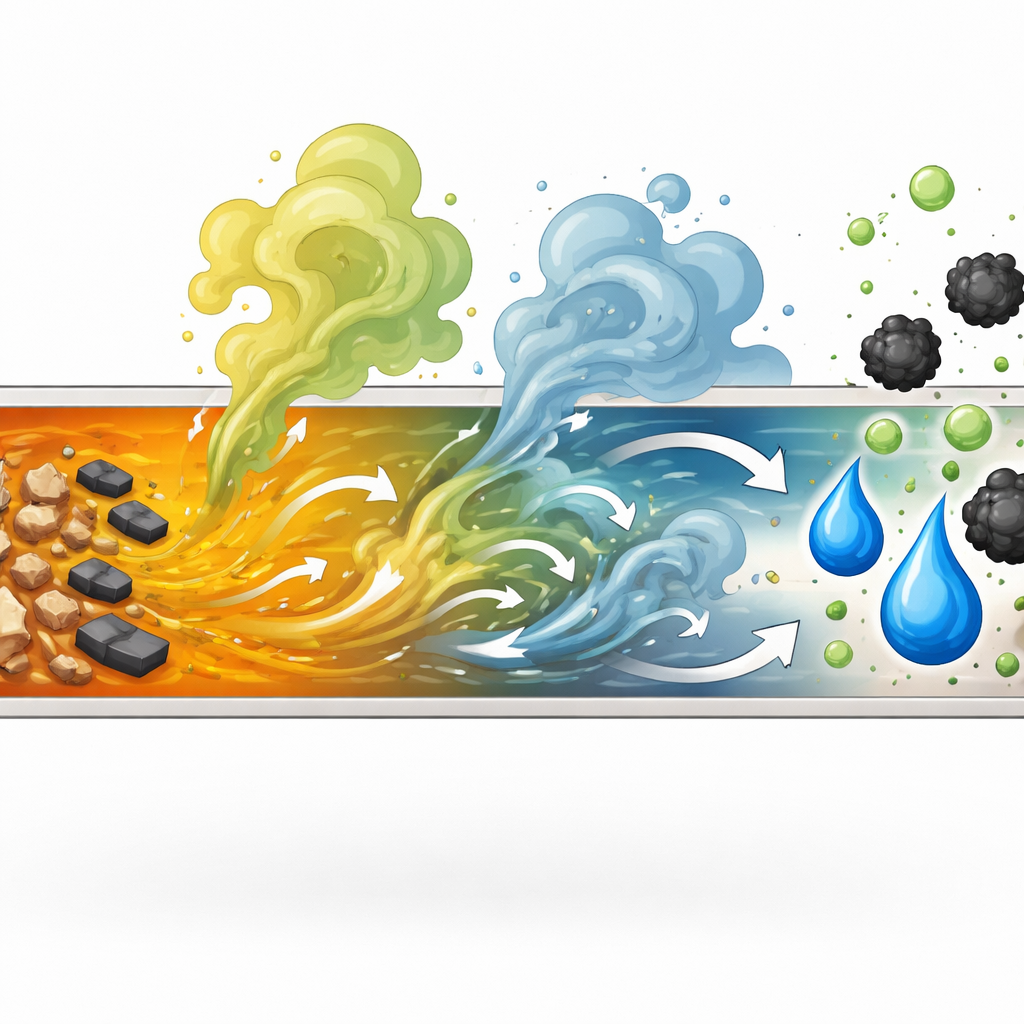
To understand these improvements, the researchers examined the chemistry of the oils, chars, and gases using thermal analysis, infrared spectroscopy, and gas chromatography–mass spectrometry. Shell-derived oil was dominated by oxygen-rich compounds such as acids, alcohols, and phenols, which lower energy content and make the liquid corrosive. Tyre-derived oil, in contrast, was rich in hydrocarbons and aromatic molecules more similar to conventional fuels. In the co-pyrolysis oils, signals from oxygenated compounds weakened while hydrocarbon signals strengthened, showing that tyre vapors had donated hydrogen and helped break down or transform the oxygen-heavy molecules from the shells. The char and gas analyses told a similar story: blended chars retained high carbon but carried less sulphur, and the gas stream shifted toward more combustible components and less climate-warming carbon dioxide.
From Lab Insight to Real-World Impact
Beyond the chemistry, the work points to broader societal benefits. Converting farm residues and scrap tyres into liquid fuel, useful gas, and carbon-rich char supports a circular economy, where wastes become resources instead of burdens. The co-pyrolysis approach reduces landfill pressure, curbs open burning, and cuts greenhouse gas emissions compared with simply discarding or burning these materials. The authors highlight that a 40% tyre blend at 500 °C offers a particularly attractive balance between high liquid yield and improved product quality, though the oil still needs further cleaning—especially to reduce sulphur—before it can fully replace conventional fuels. With future advances in catalysts, scaling, and environmental assessment, this combined treatment of agricultural and industrial wastes could evolve into a practical technology that turns everyday refuse into a valuable stream of cleaner energy products.
Citation: Anusuya, M., Kumar, P.S., Ommurugadhasan, D. et al. Investigating synergistic effects in Co-prolysis of groundnut shell and waste tyres on product distribution under different blend ratios. Sci Rep 16, 11208 (2026). https://doi.org/10.1038/s41598-026-38993-8
Keywords: co-pyrolysis, waste tyres, biomass energy, bio-oil, circular economy