Clear Sky Science · en
Rapid earthquake damage assessment via hybrid LSTM-RNN with a quantum-inspired classification head based on Autonomous Perceptron Model APM
Why fast quake checks matter
After a strong earthquake, the most urgent question is simple: which buildings are safe, and which ones are not? Today, answering that still takes time, experts, and often on‑site inspections. This paper introduces a rapid, data‑driven way to estimate how much damage buildings have likely suffered, using patterns in their motion during shaking. The goal is to help emergency teams quickly decide where to send inspectors, how to route rescue operations, and which structures need attention first.
From shaking signals to building health
Instead of relying on slow manual surveys, the authors use computer models to read four basic signs of a building’s behavior during an earthquake: how far it sways (displacement), how fast it moves (velocity), how sharply it speeds up or slows down (acceleration), and an overall damage score called a damage index. These signals are organized as short time windows—snapshots of how a structure moves over about four tenths of a second. The system learns from thousands of such windows how typical motion patterns relate to later damage, so that it can forecast the next step in a building’s response and judge whether the structure is likely unharmed, repairable, or badly affected.
One pipeline, many decisions
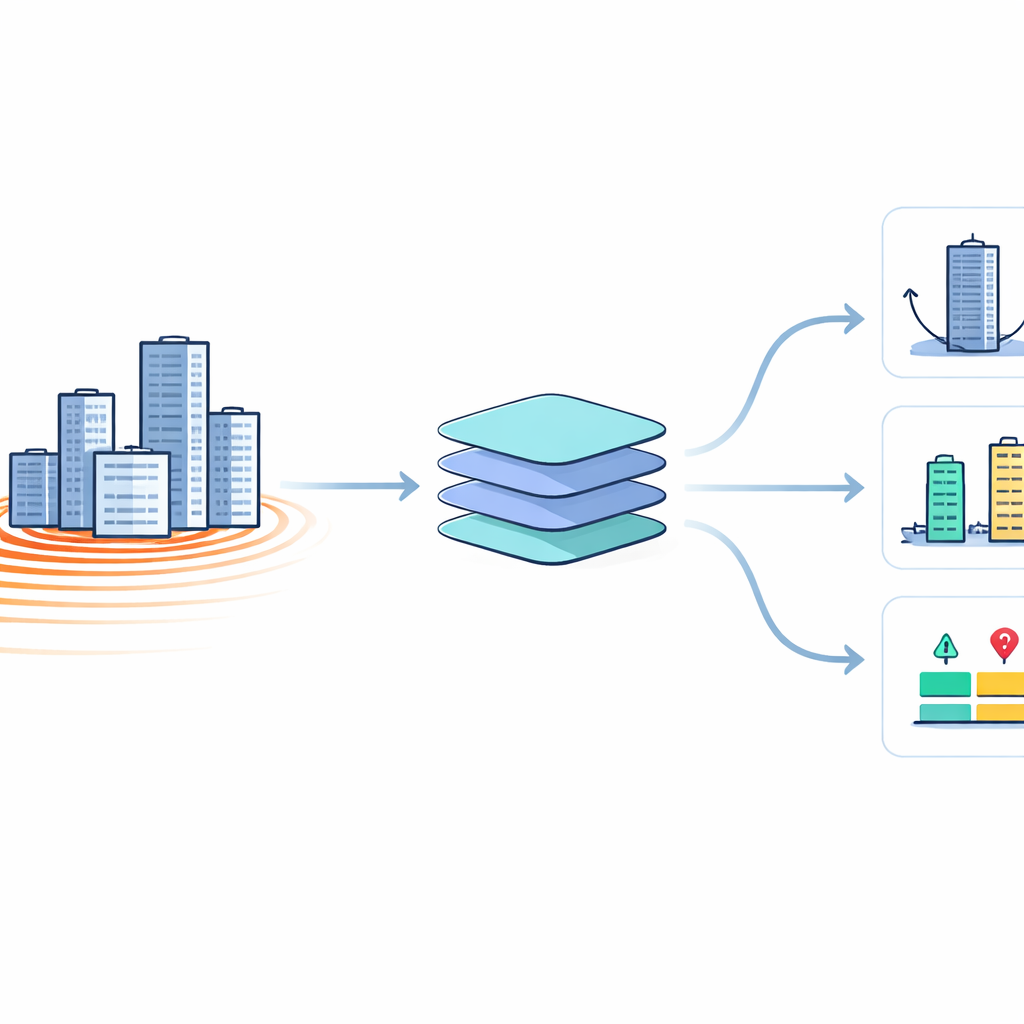
A key idea in this work is to bundle several related tasks into a single, coherent pipeline. Using a shared sequence‑processing core, the system does four things at once: it predicts the next values of displacement, velocity, acceleration, and the damage index; it decides whether the building is damaged or not; it assigns a numerical weight to damaged cases that reflects how urgent they are; and it analyzes which input features tend to be present when damage is negligible. By unifying these tasks, the same incoming motion record can immediately feed into building‑level decisions and then into city‑scale planning models that schedule repairs and restore essential services.
How the smart sequence model works
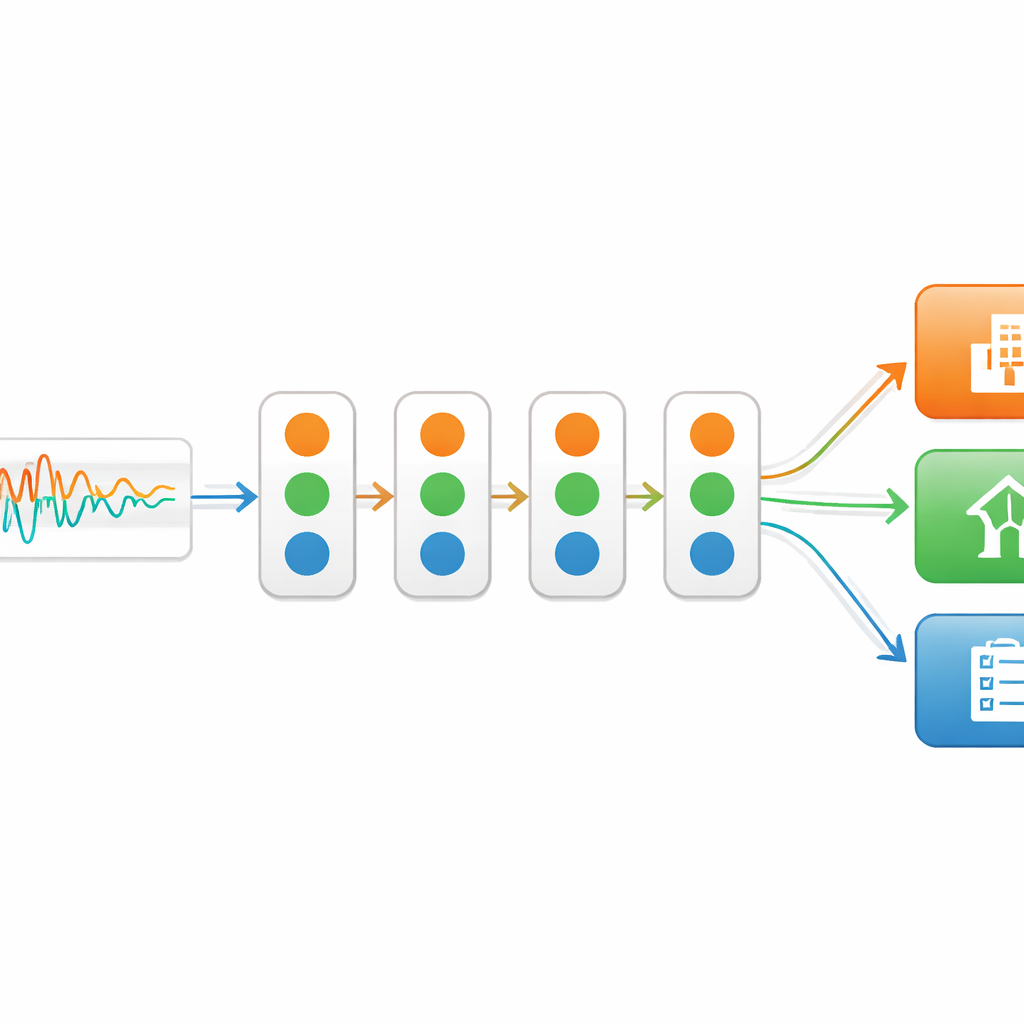
At the heart of the pipeline is a hybrid network that combines two related deep‑learning building blocks: Long Short‑Term Memory units and simpler recurrent units. Both are designed to handle sequences, remembering recent history while focusing on key patterns over time. The authors compare this hybrid design to a deeper stack of Long Short‑Term Memory layers alone. Trained on high‑fidelity simulated earthquake responses for a reinforced concrete system, the hybrid model consistently delivers more accurate predictions. It tracks the damage index especially well, reducing typical errors several‑fold and explaining nearly all of the variation in the simulated damage signal. This means the model can closely follow how damage builds up during shaking, a crucial step toward reliable rapid assessment.
A quantum‑inspired twist for damage labels
Beyond standard neural‑network outputs, the authors test an unusual “quantum‑inspired” classifier head called the Autonomous Perceptron Model. Instead of using a large layer of ordinary weights, this module compresses information into tiny two‑component vectors and passes them through small operators that mimic interference effects from quantum physics. To probe whether this compact design can still tell damage levels apart, the team generates a separate dataset of buildings subjected to controlled blast‑like loads. On this test, the quantum‑inspired classifier reaches high accuracy in sorting structures into four damage categories, suggesting that leaner, operator‑based components can be plugged into the same pipeline when data and computing power are limited.
Turning model outputs into real‑world action
The final step is to make the results usable for people in the field. When a new motion record arrives, the shared core processes it once, then instantly produces forecasts of how the structure will move, a damage label, a priority score for damaged cases, and clues about which conditions are linked to low damage. Together, these outputs support a two‑stage triage: first, separate likely damaged from likely safe structures; then, among the damaged ones, raise the alarm for those whose failure would matter most. Because the current study relies on simulated rather than real sensor data, the authors emphasize that further testing on instrumented buildings will be needed before deployment. Even so, the work shows that carefully designed sequence models, coupled with strict controls to avoid data leakage, can form a practical foundation for fast, data‑driven earthquake damage checks and smarter recovery planning.
Citation: Alotaibi, A., Alharbi, S. & Elshewey, A.M. Rapid earthquake damage assessment via hybrid LSTM-RNN with a quantum-inspired classification head based on Autonomous Perceptron Model APM. Sci Rep 16, 9686 (2026). https://doi.org/10.1038/s41598-026-38982-x
Keywords: earthquake damage assessment, structural health monitoring, deep learning, recurrent neural networks, disaster resilience