Clear Sky Science · en
Advanced synthesis and multifaceted characterization of Al-Mg alloy foams reinforced with TiH2 incorporation through friction stir processing
Why lighter metals matter
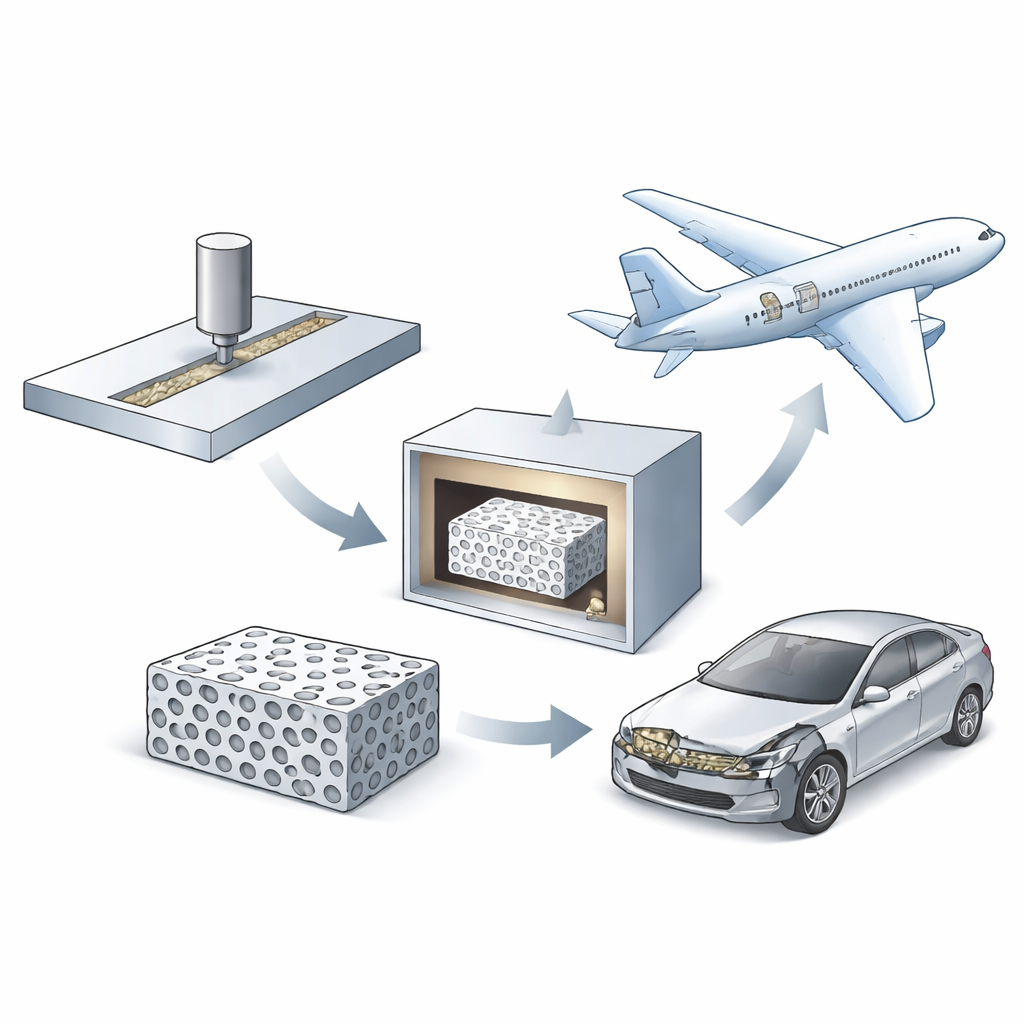
From airplanes and electric cars to laptops and protective gear, many of today’s technologies would benefit from metals that are both lighter and tougher. One promising class of materials is metal foams—solids filled with tiny pores, a bit like metallic Swiss cheese. This paper explores a new way to make strong, lightweight aluminum foam using a common engineering alloy and a carefully controlled solid-state process, opening doors for safer vehicles, more efficient cooling systems, and structures that absorb impacts better while weighing much less.
Turning solid metal into a foam
The researchers focused on a widely used alloy called Al-5052, known for its low weight, good corrosion resistance, and solid strength. Instead of foaming molten metal, they started with a solid aluminum plate and used a method called friction stir processing. A rotating tool is pressed and moved along the plate, stirring a groove that has been filled with fine titanium hydride (TiH₂) powder. By making four passes with the tool, they achieved an even spread of these particles throughout a band in the plate. Later, when this prepared material is heated, TiH₂ releases gas inside the softened metal, blowing it up from within into a foam.
Peering inside the new material
To confirm that the process worked as intended, the team used several imaging and analysis techniques. Optical and electron microscopes revealed that the titanium-containing particles were spread uniformly, with very little clumping. The intense stirring broke the original large grains of aluminum into much finer ones, a change that usually makes metals stronger. X-ray diffraction measurements showed that the crystal structure of the aluminum remained intact and that titanium-containing phases were present, proving that the foaming agent had been successfully embedded and retained in the alloy before heating.
Stronger, harder, but still workable
Before turning the material into a foam, the researchers tested how friction stir processing affected its mechanical performance. The treated aluminum zone showed a jump in ultimate tensile strength from about 263 megapascals to nearly 319 megapascals—roughly a 21% increase. Hardness also rose by about 21%. This strengthening came with a modest loss in stretchability, a common trade-off when small, hard particles and refined grains block the motion of defects inside the metal. In practical terms, the processed alloy band became a tougher, harder "skin" that is better able to carry loads and resist indentation, which is useful both for the precursor material and for the eventual foam’s cell walls.
Shaping the foam and its pores
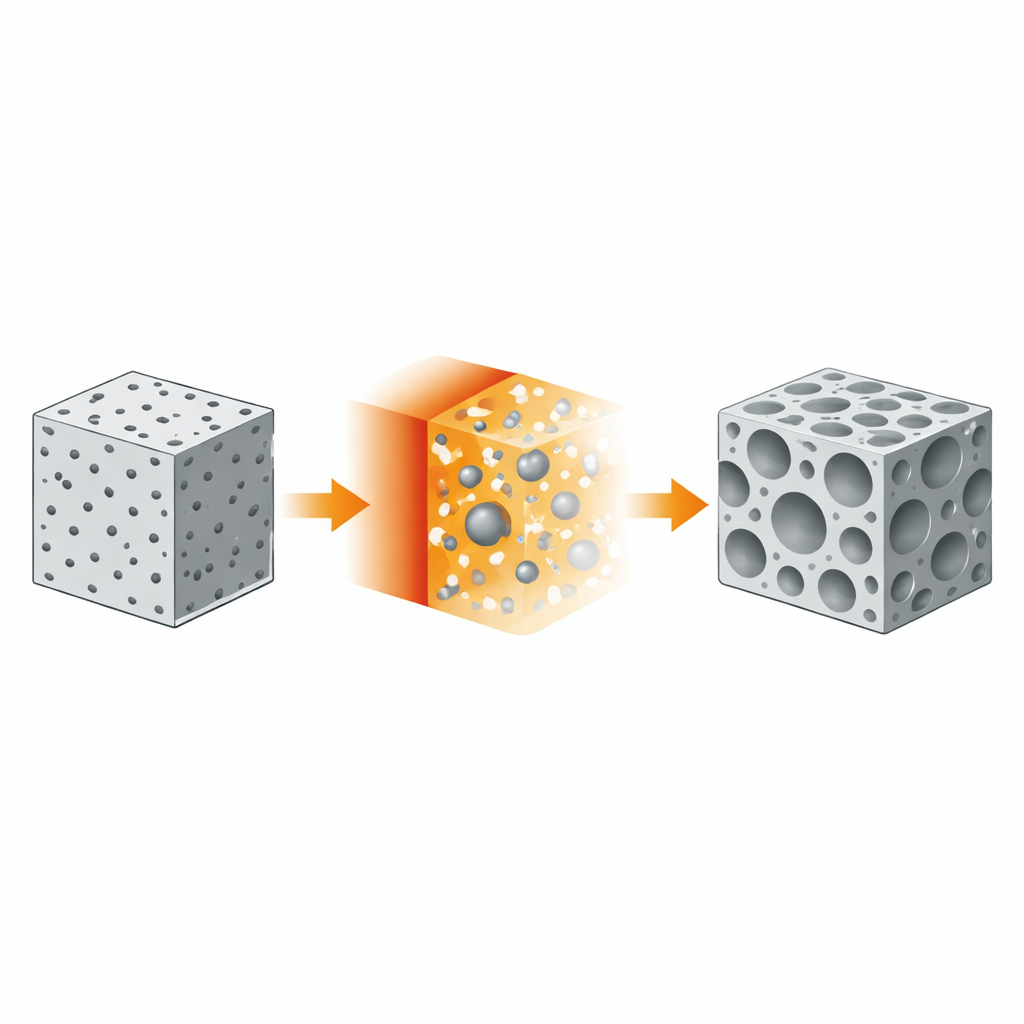
The prepared samples were then heated in a furnace under two conditions: one at 725 °C for 12 minutes and another at 750 °C for 8 minutes. In both cases, TiH₂ broke down to release hydrogen gas, which became trapped inside the softened aluminum, forming rounded pores throughout the volume. Microscopy showed relatively uniform pore networks. At 725 °C, the average pore size was about 256 micrometers; at 750 °C, it was slightly smaller, around 219 micrometers, suggesting that careful choice of temperature and time can tune how the foam looks and behaves. Chemical mapping indicated that most of the TiH₂ had decomposed, leaving titanium and titanium–aluminum compounds in the cell walls, along with oxide phases that help stabilize the foam during expansion.
Lightweight blocks with big potential
By measuring the weight and volume of the foamed samples, the team found a density of about 1,266 kilograms per cubic meter—less than half that of solid Al-5052—and a porosity of about 53%. That places these foams squarely in the sweet spot for engineering uses, where a balance of low weight, strength, and energy absorption is needed. The work shows that friction stir processing can reliably embed a foaming agent and create high-quality aluminum foam with controlled pore size and distribution, without melting the entire metal. For non-specialists, the takeaway is that we now have a cleaner, more controllable route to making strong, lightweight metal sponges that could help build safer cars, more efficient aircraft, and better thermal management systems in the years ahead.
Citation: Rathee, S., Nabi, S., Srivastava, M. et al. Advanced synthesis and multifaceted characterization of Al-Mg alloy foams reinforced with TiH2 incorporation through friction stir processing. Sci Rep 16, 11568 (2026). https://doi.org/10.1038/s41598-026-38973-y
Keywords: aluminum foam, lightweight materials, friction stir processing, titanium hydride, aerospace structures