Clear Sky Science · en
Machine learning-based assessment of offshore wind farm impacts on soft-bottom benthic communities in the Shandong Peninsula
Life on the Seafloor Meets Wind Power
As offshore wind farms spread along coastlines, many people worry about what endless rows of towers might be doing to life on the seafloor. This study looks at that question in detail for four big wind farms off China’s Shandong Peninsula. Using nearly a decade of field surveys combined with satellite data and modern computer modeling, the authors show how seafloor communities first suffer, then recover, and in some ways even thrive around these new energy structures.
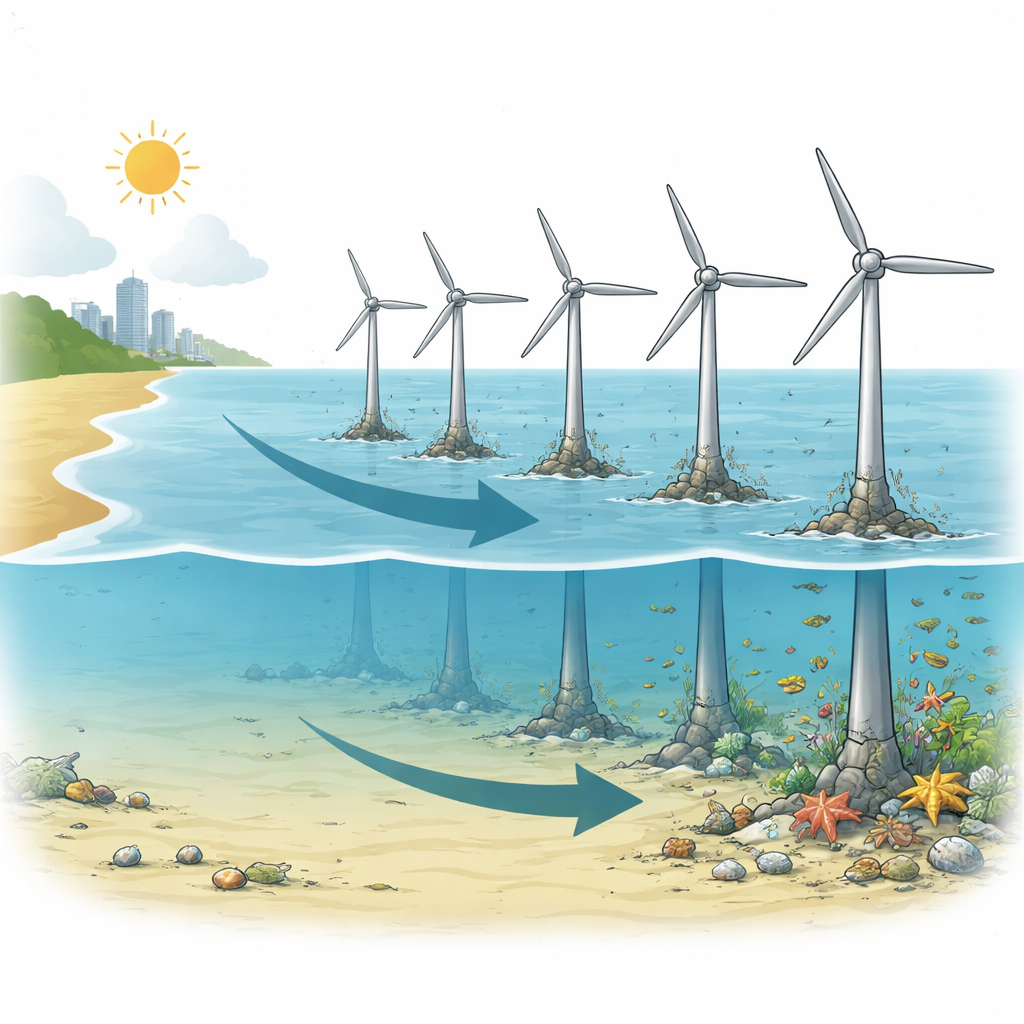
The Changing Seafloor Under Turbines
The research focuses on “soft-bottom” habitats—muddy and sandy seabeds that host worms, clams, crustaceans, and other bottom-dwellers that form the base of marine food webs. Before construction, the area was mostly flat, silty seafloor. Pile driving, cable laying, and sediment disturbance during building caused a temporary drop in the number of species and in overall community diversity. But once the wind farms began operating, the metal towers and their rock armor around the bases created patches of hard ground where none existed before, turning parts of the seabed into artificial reefs.
A Natural Experiment in Space and Time
The four wind farms were built and switched on at different times between 2021 and 2024, forming a natural “timeline” from newly built to well-established sites. From 2015 to 2024, scientists sampled seafloor animals twice a year at more than 200 stations: inside the farms, near their edges, and in distant control areas. At the same time, they used satellites to track water temperature, algae levels, and suspended particles. This allowed them to separate changes caused by the turbines from those driven by broader climate and ocean conditions.
Letting the Data Speak With Machines
To make sense of this complex, scattered data, the team used a machine learning method called XGBoost and compared it with a more traditional statistical model. Both tried to predict how diverse the seafloor community was at each site, based on environmental conditions, distance to turbines, how long the farm had been operating, and how much hard surface was present. XGBoost captured more of the real-world variation—explaining about three quarters of the differences in diversity—while also revealing which factors mattered most. A tool called SHAP helped translate the model’s inner workings into easy-to-read rankings and response curves.
From Disturbance to Recovery and Gain
The strongest signal the models found was time since the turbines began running. During construction and the first couple of years of operation, seafloor diversity dipped below the original baseline. Around two and a half years after start-up, that trend flipped: diversity recovered and then slightly exceeded pre-construction levels. Close to turbine bases, where rock was added for stability, the effect was striking. These hard patches hosted about 40 percent more species and roughly 13 percent higher diversity scores than nearby undisturbed areas. The pattern suggests a classic artificial reef effect: new surfaces attract barnacles, mussels, and other settlers, which in turn draw in more mobile animals and boost overall biomass.
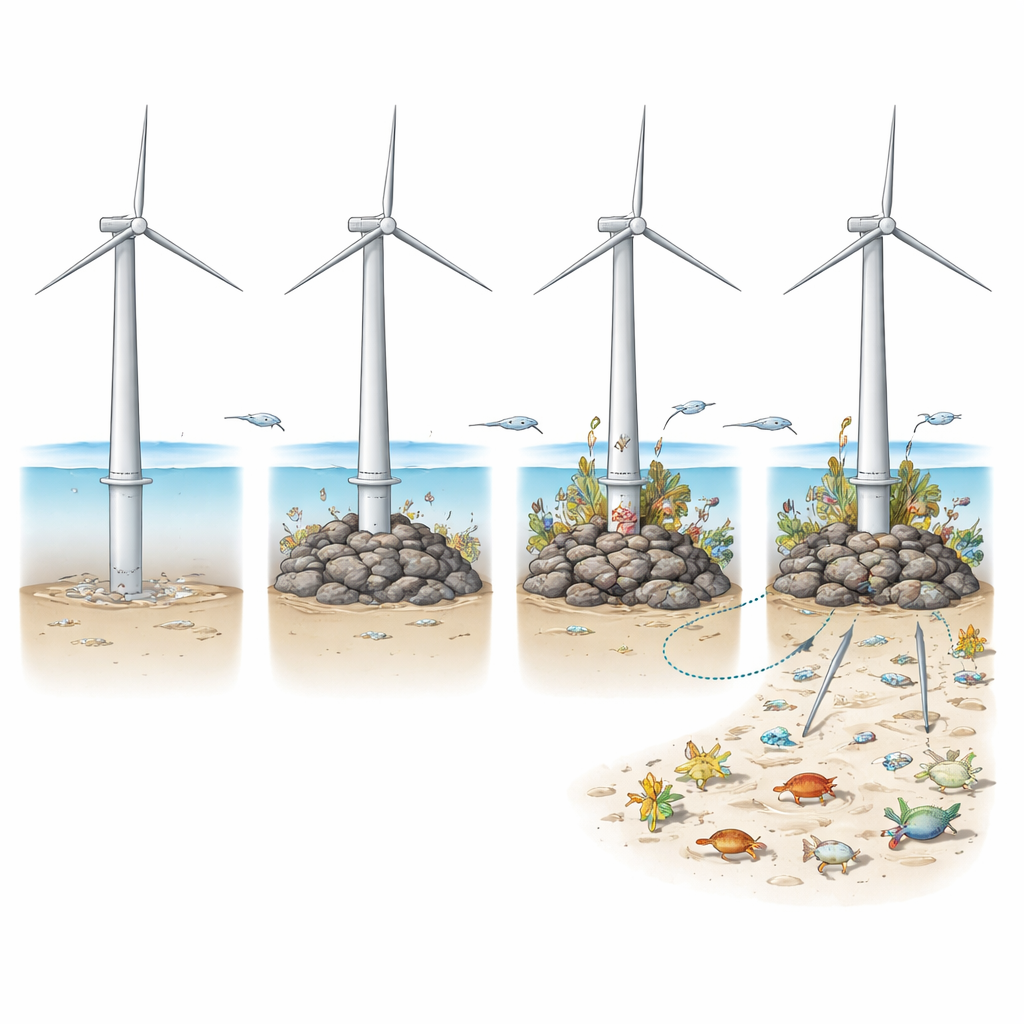
Finding the Sweet Spot for Design
The study also hints at design rules for “friendlier” wind farms. Diversity rose with the share of hard ground up to a point, then leveled off, implying that scattering moderate-size reef-like zones may work better than paving the seabed with rock. Turbine spacing showed an inverted U-shaped effect: low densities did too little to change habitat, while very dense layouts may introduce enough noise and other disturbances to offset the benefits. An intermediate density range seemed to support the richest communities.
What This Means for Ocean Life and Energy
For non-specialists, the takeaway is surprisingly hopeful. Offshore wind farms do disturb seafloor life at first, but in this case communities rebounded within a few years and even gained species around turbine foundations. By carefully choosing turbine density, foundation design, and the amount of rock placed on the seabed, planners can reduce short-term damage and enhance long-term habitat value. The authors’ modeling framework—combining field surveys, satellites, and interpretable machine learning—offers a blueprint for checking and improving the ecological footprint of future wind projects, helping the push for clean energy align more closely with healthy oceans.
Citation: Wang, L., Zhang, Y., Gu, X. et al. Machine learning-based assessment of offshore wind farm impacts on soft-bottom benthic communities in the Shandong Peninsula. Sci Rep 16, 11780 (2026). https://doi.org/10.1038/s41598-026-38939-0
Keywords: offshore wind farms, seafloor biodiversity, artificial reefs, marine ecology, machine learning in ecology