Clear Sky Science · en
Emergent altermagnetism and topological response in Janus MnPSX monolayers
A New Kind of Magnetism in Ultra‑Thin Crystals
Imagine a material as thin as a single sheet of atoms that can control the spin of electrons like a traffic director, while also guiding them along its edges without resistance. This study explores how to design such "smart" two‑dimensional crystals, called Janus MnPSX monolayers, that combine an emerging type of magnetism with exotic topological behavior. These unusual properties could one day power ultra‑efficient electronics and quantum technologies that go beyond today’s computer chips.
From Familiar Magnets to a Hidden Fifth Kind
Most people learn that materials are either non‑magnetic or fall into three classic categories: ferromagnetic (like a bar magnet), ferrimagnetic, or antiferromagnetic. In the last few years, researchers have uncovered a new magnetic phase called altermagnetism. In these systems, the overall magnetization cancels out, but deep in momentum space—the landscape that describes how electrons move—spins separate in a patterned way. Electrons with opposite spins occupy different parts of this landscape, even without the usual relativistic effect known as spin–orbit coupling. This hidden order lets altermagnets generate unusual electrical and optical responses while remaining magnetically “quiet” on average, an enticing combination for future spin‑based devices.
Building an Asymmetric Atomic Sandwich
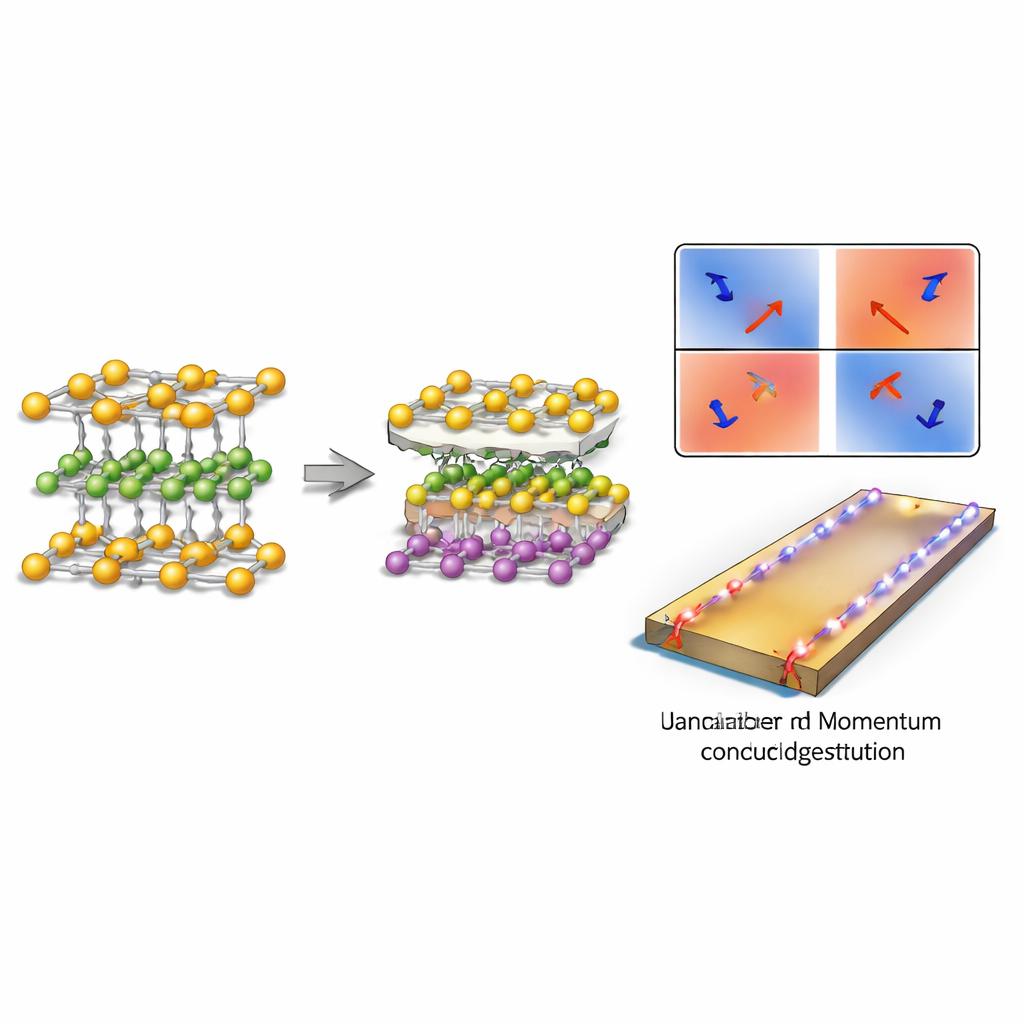
The starting point of the work is a well‑known two‑dimensional crystal called MnPS₃, where manganese, phosphorus, and sulfur atoms form a layered honeycomb network only a few atoms thick. In its original form, this monolayer is symmetric: the top and bottom sulfur layers are equivalent, and the structure has an inversion center, meaning it looks the same if flipped upside down. The authors redesign this atomic sandwich by replacing only one of the two sulfur sheets with a different chalcogen atom—oxygen, selenium, or tellurium—creating so‑called Janus structures MnPS₁.₅O₁.₅, MnPS₁.₅Se₁.₅, and MnPS₁.₅Te₁.₅. This one‑sided substitution breaks the up–down symmetry, produces a built‑in polarity, and redistributes the electronic charge across the thickness of the monolayer. Extensive computer simulations show that these new Janus crystals are structurally stable and, in particular, the oxygen‑based variant is especially favorable to form.
How Charge Imbalance Switches On Altermagnetism
Breaking the structural symmetry turns out to be the key to unlocking altermagnetism in these ultrathin sheets. In pristine MnPS₃, a combination of spatial inversion and time reversal forces every electronic state to come in spin‑degenerate pairs: up‑ and down‑spin electrons share the same energy at every momentum. Once one sulfur side is replaced, that combined symmetry is lost, but the underlying antiferromagnetic pattern remains. The resulting charge density imbalance—strongest for oxygen, weaker for selenium and tellurium—distorts the electronic environment around the manganese and phosphorus atoms. The calculations reveal that this asymmetry lifts the previous degeneracy and produces a momentum‑dependent splitting of spin bands with an alternating pattern across momentum space, the hallmark of so‑called g‑type altermagnetism. Oxygen, being the smallest and most electronegative of the substitutes, strengthens its bonds the most, contracts the lattice, and yields the largest spin splitting; selenium and tellurium give milder but still clear effects.
From Exotic Magnetism to Edge Highways
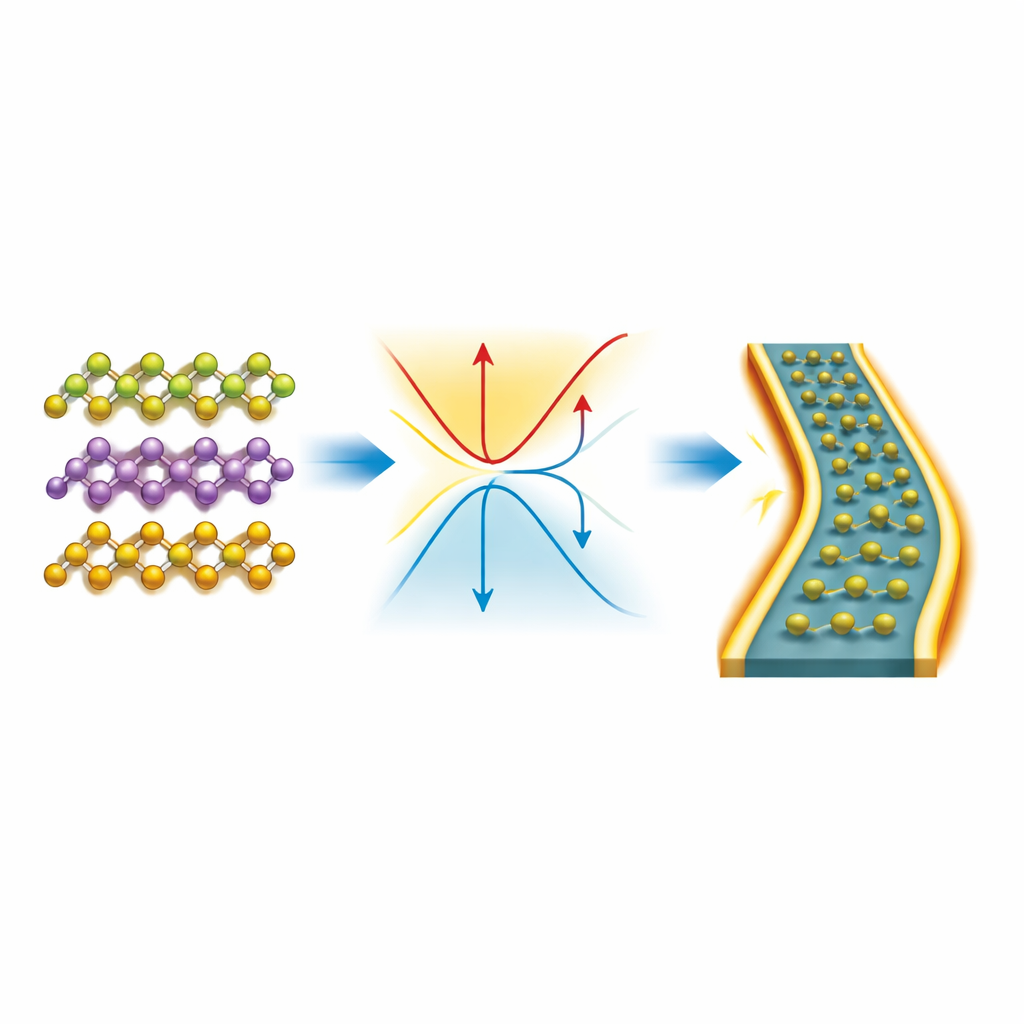
When the researchers add spin–orbit coupling to their simulations—capturing how an electron’s spin feels its orbital motion—the Janus structures reveal a second remarkable feature. In the oxygen‑ and tellurium‑based monolayers, spin–orbit interactions invert the ordering of certain electronic bands and open (or nearly close) small gaps at specific points in momentum space. The team analyzes the resulting spin Hall conductivity and tracks the flow of special charge centers known as hybrid Wannier centers. Both tools show that MnPS₁.₅O₁.₅ and MnPS₁.₅Te₁.₅ host a nontrivial quantum spin Hall phase: inside the gap, the crystal behaves as an insulator in the bulk but supports conducting, spin‑polarized channels confined to its edges. These edge states are protected by the material’s topology and by its underlying magnetic and crystalline symmetries, and they coexist with the nonrelativistic altermagnetic spin splitting.
Why This Matters for Future Devices
In simple terms, the authors show how to turn a fairly ordinary magnetic monolayer into a dual‑purpose quantum material simply by changing the atoms on one side. This one‑sided "makeover" uses charge imbalance to create altermagnetism—hidden spin order without net magnetization—and, with the help of spin–orbit coupling, to generate a topological state with robust edge currents. Because the strength of these effects can be tuned by choosing different substituting atoms, this approach offers a design toolkit for two‑dimensional magnets that can route spins and charges in precise ways. Such Janus altermagnets could underpin future spintronic and quantum devices that are energy‑efficient, robust, and engineered layer by layer at the atomic scale.
Citation: Guerrero-Sanchez, J., Ponce-Perez, R., Hoat, D.M. et al. Emergent altermagnetism and topological response in Janus MnPSX monolayers. Sci Rep 16, 13056 (2026). https://doi.org/10.1038/s41598-026-38927-4
Keywords: altermagnetism, Janus monolayers, quantum spin Hall, spintronics, 2D magnetic materials