Clear Sky Science · en
A quantum resilient deepfake detection framework using enhanced resnext and post quantum cryptography defence
Why Fake Photos Matter to Everyone
Images and videos that look real but are secretly fabricated—often called deepfakes—are no longer just internet curiosities. They can sway public opinion, smear reputations, confuse courts, and make it harder to trust anything we see online. This paper presents DeepQShield, a new system designed not only to spot such fake images with very high accuracy, but also to protect its own results against powerful future computers that might try to tamper with or fool it.
Seeing the Difference Between Real and Fake Faces
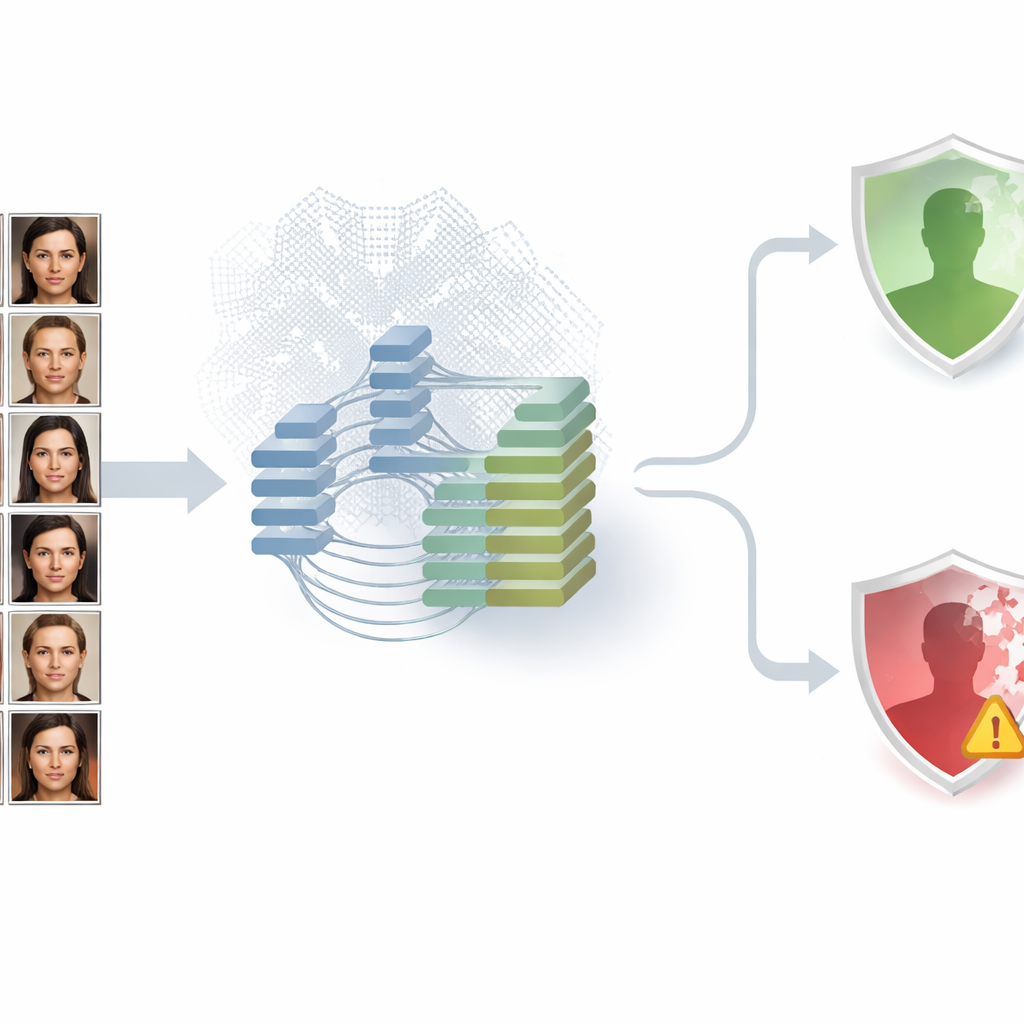
At the heart of DeepQShield is a modern image-recognition network that has been adapted to the special task of telling genuine faces from synthetic ones. Trained on 140,000 images from the Deepfake Detection Challenge, evenly split between real and fake, the system learns to pick up tiny visual clues that the human eye often misses. These clues can come from subtle inconsistencies in lighting, skin texture, or how different parts of a face line up. By carefully preparing the data—resizing, normalizing colors, checking file integrity—and using an efficient backbone called ResNeXt, the system builds a robust sense of what authentic faces “should” look like under many conditions.
Training the System to Withstand Trickery
Many existing deepfake detectors work well until an attacker deliberately tweaks images in ways designed to confuse them. DeepQShield addresses this by training itself on both normal images and specially perturbed versions that mimic such attacks. These perturbations are not random; they are guided by a mathematical framework known as “learning with errors,” which comes from the field of post-quantum cryptography. In practice, this means the system is repeatedly exposed to images with carefully structured noise, forcing it to rely on deeper, more stable facial cues instead of fragile patterns that can be easily manipulated. As a result, it becomes far harder for an attacker—even one with detailed knowledge of the model—to nudge an image just enough to slip past the detector unnoticed.
Locking Down Results with Future-Proof Security
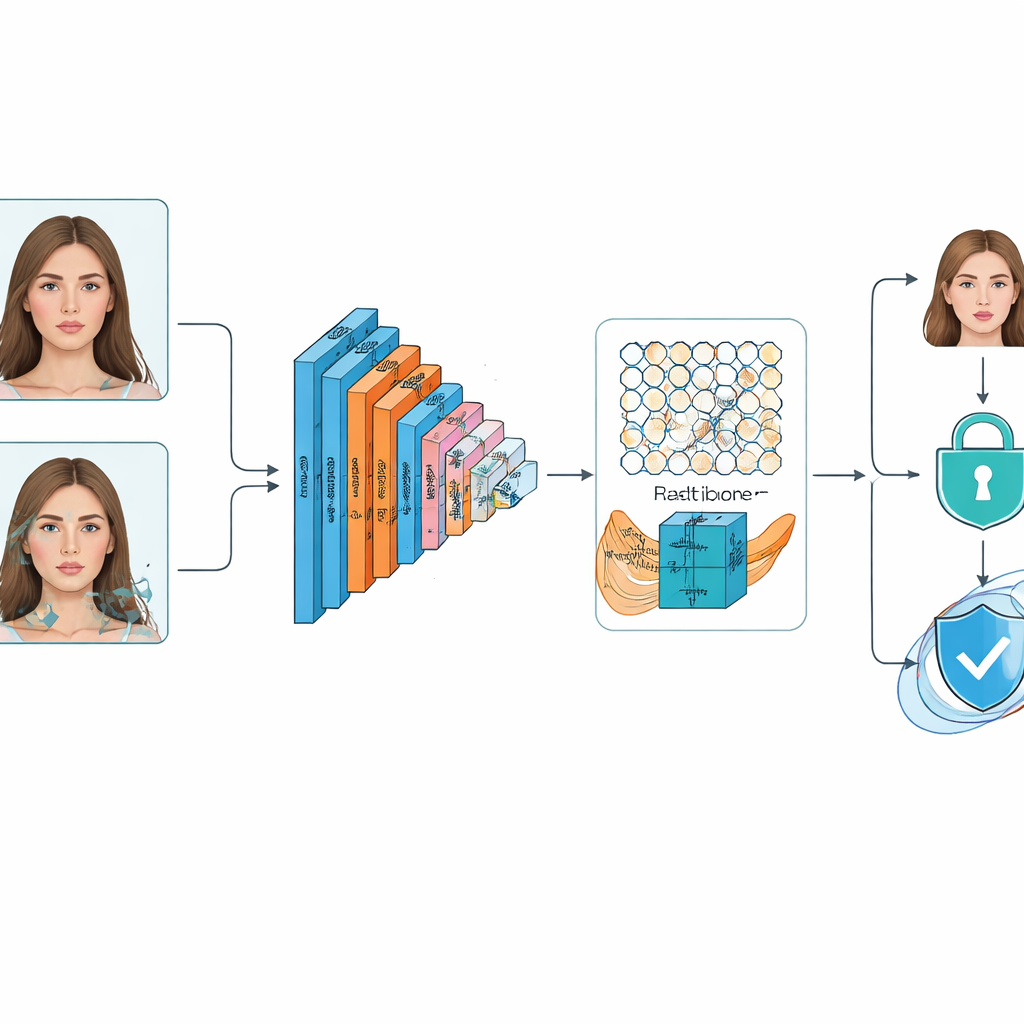
Spotting a fake is only part of the story, especially in courtrooms, newsrooms, and content-moderation systems where the verdict itself must be trusted. DeepQShield wraps every detection result in strong, quantum-resistant cryptography. Two leading algorithms, Kyber and Dilithium, are used to exchange encryption keys and to sign each prediction in a way that remains secure even against future quantum computers. The system can also combine these with classical methods like RSA and elliptic-curve keys, creating a hybrid shield around the output. Along with rich security metadata and a clear chain of custody, this lets investigators and third parties verify that a given “real” or “fake” decision truly came from the original model and has not been altered in transit.
How Well the Shield Holds Up
When tested on the benchmark Deepfake Detection Challenge images, DeepQShield reached an accuracy of 99.28 percent and an almost perfect area-under-the-curve score of 0.9997, outperforming well-known alternatives such as EfficientNet, vision transformers, and several ensemble and attention-based models. It also generalized well to different deepfake collections, including FaceForensics++ and Celeb-DF, where data are captured under other filming conditions and manipulation styles. Stress tests with standard “adversarial” attack methods showed that, even when images were deliberately nudged to confuse it, the system retained a meaningful level of performance and could use calibrated confidence scores to flag suspicious cases rather than offering overconfident but wrong answers.
What This Means for Trust in Digital Media
DeepQShield demonstrates that it is possible to combine state-of-the-art fake-image detection with security measures designed for a world in which quantum computers are practical. For non-specialists, its main message is simple: we can build tools that not only recognize forged faces with great reliability but also prove, in a verifiable and tamper-resistant way, that those judgments are genuine. If adopted in settings such as social media platforms, news organizations, and legal forensics, systems like DeepQShield could help restore some of the trust that deepfakes are steadily eroding.
Citation: Shreeya, K.N., Subburaj, B., Saketh, K.S.G. et al. A quantum resilient deepfake detection framework using enhanced resnext and post quantum cryptography defence. Sci Rep 16, 10046 (2026). https://doi.org/10.1038/s41598-026-38924-7
Keywords: deepfake detection, image forensics, adversarial attacks, post-quantum security, cryptography