Clear Sky Science · en
Novel iterative method for the approximation of fixed point of a class of generalized ( $$\alpha ,\beta$$ )-nonexpansive mapping with applications to seir epidemic model
Why this matters for disease modeling
When we hear about computer models predicting how an epidemic will spread, those forecasts ultimately depend on solving complicated mathematical equations. Often, these equations are too hard to solve in one step, so scientists use step‑by‑step approximation procedures called iterative schemes. This paper introduces a new, faster and more reliable way to carry out those step‑by‑step calculations, and then shows how it can sharpen the analysis of a modern SEIR epidemic model that includes memory effects in disease transmission.

Improving the engines behind many simulations
At the heart of countless models in physics, engineering, economics and epidemiology lies the idea of a fixed point: a state that remains unchanged when a system’s rules are applied. Finding such a state is rarely straightforward, so researchers use iterative procedures: start from a guess, apply a transformation, and repeat until the updates settle down. Over the years, many such procedures have been proposed, each tailored to different technical assumptions. The authors focus on a very broad class of transformations that gently move points without stretching distances too much, known as generalized (α, β)-nonexpansive mappings. This broad setting already includes several widely used methods, so a more powerful scheme here can impact many application areas at once.
A new step‑by‑step recipe
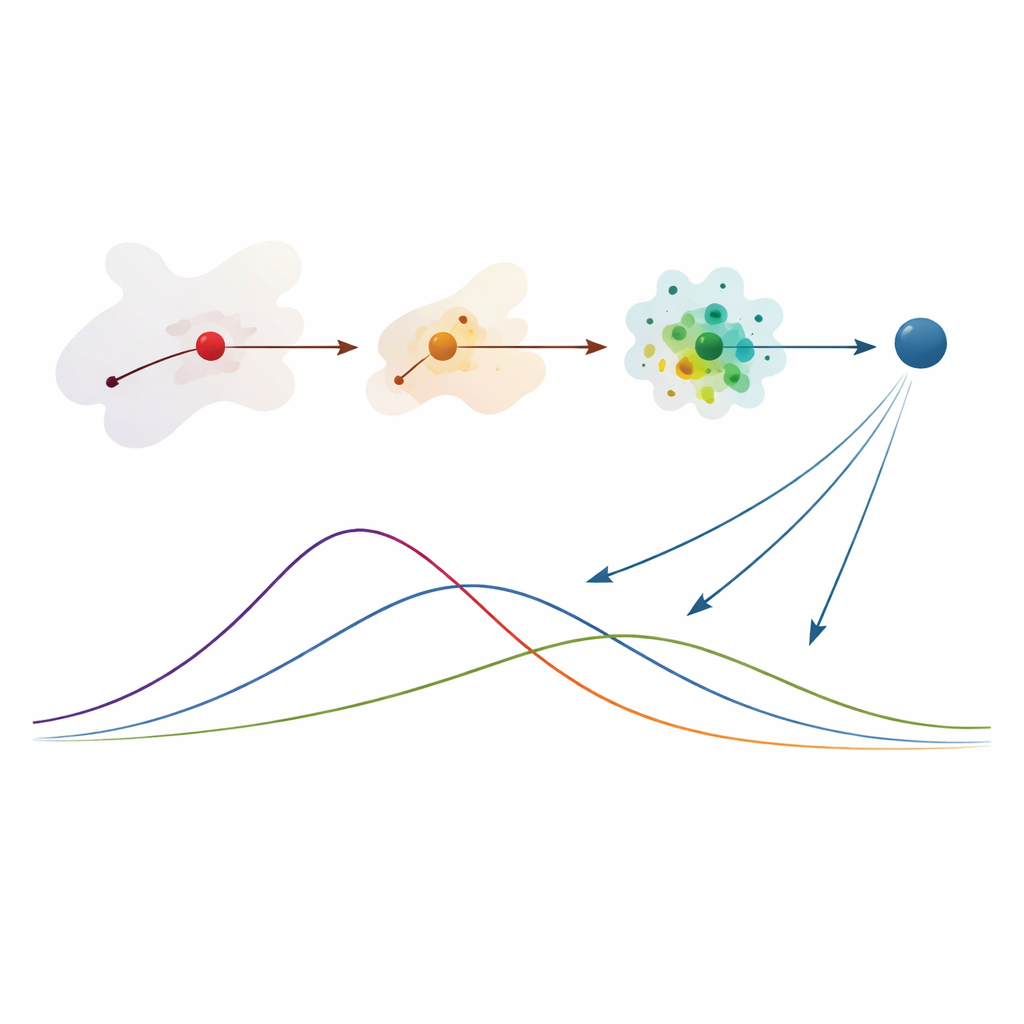
The paper proposes a new four‑stage iteration that systematically refines an initial guess. In each cycle, the current guess is first transformed once, then blended with more advanced evaluations of the same transformation, and finally passed through the transformation again. These blending steps act like controlled averaging, designed to stabilize the path and incorporate deeper information about how the system behaves. Mathematically, the authors prove that under natural conditions in a uniformly convex Banach space—a standard framework for dealing with infinite‑dimensional problems—the new recipe always produces a sequence that approaches a fixed point whenever one exists. They establish both “weak” and “strong” forms of convergence, which roughly correspond to approaching the true solution in increasingly stringent senses.
Faster, more stable convergence in practice
To see whether the new scheme is merely elegant or also efficient, the authors compare it with several popular iterative methods, including the classical Picard iteration and more recent multi‑step variants. Using carefully chosen test problems, they track how quickly each method approaches the correct fixed point and how many steps it needs before numerical errors become negligible. The tables and graphs show that the new scheme typically reaches the target in fewer iterations or with more stable behavior, especially in difficult examples. Beyond speed, the authors also analyze how sensitive the method is to small changes in the underlying rules, a property known as data dependence, and they prove notions called G‑stability and almost G‑stability. These results show that the procedure is robust: small perturbations do not derail convergence but only cause controlled, bounded changes in the final answer.
Linking abstract math to epidemic curves
To demonstrate real‑world relevance, the authors apply their fixed‑point machinery to a SEIR epidemic model, which divides the population into susceptible, exposed, infectious and recovered groups. Instead of using ordinary derivatives that look only at the present rate of change, they adopt a fractional derivative of Caputo type, which incorporates memory of the past—a feature especially important for diseases with long incubation times or lingering effects. This fractional SEIR system can be rewritten as an equivalent integral equation whose solutions correspond to fixed points of a suitable operator. By proving that this operator fits their generalized nonexpansive framework and satisfies a technical “Lipschitz” bound, the authors show that their new iterative scheme converges to the unique solution of the epidemic model. In practical terms, one can start from an initial guess of how the four compartments evolve over time and repeatedly apply the scheme to obtain increasingly accurate epidemic trajectories.
What the study ultimately shows
Put simply, the authors have built a more versatile and reliable engine for the kinds of step‑by‑step calculations that underpin many scientific models. They show that this new iteration can unify and extend several existing methods, converge quickly and stably, and handle complex systems such as fractional SEIR epidemic models with memory. For a lay reader, the key takeaway is that advances in the underlying mathematics of fixed‑point approximation can directly improve our ability to simulate and understand complex dynamical systems—from how diseases spread through a population to how other nonlinear processes evolve over time—resulting in more trustworthy predictions and analyses.
Citation: Alharthi, N.H., Okeke, G.A., Udo, A.V. et al. Novel iterative method for the approximation of fixed point of a class of generalized (\(\alpha ,\beta\))-nonexpansive mapping with applications to seir epidemic model. Sci Rep 16, 11833 (2026). https://doi.org/10.1038/s41598-026-38884-y
Keywords: fixed point iteration, fractional SEIR model, epidemic dynamics, numerical convergence, nonlinear dynamical systems