Clear Sky Science · en
Selection criteria for foaming agent and mechanical performance evaluation of conditioned soil for EPB shield tunneling in water-rich sand strata
Why bubbles matter underground
Modern cities rely on underground rail lines and utility tunnels, many of which are dug by giant machines that chew through soil like underground trains. When these tunnel boring machines work in loose, water‑soaked sand, the ground can behave more like quicksand than solid earth, risking sinkholes, floods and costly delays. This study explores how cleverly engineered foam—essentially controlled bubbles—can be used to tame that difficult sand, keep the tunnel face stable and help the machine move forward safely and efficiently.
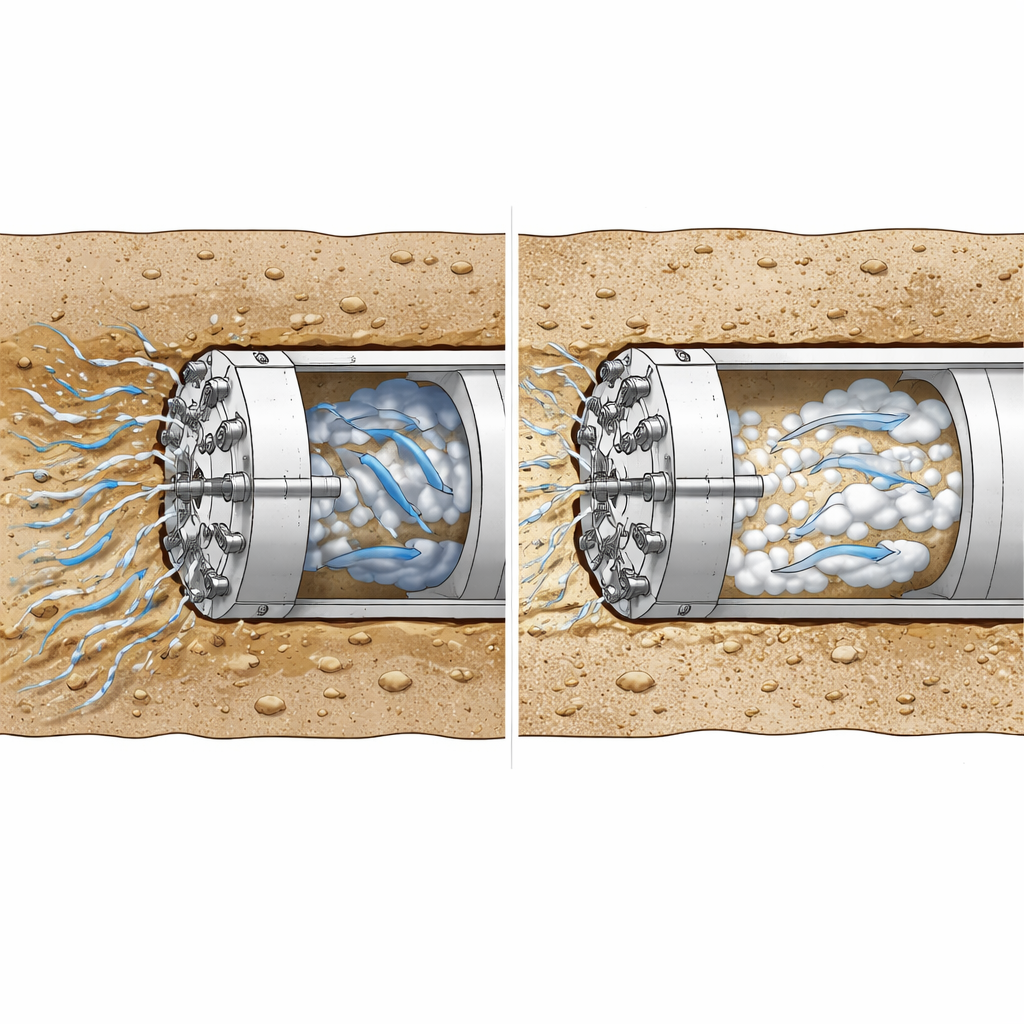
Digging through wet and shaky sand
The type of tunnel boring machine examined here is called an Earth Pressure Balance (EPB) shield. It pushes against the soil at the tunnel face while slowly advancing. In water‑rich sand, the excavated soil is very permeable and grainy, with low stickiness and high internal friction. Water can gush into the machine’s screw conveyor, and the loose sand is prone to arching and blockages. To avoid this, operators inject conditioners such as foam into the freshly dug soil. The goal is to turn rough, leaky sand into a smooth, paste‑like mixture that can safely carry pressure, flow through the machine and be removed without clogging or sudden bursts of water and soil.
Testing many bubble recipes
The researchers examined eight commercial foaming agents—chemical mixes that create bubbles when combined with water and air. Using a custom foam generator and several laboratory devices, they measured key properties of the foam solutions. These included surface tension (how easily bubbles form), the foam expansion ratio (how much foam volume comes from a given liquid volume), how quickly the foam collapses in a glass tube, and the foam’s half‑life, which indicates how long half of the foam survives before draining away. By varying the concentration of each foaming agent, they identified a “sweet spot” where bubbles form easily yet remain stable, without wasting material.
From bubble tests to ground behavior
Foam quality alone is not enough; it must actually improve the excavated sand. The team selected three representative foaming agents and mixed their foam with poorly graded, water‑rich sand from a metro tunnel site in Nanchang, China. They then measured how the treated sand behaved, using simple but informative tests. A slump test checked how far a cone of conditioned soil spreads under its own weight, indicating flowability. Permeability tests under pressure showed how easily water can pass through the mixture. A miniature vane test measured undrained shear strength, a gauge of how much the conditioned soil can resist deformation while still acting like a plastic mass. By adjusting how much foam was injected, the researchers matched the soil’s behavior to ranges known to be safe and workable for EPB tunneling.
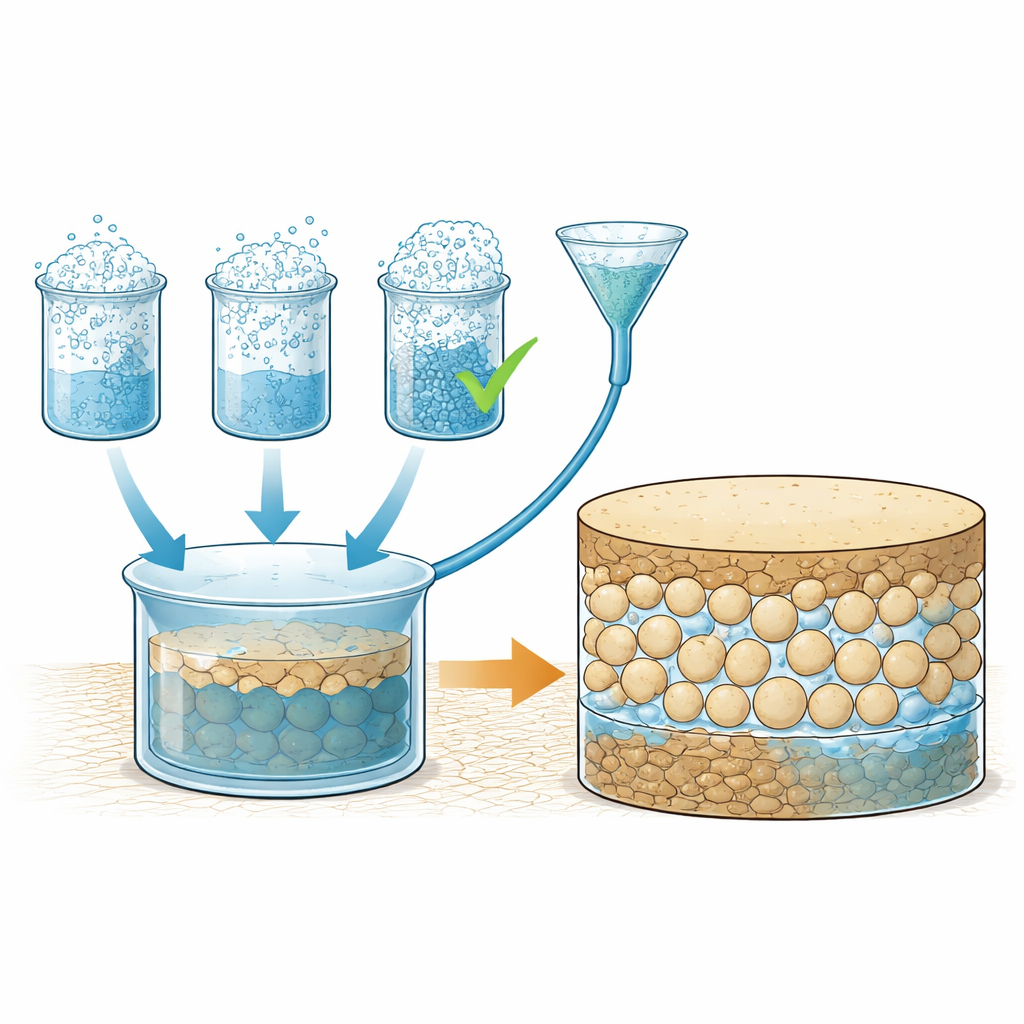
Picking the right foam for the job
From these experiments, the authors distilled practical selection rules. An effective foaming agent should, at around 3% concentration in water, reduce surface tension below 40 mN/m, produce foam that expands to more than 12 times the liquid volume, maintain at least 150 mL of foam in a standard test after 15 minutes, and have a half‑life longer than 400 seconds. They also found that foams whose volume decays in a gently curving, “concave” pattern over time tend to perform better than those that lose volume more linearly and quickly. When such foams are injected at suitable volumes—often around 20–25% of the excavated soil volume—the resulting soil shows slumps of 150–200 mm, very low permeability, and modest shear strength, all of which support smooth, controlled machine operation.
What this means for safer tunnels
For non‑specialists, the message is that not all bubbles are created equal. By carefully tuning how foam is made and selecting it using clear numerical thresholds, engineers can transform troublesome, water‑rich sand into a manageable material that carries pressure, flows like thick cream and resists dangerous leaks. The study offers a standardized way to choose and test foaming agents, reducing trial‑and‑error on construction sites and helping safeguard workers, city streets and nearby buildings as new underground space is carved out beneath our feet.
Citation: Zhou, Y., Zhu, B., Luo, R. et al. Selection criteria for foaming agent and mechanical performance evaluation of conditioned soil for EPB shield tunneling in water-rich sand strata. Sci Rep 16, 12331 (2026). https://doi.org/10.1038/s41598-026-38868-y
Keywords: tunnel boring, soil conditioning, foaming agents, water-rich sand, underground construction