Clear Sky Science · en
Disturbance-tolerant quadrotor control using a hybrid LQR and super-twisting sliding mode approach
Keeping Small Flying Machines Steady
From package delivery to search-and-rescue, small drones are being asked to fly in messy real-world conditions—gusty winds, fading batteries, changing payloads, even failing motors. Yet most drones still rely on control systems that assume the world is calm and predictable. This paper presents a new way to keep a quadrotor-style training platform steady and safe when things go wrong, aiming at more reliable flight for future air robots working over cities, farms, and disaster zones.
Why Balancing a Drone Is So Hard
Quadrotor drones are like flying tightrope walkers: they must continually balance around three main angles—yaw, pitch, and roll—using only four spinning propellers. In theory, classic control methods can keep them stable when conditions match the math on paper. In practice, drones face wind, shifts in weight, wear in motors, and sensor noise. More advanced approaches such as model predictive control and various flavors of sliding mode and adaptive control can handle some of these issues, but they often demand heavy computation and intricate tuning. The authors set out to find a middle ground: a controller that is robust to bad conditions, yet simple enough to implement on real hardware.
A Two-Layer "Brain" for the Drone
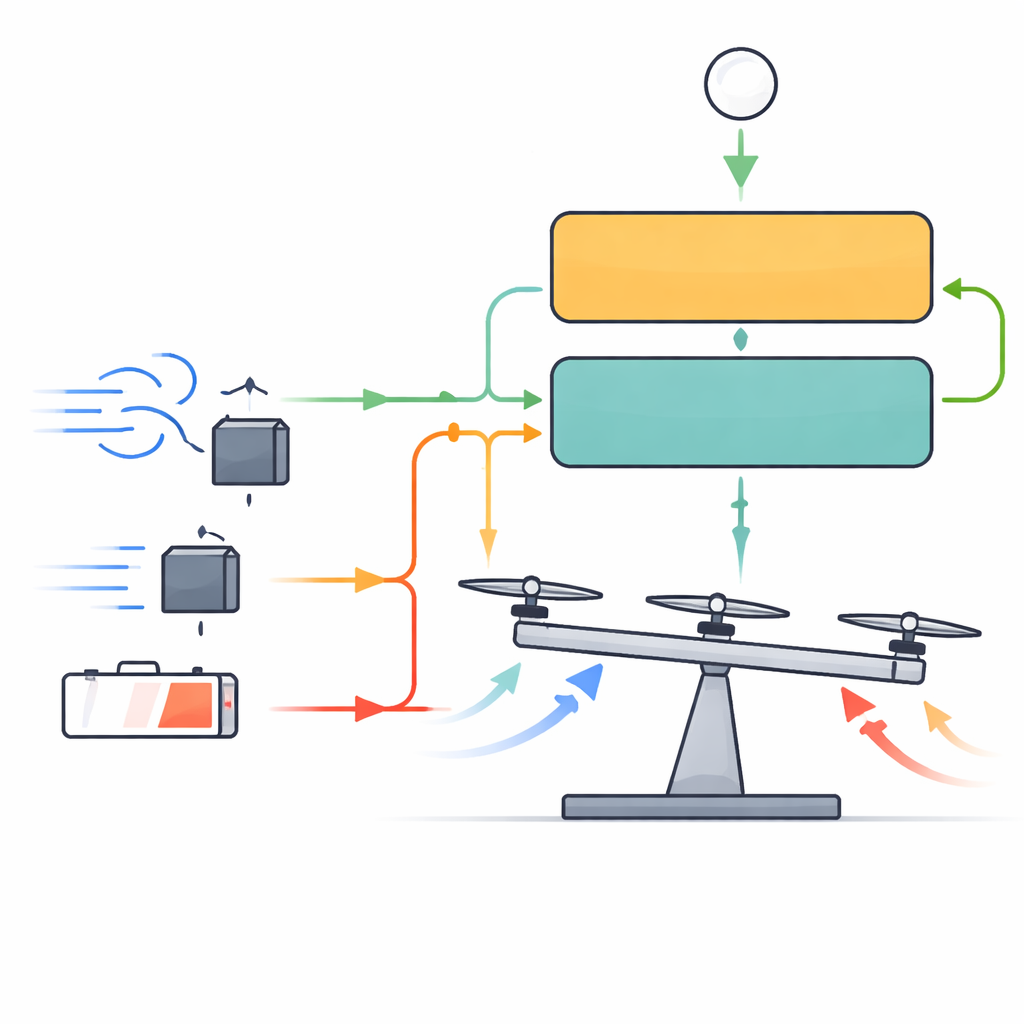
The study introduces a hybrid control scheme with two layers working together. The inner layer uses a well-known method called Linear Quadratic Regulator, which is very good at keeping the system smooth and energy-efficient when the model is accurate and disturbances are mild. Around it, the researchers wrap a second, more rugged layer based on a technique called super-twisting sliding mode control. This outer layer constantly watches how the system deviates from the desired motion and generates a corrective offset—a kind of moving target—that the inner layer then tracks. Rather than directly yanking on the motors, the robust layer reshapes the reference signal fed to the inner controller, so the drone behaves as if the disturbances had disappeared.
Teaching the Controller to Handle the Unexpected
To make the outer layer as effective as possible, the authors automatically tune its key parameters using a metaheuristic optimization method amusingly named Big Bang–Big Crunch. In this search process, many candidate parameter sets are tried in simulation, rated by how well they reduce tracking error over time, and then contracted toward the best region until an efficient combination is found. The complete hybrid controller is tested on a three-degree-of-freedom hover system from a commercial laboratory setup, where a bar with four rotors can rotate in yaw, pitch, and roll around a pivot. This setup captures the essential balancing challenge of a quadrotor while staying safely bolted to a bench.
Stress-Testing in Virtual Skies
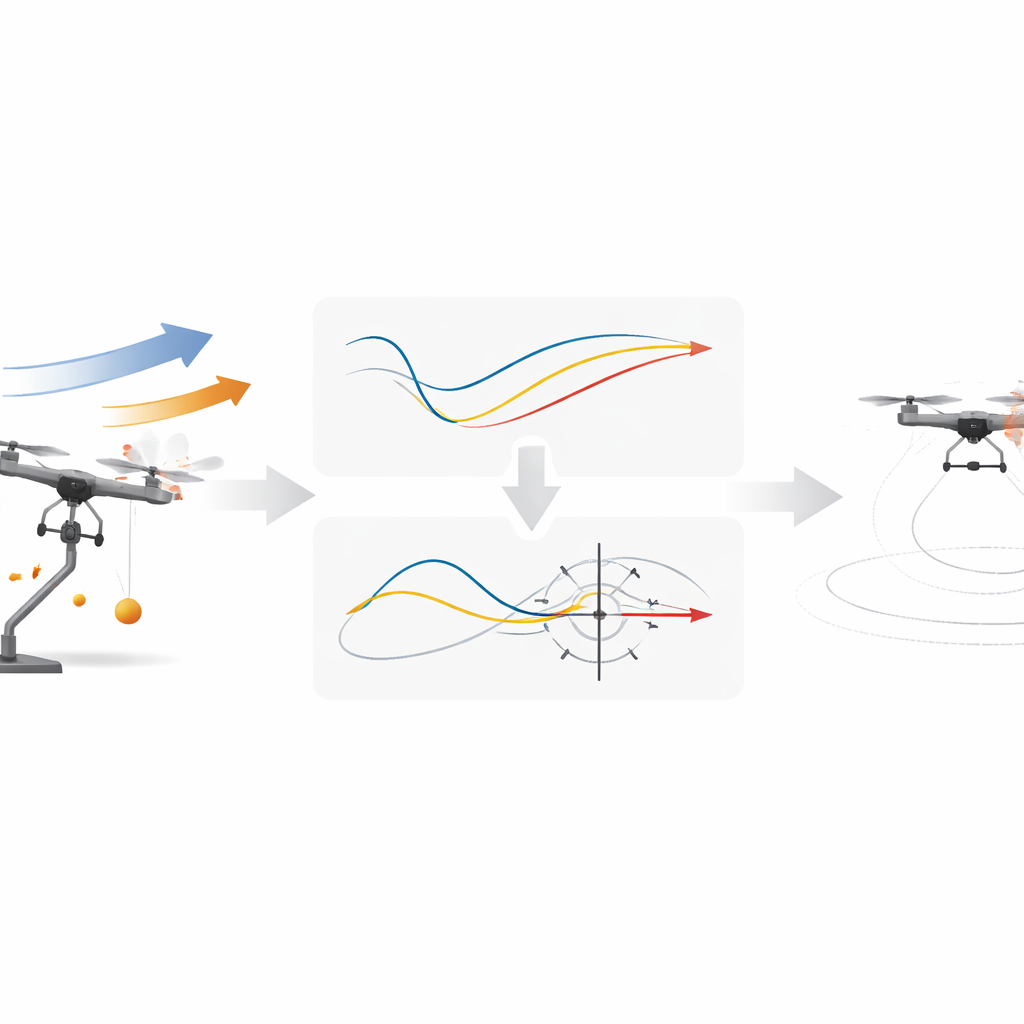
The researchers compare three approaches—classical LQR, model predictive control, and the new hybrid controller—across four demanding scenarios. First, they add steady wind forces along all axes; second, they gradually weaken the motor thrust to mimic a draining battery; third, they completely shut down one motor for a short interval; and fourth, they drop a heavy payload mid-flight, suddenly changing the system’s mass and balance. For each case, they measure several error scores that capture how large the deviations are, how long they last, and how quickly the system settles again. They also reconstruct the three-dimensional motion of a rotor tip to see, in space, how tightly each controller can confine the movement.
What the Results Show
Across all scenarios, the hybrid controller not only keeps the platform stable but also reduces tracking errors by orders of magnitude compared with both LQR and model predictive control. While the predictive controller often reacts faster at first, it tends to drift or struggle when the underlying model no longer matches reality—for example, after a payload drop or when the thrust characteristics change. The hybrid scheme, in contrast, shrugs off these mismatches: the outer robust layer cancels the effect of disturbances and parameter shifts, letting the inner layer do what it does best. The reconstructed rotor paths confirm this visually: the motion under the hybrid controller stays confined to a tight envelope, indicating smaller oscillations and better practical stability.
What This Means for Everyday Drones
In plain terms, the paper shows that giving a drone a two-layer control "brain"—one part smooth and efficient, one part tough and disturbance-hungry—can greatly enhance its ability to stay upright and on course when the world does not behave as expected. Because the approach is relatively simple and computationally light, it is well suited for real onboard electronics, not just simulations. As this method is brought from the lab rig to fully free-flying drones, it could help future aerial robots carry loads, survive sudden faults, and operate more safely in the unpredictable air above us.
Citation: Budak, S., Sungur, C. & Durdu, A. Disturbance-tolerant quadrotor control using a hybrid LQR and super-twisting sliding mode approach. Sci Rep 16, 9718 (2026). https://doi.org/10.1038/s41598-026-38820-0
Keywords: quadrotor control, fault-tolerant flight, robust drone stabilization, hybrid control systems, wind and payload disturbances