Clear Sky Science · en
Inferring bacterial cell size dynamics across media conditions
Why tiny cells matter
Even the smallest organisms on Earth carefully control their own size. For bacteria, being a bit bigger or smaller can change how quickly they take up food, get rid of waste, and survive stress. This study asks a simple but important question: as bacterial populations grow and run out of nutrients, how do individual cells change their size, and what does that reveal about the rules that keep their growth in check?
Following cells through a day in their life
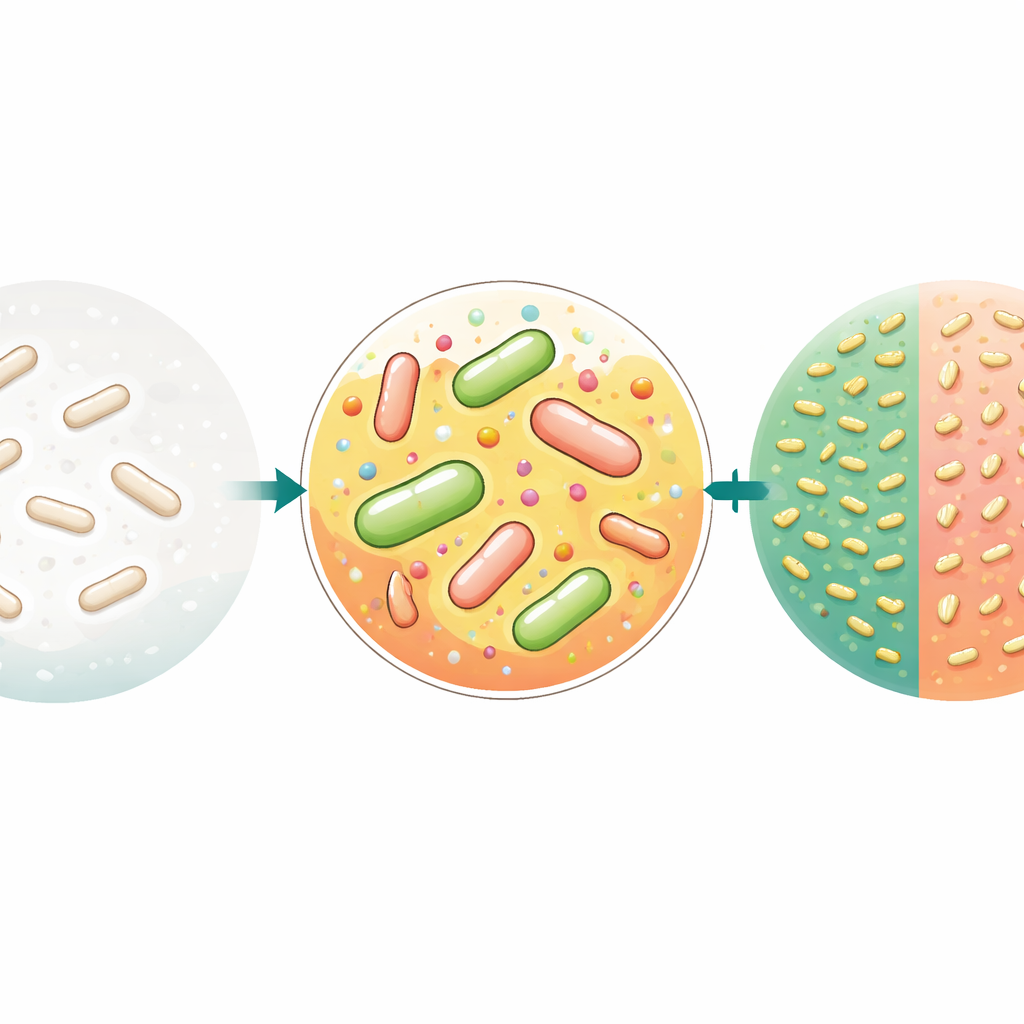
The researchers watched two common rod-shaped bacteria, Escherichia coli and Salmonella enterica, as they grew in different liquid foods, from very rich broths to bare-bones sugar solutions. Using high-resolution microscopy and automated image analysis, they measured each cell’s volume, length, and width at many time points along the classic population “growth curve” — from slow, crowded overnight cultures, through rapid expansion, and back to a stalled, stationary phase. At the same time, they tracked how cloudy the cultures became, a standard lab measure that reflects the total biomass in the flask.
A growth spurt, then a slimming down
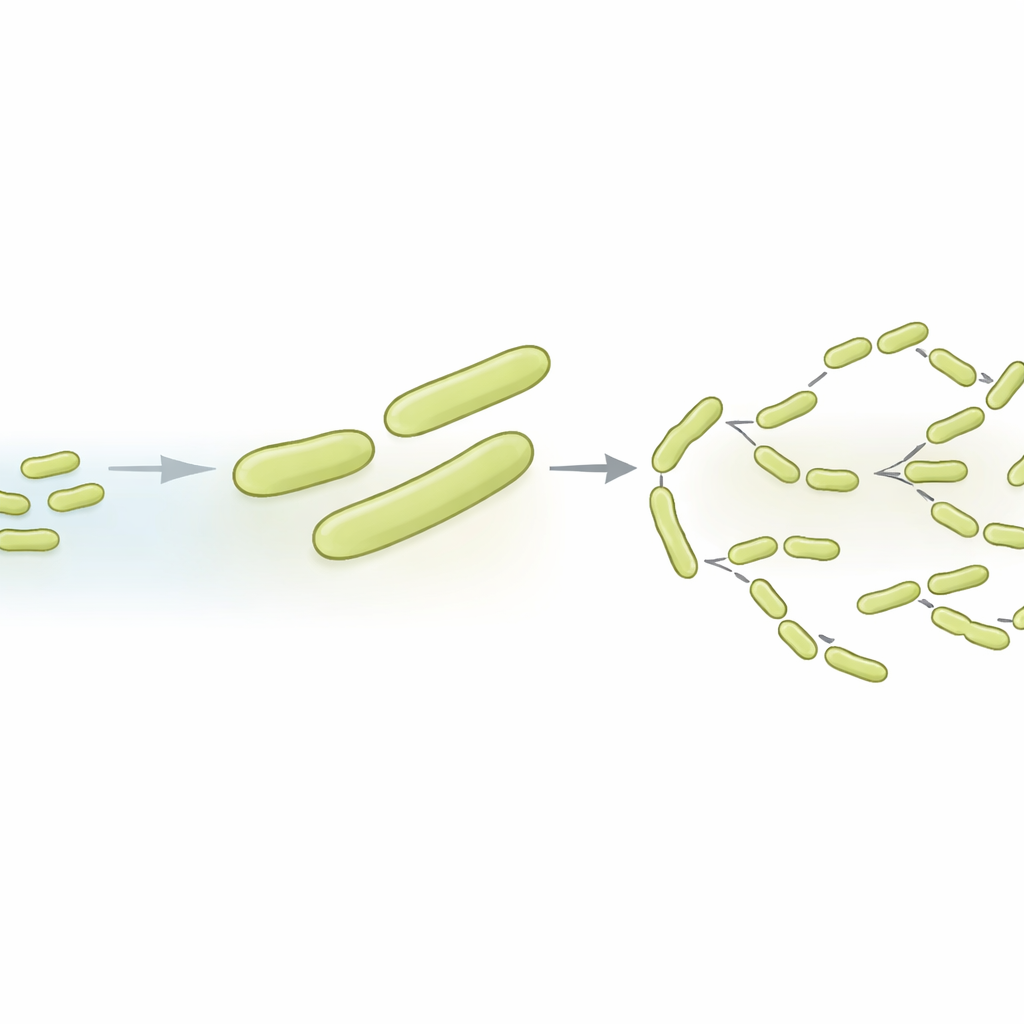
In nutrient-rich media, a striking pattern emerged. Cells starting from an overnight, nutrient-starved state were quite small. Once moved into fresh rich food, they rapidly swelled to about five times their original volume within roughly two hours. This growth burst involved both getting longer and thicker, with width increasing slightly earlier than length. However, this large size was short-lived: as nutrients were gradually used up, average cell volume declined again and eventually settled at a small, nearly identical size in stationary phase, regardless of which rich medium the cells had grown in. In contrast, when cells were kept in continuous, fresh rich medium by regularly diluting the culture, they held onto their large size and broad size distribution for many hours, showing that the later shrinking is triggered by the changing environment, not by some built-in timer.
How poorer diets reshape cells
When the team switched to a leaner, precisely defined medium containing only a simple sugar, the story changed. Under these poor conditions, cells grew more slowly and their volume stayed close to the small stationary-phase size throughout the entire growth curve. Length increased modestly, but width decreased a bit, so that total volume and surface-to-volume ratio hardly changed. Adding small amounts of amino acids to this minimal medium created intermediate behaviors: the richer the supplement, the higher the peak in cell volume, although the timing of the peak — around two hours after transfer — remained similar. These patterns were mirrored in both E. coli and Salmonella, suggesting that the way nutrient quality shapes cell size is shared across related species.
Connecting cloudiness, cell numbers, and hidden rules
The authors next compared how quickly total biomass increased with how quickly actual cell numbers rose. They found that early in growth, the culture’s cloudiness increased mainly because individual cells were getting larger, not because more cells were being made. Only later did division catch up. To make sense of this coordination, they built a simple mathematical model in which cell size grows smoothly in time, while division acts as a sudden halving event. By feeding in the measured population growth rates and fitting the average cell sizes, they inferred how the effective “division drive” must vary over time. This inferred division drive started low, ramped up as growth slowed, and then leveled off, in a way that depended strongly on the nutrient environment. In rich media, cells tolerated larger sizes before ramping up division, whereas in poor media the division behavior changed little.
What this means for the bigger picture
Put simply, the study shows that bacteria do not grow and divide at fixed sizes; instead, they flexibly rebalance how much they enlarge versus how often they split, depending on food quality and how quickly that food is disappearing. In rich environments, they briefly become large and diverse in size before tightening control and shrinking back to a common small volume as nutrients wane. In poor environments, they largely skip this overshoot and remain small. The modeling framework developed here turns routine population measurements into a window on these hidden size-control rules, offering a practical way to compare how different species, genetic variants, or environments shape the growth strategies of microscopic life.
Citation: Nieto, C., Igler, C. & Singh, A. Inferring bacterial cell size dynamics across media conditions. Sci Rep 16, 9883 (2026). https://doi.org/10.1038/s41598-026-38811-1
Keywords: bacterial cell size, nutrient conditions, growth curve, cell division, single-cell imaging