Clear Sky Science · en
A bio-polymeric strategy for enhancing the strength, durability of concrete and shrinkage reduction
Why Cracking Concrete Matters to Everyone
Concrete holds up our homes, bridges, and sidewalks, but it has a hidden weakness: it tends to crack, especially when it dries too quickly or is not cured properly with water. In many parts of the world, clean water is scarce, so builders cannot always give fresh concrete the long, careful watering it needs. This study explores a new way to help concrete look after itself from the inside, using tiny water‑holding grains and helpful bacteria to keep it from cracking and to make it stronger and longer‑lasting. 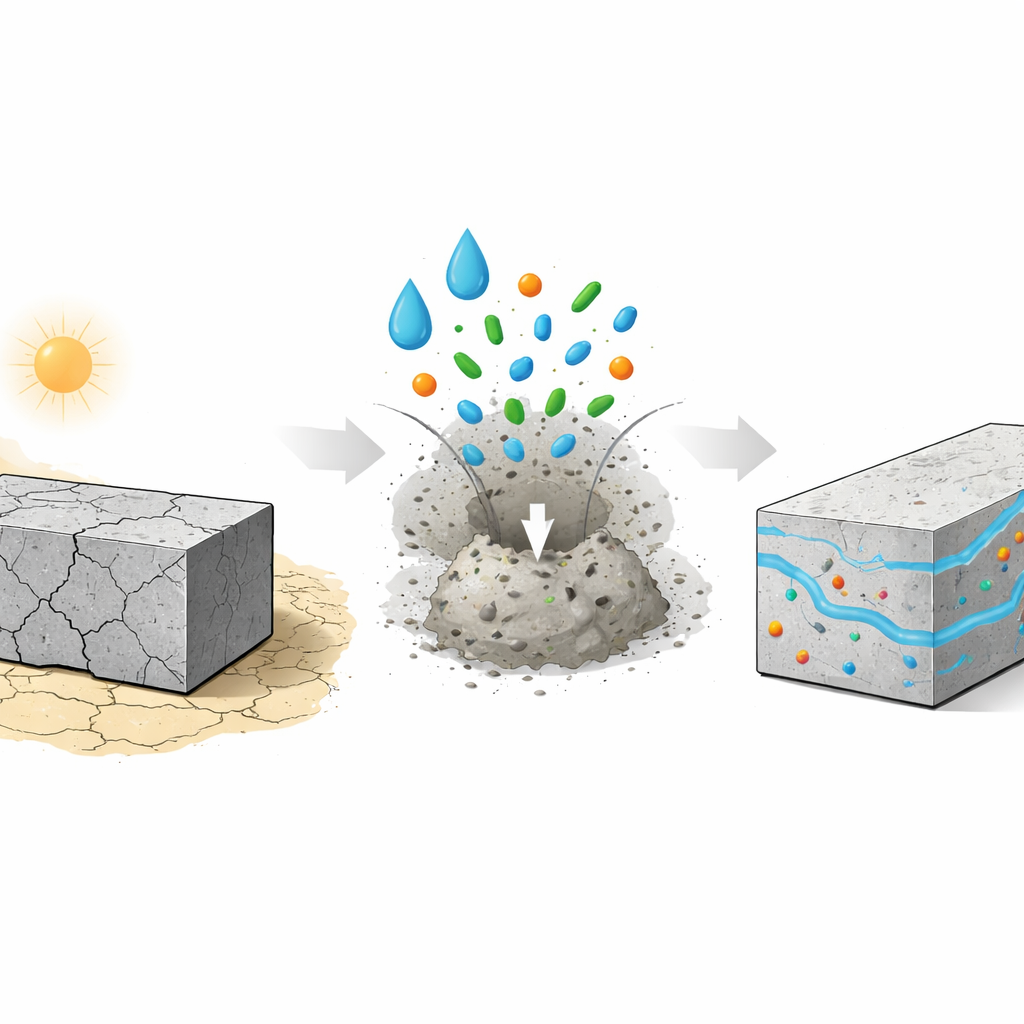
A New Recipe for Long‑Lasting Concrete
The researchers tested four types of concrete: a standard mix, a mix with special water‑absorbing grains called superabsorbent polymers, a mix with crack‑healing bacteria, and a mix that combined both additions. All versions used the same basic cement, sand, and gravel, so the differences in performance could be traced to these extra ingredients. The idea was simple but powerful: the polymer grains act like tiny sponges that soak up extra water when the concrete is mixed and then slowly release it from within, while the bacteria stay dormant until they sense moisture and air entering through tiny cracks, at which point they help seal those cracks with new mineral deposits.
Keeping Shrinkage and Early Cracks Under Control
Fresh concrete shrinks as it loses water and as chemical reactions inside it proceed, and this early‑age shrinkage often leads to fine cracks that later grow bigger. To understand and limit this problem, the team measured shrinkage during the first eight hours after adding water, the period when most of the movement occurs. The mix with superabsorbent polymer alone showed about a one‑quarter reduction in shrinkage compared with normal concrete, because the internal water reservoirs released moisture back into the mix as it began to dry. The mix with bacteria alone also shrank less, thanks to early mineral formation that tightened up the internal structure. When polymers and bacteria were used together, shrinkage dropped by nearly one‑third, showing a clear benefit from combining both strategies.
Stronger Concrete Through Hidden Helpers
Concrete strength was checked by crushing small cubes after 7 and 28 days and by bending beam‑shaped samples to measure how well they resisted cracking under load. Compared with ordinary concrete, the polymer‑only mix gained roughly 10 to 17 percent more crushing strength, while the bacteria‑only mix improved it by about 6 to 14 percent. The most impressive gains came from the blend of polymers and bacteria, which boosted compressive strength by about 15 percent at one week and more than 25 percent after four weeks. Bending strength followed the same pattern: the combined mix was roughly one‑quarter stronger than the standard mix after 28 days, and it kept an advantage at later ages. These results match the idea that better internal moisture and crack‑filling minerals work together to create a denser, tougher material. 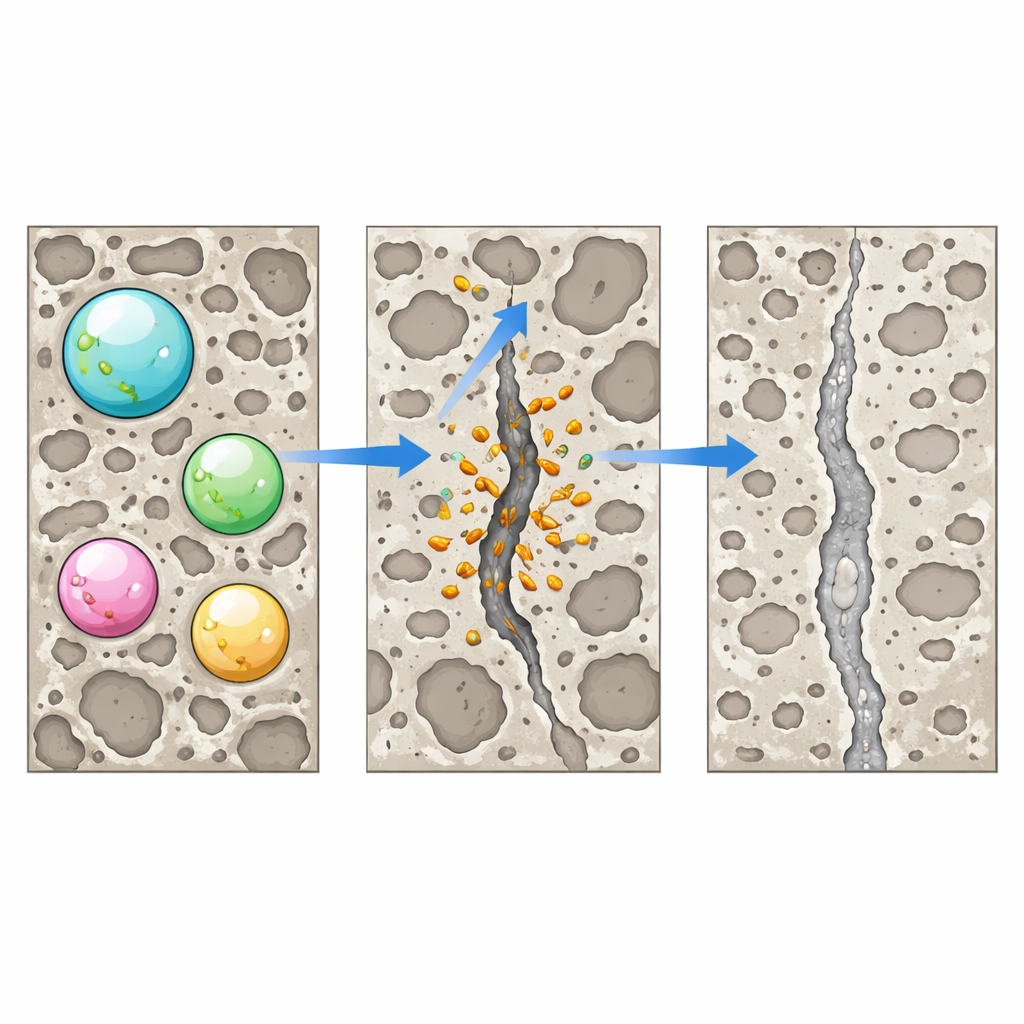
Making Concrete More Resistant to Damage
To see how well the concrete would stand up to long‑term attack from water and dissolved salts, the team measured electrical resistivity, a property linked to how easily damaging substances can move through the material. Higher resistivity generally means a tighter, less leaky network of pores. The standard concrete had the lowest resistivity, while the mix with both polymers and bacteria showed the highest, about half again as large. This suggests that its internal pathways for water and ions are more effectively blocked by the combination of slow, steady curing from within and bacterial filling of pores and micro‑cracks. A clear trend emerged: mixes that shrank less and had denser internal structures also showed greater strength and higher resistivity.
What This Means for Future Buildings
By pairing water‑storing polymer grains with crack‑healing bacteria, this research offers a practical recipe for concrete that shrinks less, carries more weight, and is better protected against long‑term damage. For communities where clean water is limited, this approach could reduce the need for prolonged external curing while extending the useful life of bridges, buildings, and other structures. To a layperson, the message is straightforward: by letting concrete carry its own mini water tanks and built‑in repair crew, we can build structures that are sturdier, safer, and more sustainable over time.
Citation: Vijay, K., Sarma, V.V.S., Kuruva, V. et al. A bio-polymeric strategy for enhancing the strength, durability of concrete and shrinkage reduction. Sci Rep 16, 11346 (2026). https://doi.org/10.1038/s41598-026-38804-0
Keywords: self-healing concrete, superabsorbent polymers, bacterial concrete, crack reduction, durable infrastructure