Clear Sky Science · en
Evaluation of deformable image registration vs offline adaptive replanning in post-op oral cavity cancer treated with volumetric modulated Arc therapy
Why this matters for people with mouth cancer
Radiation after surgery is a key part of treatment for many people with cancers of the mouth, but the shape of the head and neck can change a lot during the several weeks of therapy. This study asks a practical question with real-world impact: can a newer, faster computer method safely update radiation plans on the fly, or do doctors still need to redo the full plan the old-fashioned way to protect healthy tissues while not missing the tumor area?
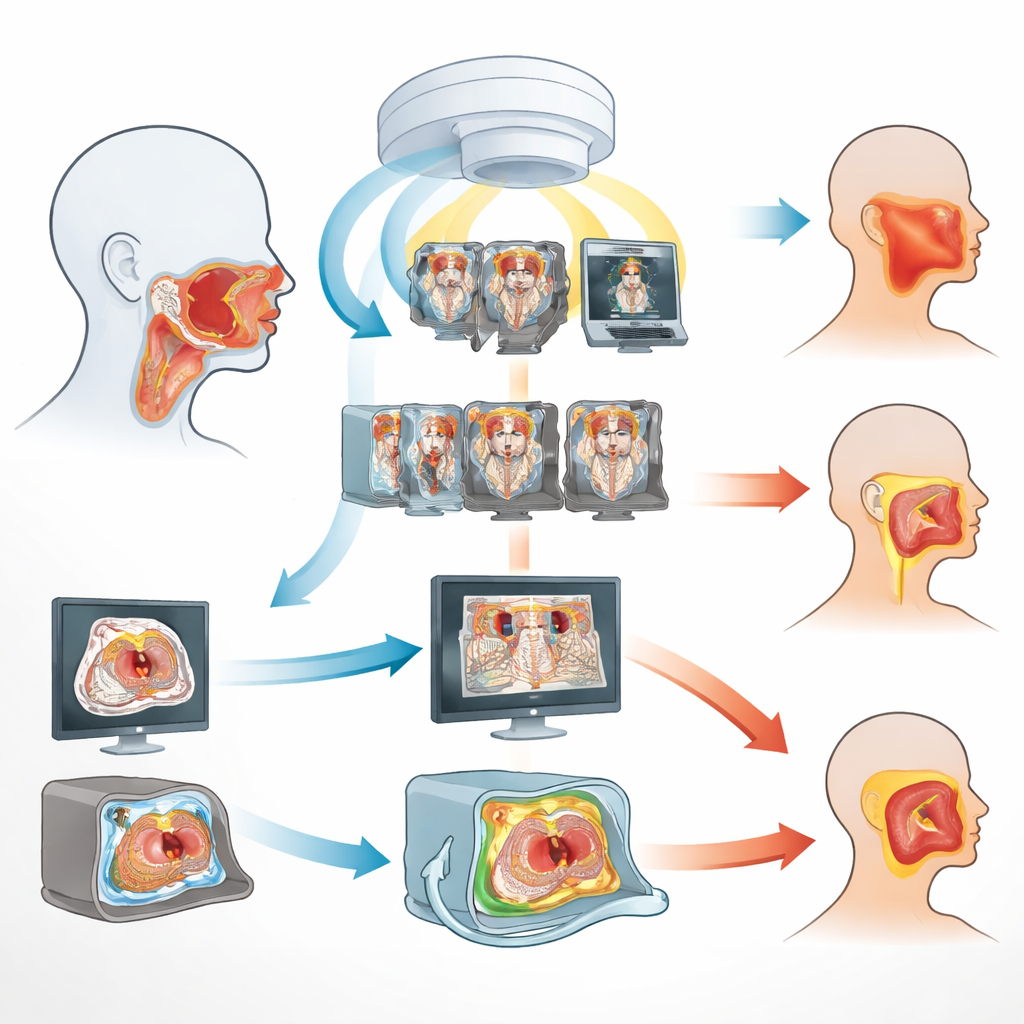
How cancer treatment plans can fall out of date
After surgeons remove an oral cavity tumor, patients usually receive weeks of radiation to lower the risk of the cancer returning. Modern techniques such as volumetric modulated arc therapy can wrap the high-dose region tightly around the area at risk while reducing exposure to nearby organs like the spinal cord, jawbone, salivary glands, and voice box. But over the course of treatment, people often lose weight and swelling goes down. As a result, both the body outline and internal tissues shrink or shift. If the original radiation plan is used unchanged, some of the intended target may no longer get the full dose, while sensitive organs can unexpectedly receive more radiation than intended.
Two ways to update a radiation plan
Clinics can respond to these changes in two main ways. The traditional approach, called conventional adaptive replanning, performs a new CT scan, has doctors manually redraw all the key structures, and then creates a fresh plan. This is accurate but slow and labor intensive. The newer approach uses deformable image registration, in which software mathematically "warps" the original planning scan to match a cone-beam CT taken on the treatment machine. This produces a synthetic CT that reflects the patient’s current anatomy while keeping the original image quality. The original outlines of the target and organs are automatically carried over and then adjusted by hand if needed, potentially saving days of work.
Putting the two methods to the test
The researchers prospectively studied 25 patients who had surgery for oral cavity squamous cell carcinoma and were receiving postoperative radiation, often with chemotherapy. They enrolled patients whose cone-beam images showed at least a 5-millimeter change in body outline, signaling meaningful anatomical change. For each patient, they created one adaptive plan based on a full repeat CT (the conventional method) and another based on the synthetic CT produced by deformable registration. They then compared how closely these plans matched each other in terms of volumes of targets and organs, how well the targets were covered by the intended dose, and how much dose critical organs received. They also checked how accurately the software could reshape structures, using standard measures of overlap and boundary agreement.
What the study found about dose and safety
As expected, most targets and organs shrank over the course of treatment, confirming that some form of adaptation is needed. When the team simply projected the original plan onto the updated anatomy, the coverage of the low-risk target region dropped significantly, and some organs, especially the jawbone, saw higher doses. Comparing the two adaptive methods showed a trade-off. Plans made directly on the synthetic CT tended to spare organs at risk slightly better, particularly the voice box and salivary glands. However, these same plans provided poorer coverage of both high-risk and low-risk target regions: the portion of the target receiving the intended dose and the near-minimum dose values were consistently lower than in plans based on a full repeat CT. The deformable method also struggled with certain structures, such as the spinal cord and very large target volumes, where shape changes were more complex.
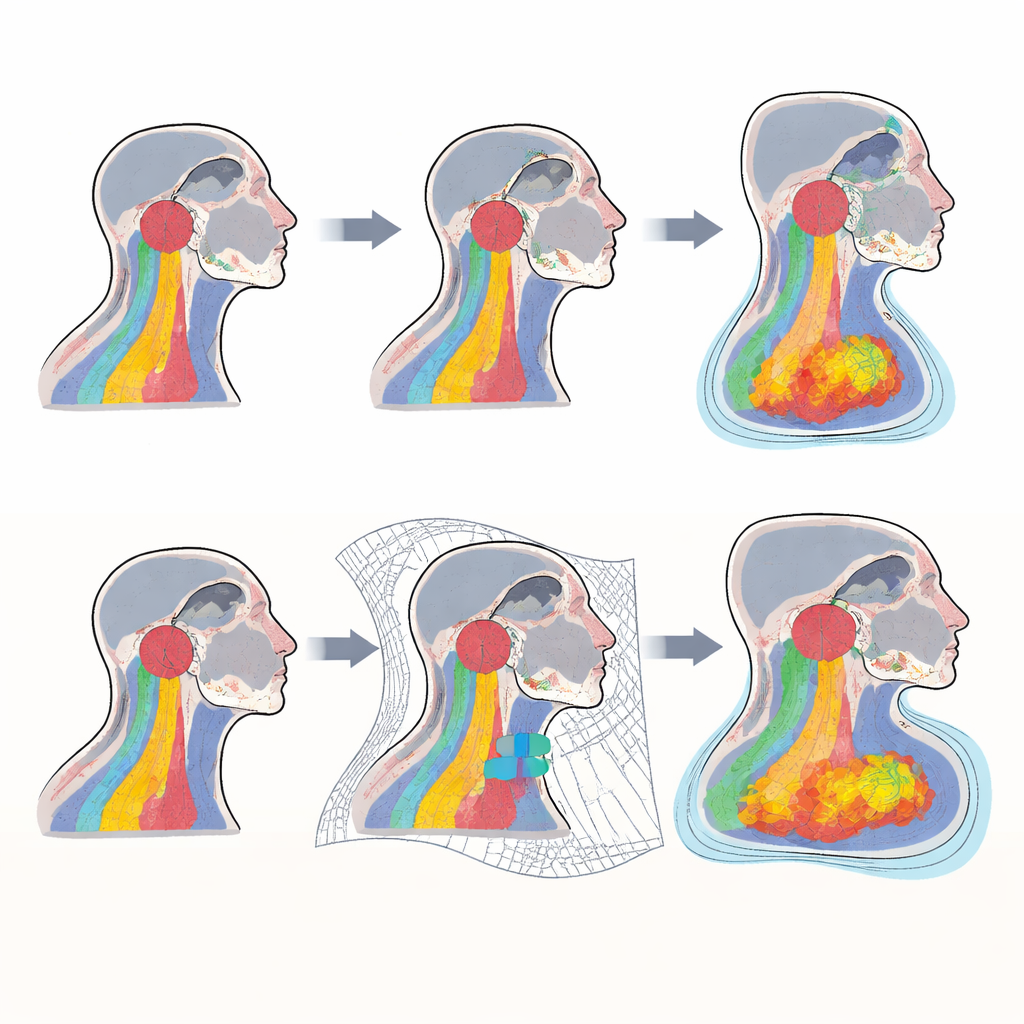
What this means for patients and future care
For now, the study concludes that while deformable registration–based planning can speed up the workflow and slightly reduce radiation to healthy tissues, it may not reliably deliver full dose to all the areas at risk of cancer returning. Until the underlying software becomes more accurate—especially for large or tricky structures—this faster method should not completely replace full adaptive replanning in postoperative mouth cancer. Instead, deformable tools are best used today to track how the delivered dose changes over time and to help decide when a full, carefully checked new plan is truly needed.
Citation: Dokania, S., Mukherji, A., Nanda, S.S. et al. Evaluation of deformable image registration vs offline adaptive replanning in post-op oral cavity cancer treated with volumetric modulated Arc therapy. Sci Rep 16, 10406 (2026). https://doi.org/10.1038/s41598-026-38776-1
Keywords: adaptive radiotherapy, head and neck cancer, oral cavity carcinoma, deformable image registration, treatment replanning