Clear Sky Science · en
Autonomous nursing professional development framework using blockchain technology
Keeping Nurses’ Skills Up to Date
When you are in a hospital bed, you want every nurse who cares for you to be fully trained and up to date on the latest practices. Yet behind the scenes, tracking all the courses, licenses, and certifications that nurses earn is a complex and paperwork-heavy job. This article explores a new way to manage nursing credentials using blockchain, a technology best known from digital currencies, to make professional development more secure, transparent, and easier for both nurses and hospitals.
Why Nursing Credentials Are Hard to Manage
Nurses are required to complete many training programs throughout their careers, from trauma care to ethics and digital health. In many healthcare systems, including Taiwan’s, they must accumulate a set number of points over several years to keep their licenses active. Traditionally, these records are spread across hospital databases, professional associations, and third-party course providers. Human resource offices must manually check whether each nurse meets government and internal rules, which is time-consuming and prone to errors. Existing digital systems are usually centralized, meaning that a single database and administrator control all the information, raising concerns about data tampering, privacy, and system failures.
What Blockchain Can Add to the Picture
Blockchain offers a different approach. Instead of storing all credential details in one place, it records tamper-evident summaries of those records across a network of computers. Once information is written to the chain, it cannot be changed without leaving a trace. Smart contracts—small programs that run automatically on the blockchain—can check whether a nurse’s training meets agreed rules. Previous work has applied blockchain to hiring, pay, and training in business settings, and to medical records in healthcare. However, little attention has been paid to frontline staff such as nurses, or to how they could directly use the technology to steer their own professional growth while still satisfying regulators.
A New Three-Layer System for Nurses
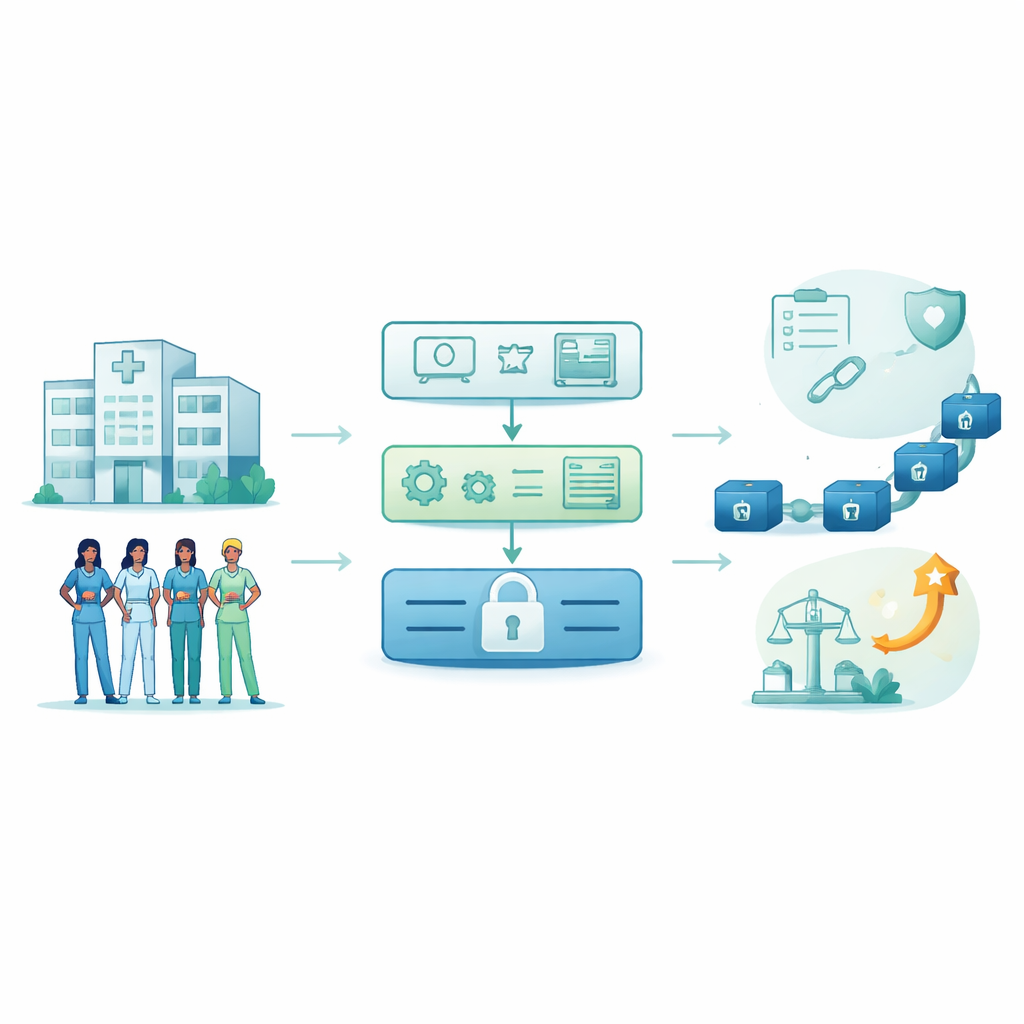
The authors introduce a framework called BCeANPDF that gives nurses more control over their professional development while helping hospitals meet oversight demands. The design has three layers. At the top, an interaction layer defines what nurses, hospital human resource staff, and nursing association officers are allowed to do—such as creating, reading, or updating credential records and requesting compliance checks. In the middle, a service layer handles sign-in, permissions, and the logic that decides which data should be sent to or read from the blockchain. At the bottom, a storage layer combines ordinary databases, where detailed records like course names and dates are kept, with a private blockchain that stores secure digital fingerprints—or hashes—of those credentials plus a set of smart contracts that can automatically evaluate them.
How Credentials Are Secured and Checked
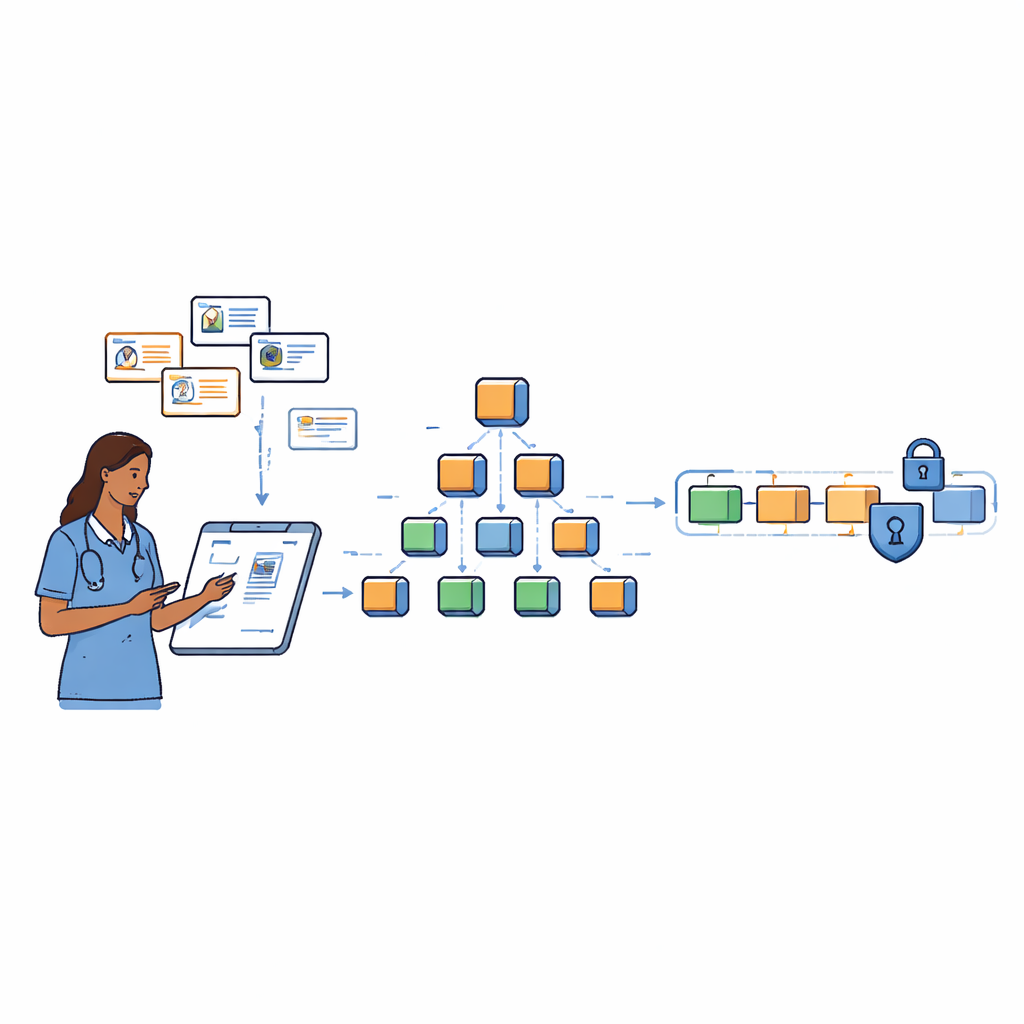
When a nurse completes a course, the hospital or nursing association creates a record in the database. The nurse can then trigger an “on-chain” operation that turns key parts of that record into a hash and organizes it into a tree-like structure, whose top value is placed into a blockchain block. Personal identifiers are carefully scrambled so that sensitive details never appear directly on the chain. Smart contracts ensure that only the rightful nurse can upload their own credentials, and that no one else can quietly alter them. Other contracts total up professional and non-professional training points for a single nurse, or across an entire hospital, and compare them with thresholds set by ministries or internal policies. Human resource managers can quickly see which departments are on track, which nurses still lack points, and whether the organization as a whole is ready for inspections, all without sifting through piles of paperwork.
Testing Performance in a Realistic Setting
To see whether this framework could work at scale, the researchers built a prototype using an Ethereum-like private blockchain and tested it with thousands of simulated nurses and hundreds of thousands of credentials. They measured how long it took to upload credentials and to look them up later. On average, each credential took about 12 seconds to be written to the chain—similar to what is seen on major public blockchain networks—while lookup times were only a few thousandths of a second, thanks to the local network setup. These results suggest that the system can comfortably handle typical hospital workloads, where training records are created in batches rather than every second, while providing strong guarantees against tampering.
What This Means for Patients and Hospitals
For the general public, the key message is that this kind of system can make it easier to trust that the nurses by your bedside truly meet current professional standards. Nurses gain a clearer, more autonomous way to track their own growth and plan future training, even if they move between departments or hospital branches. Administrators gain fast, reliable oversight without extra bureaucracy, and regulators can audit compliance with greater confidence. The authors note that future versions could link multiple hospitals, add artificial intelligence to suggest tailored learning paths, and use advanced privacy tools. Even in its current form, however, the proposed framework shows how blockchain can support a safer, more transparent, and competency-focused healthcare environment without making daily operations more complicated.
Citation: Lin, CC., Lin, YH. & Hsu, IC. Autonomous nursing professional development framework using blockchain technology. Sci Rep 16, 11825 (2026). https://doi.org/10.1038/s41598-026-38750-x
Keywords: nursing credentials, blockchain, professional development, healthcare workforce, smart contracts