Clear Sky Science · en
CRISPR/Cas9-mediated mutagenesis of SMXL4 alters plant height and yield-related traits in rice (cv. Samkwang)
Why shorter rice plants matter
As storms grow stronger with climate change, rice farmers face a familiar but worsening problem: tall plants that topple over before harvest. This lodging not only makes mechanical harvesting difficult, it also slashes both yield and grain quality. The Korean variety Samkwang is popular for its good taste and productivity, but its tall, slender stems leave it especially vulnerable. This study explores whether precise gene editing can gently shorten Samkwang plants while keeping their desirable traits, offering clues for breeding rice that stands firm when the weather does not.
Editing a single gene in a favorite rice variety
The researchers focused on a gene called SMXL4, part of a larger gene family known to influence plant growth and the development of the phloem, the tissue that transports sugars from leaves to grains. Using the CRISPR/Cas9 gene-editing system, they created a mutation in SMXL4 within the Samkwang genetic background. From more than a hundred edited lines targeting many different genes, they selected one SMXL4-edited line, called smxl4, that showed stable growth and clearly reduced plant height in field trials. DNA analysis confirmed a tiny insertion in the SMXL4 gene that disrupted its normal code, and follow-up checks indicated that no detectable off-target changes had been introduced elsewhere in the genome.

How the edited plants look and yield in the field
When grown side by side with unedited Samkwang, the smxl4 plants were consistently shorter throughout the growing season. Their stems (culms) and the flowering heads (panicles) were both reduced in length, and several of the upper internodes—the segments between stem joints—were noticeably shorter. At the same time, smxl4 produced more panicles per plant than Samkwang, suggesting a shift in how the plants allocate their growth. Yet the total grain output per plot was lower: each panicle carried fewer grains, and the average grain weight dropped. Interestingly, the grains themselves were similar in size and shape, indicating that the difference likely lies in how well they fill, not in their external form.
Hidden changes in seeds and roots
The gene edit also left its mark on early growth stages. In germination tests, seeds from smxl4 and Samkwang sprouted at similar rates during the first two days, but the edited line lagged behind on later days, ending up with a noticeably lower final germination percentage. Young seedlings of smxl4 developed shorter roots, even though their shoots reached similar heights as the original variety. These findings suggest that SMXL4 influences not only stem elongation but also how seeds wake up from dormancy and how roots establish themselves—traits that matter for uniform crop stands and resilience under stress.
What happens inside the stems
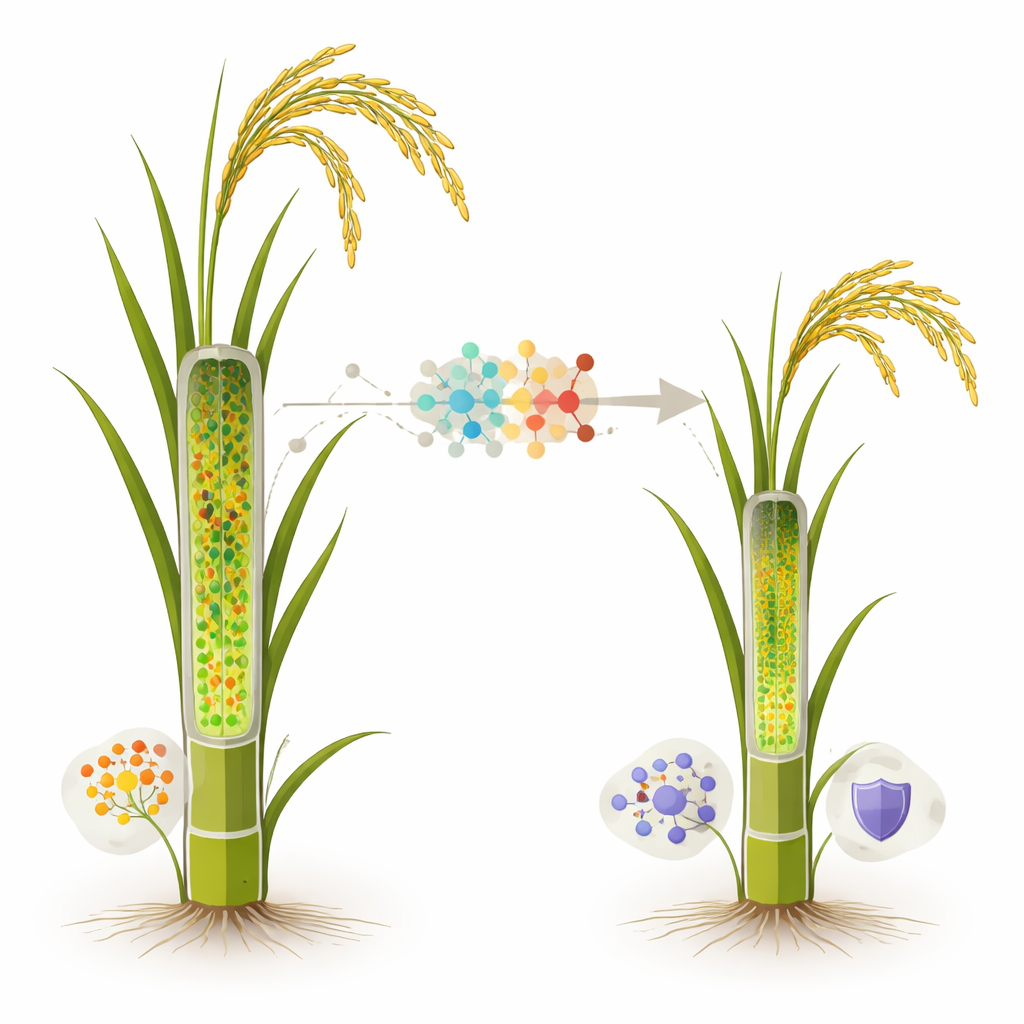
To understand the inner workings behind the altered plant shape, the team compared gene activity in elongating stem segments from smxl4 and Samkwang at two key stages, just before and just after the panicles emerged. They found fewer than a few hundred genes whose activity changed significantly, but a clear pattern emerged. Many genes linked to cell wall building and remodeling, including enzymes that shape or break down wall components, were more active in the edited plants. Another large group of genes involved in defense responses—such as those associated with disease resistance and protective chemicals—was also turned up. Contrary to what one might expect, classic growth-promoting genes for elongation were not broadly turned down. The authors propose that the plant may be compensating for altered development by strengthening cell walls and priming defenses, hinting at a trade-off between growth and protection.
Implications for future rice breeding
The study shows that knocking out SMXL4 reliably produces shorter Samkwang plants but at the cost of reduced yield and some early growth drawbacks. This means smxl4 itself is unlikely to be a ready-made solution for farmers seeking storm-proof rice. However, the work reveals SMXL4 as a key regulator of rice growth, seed behavior, root development, and the balance between growth and defense. By better understanding how SMXL4 influences phloem function and cell wall dynamics, breeders and biotechnologists may eventually learn to fine-tune its activity—rather than fully disabling it—to design rice varieties that stay standing in harsh weather while still filling their grains efficiently.
Citation: Kim, Y., Jun, Y., Han, J. et al. CRISPR/Cas9-mediated mutagenesis of SMXL4 alters plant height and yield-related traits in rice (cv. Samkwang). Sci Rep 16, 12381 (2026). https://doi.org/10.1038/s41598-026-38708-z
Keywords: rice lodging, CRISPR gene editing, plant height, yield traits, SMXL4