Clear Sky Science · en
Symbiotic state affects microbiome recovery in a facultatively symbiotic cnidarian
Why tiny sea anemones matter for coral health
Coral reefs depend on a delicate partnership between animals, microscopic algae that live in their tissues, and a bustling community of bacteria and other microbes. When heat waves, pollution, or disease disturb this balance, reefs can bleach and die. This study uses a small sea anemone, Aiptasia, as a stand-in for corals to ask a crucial question: after a disturbance that wipes out many of their bacteria, can these animals rebuild a healthy microbiome—and does it matter whether they still have their algal partners?
Three partners in one tiny animal
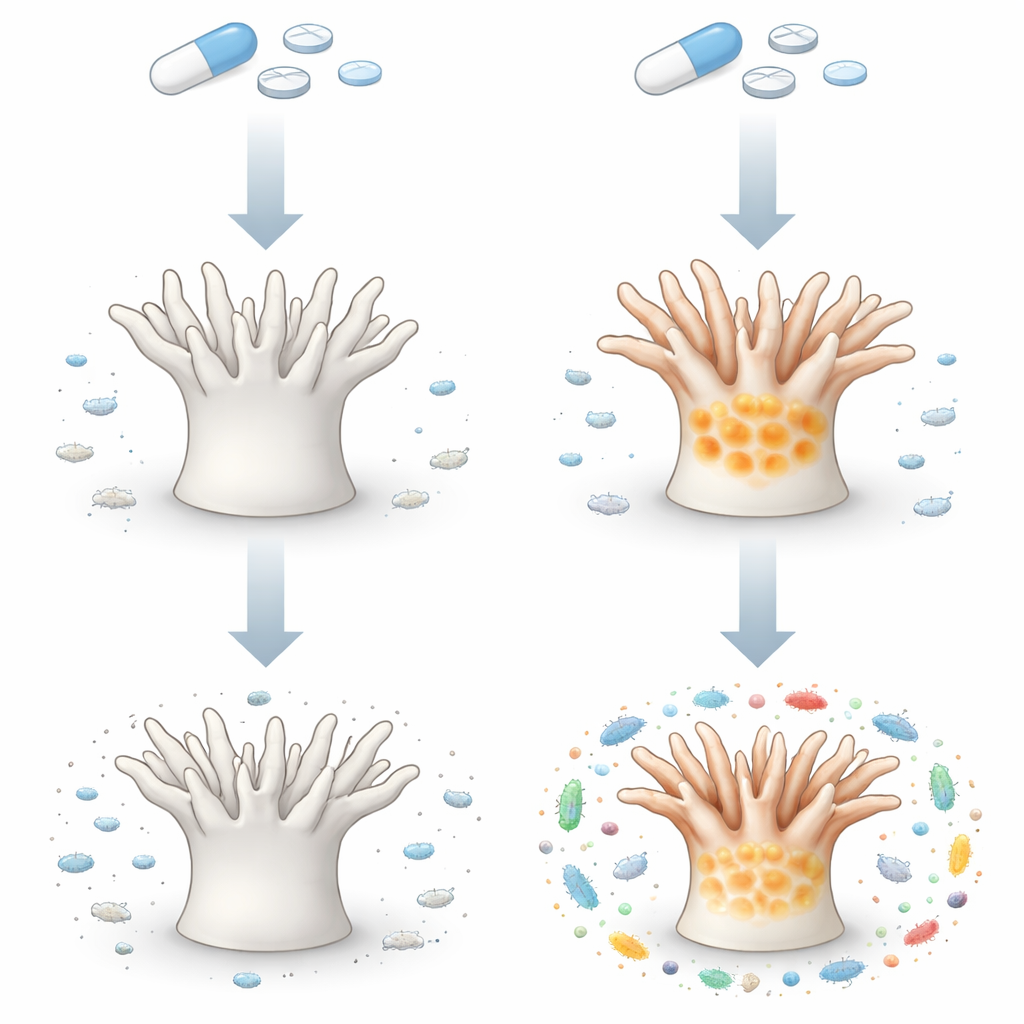
Like corals, Aiptasia is a “holobiont”: a mini-ecosystem made of the animal host, photosynthetic algae that provide food, and a diverse microbiome living on and inside them. The authors compared two versions of this system. In the symbiotic state, the anemones hosted their normal algae. In the aposymbiotic state, the algae had been removed, mimicking a bleached coral. Both types were treated with a cocktail of antibiotics to dramatically reduce their bacteria. The team then tracked how bacterial communities and host biology changed over a week of recovery, using bacterial DNA sequencing, measurements of bacterial abundance, and gene and protein analyses in the host.
Different recoveries for different states
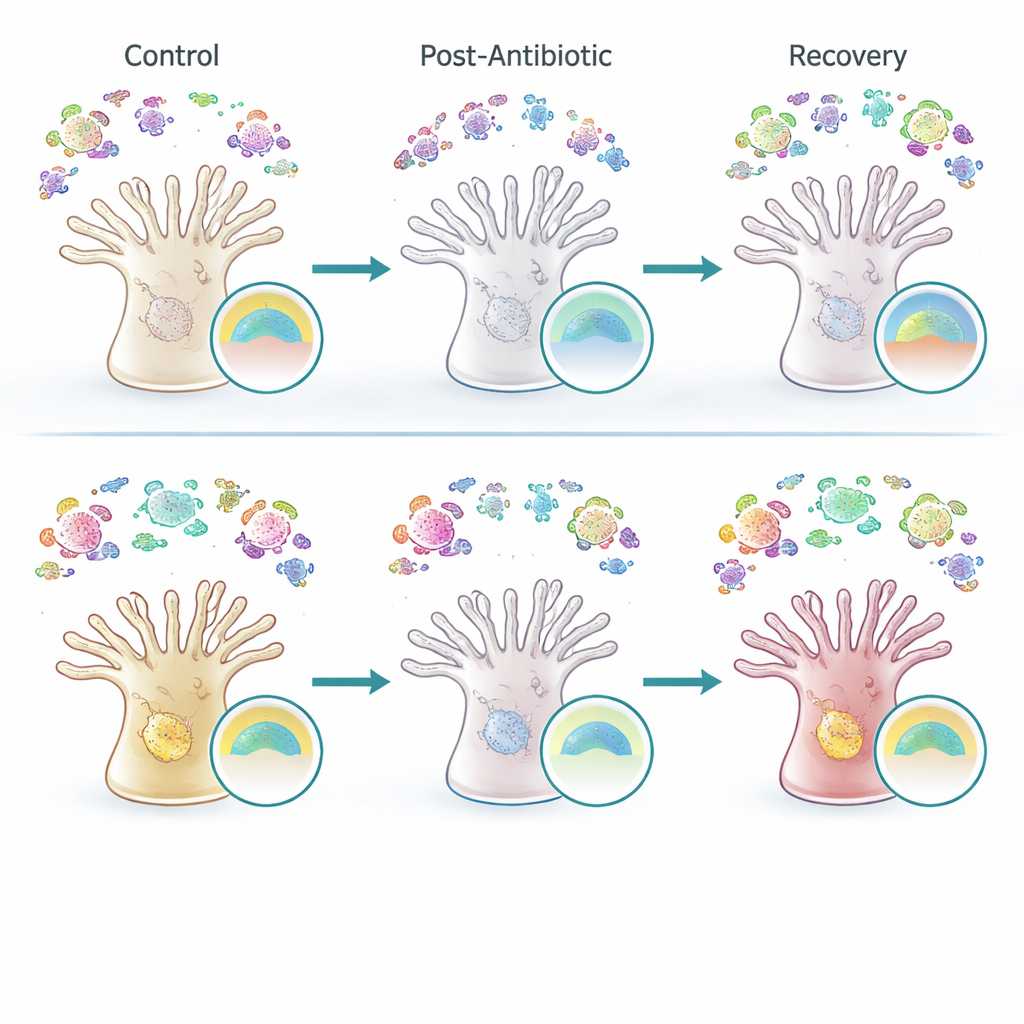
Antibiotics sharply reduced the number of bacteria in both symbiotic and aposymbiotic anemones, but the total bacterial load rebounded within two days in both groups. Beneath this apparent recovery, however, the details told a different story. In symbiotic anemones, the overall mix of bacterial types gradually shifted back toward the original, “control-like” community. In contrast, aposymbiotic anemones rebuilt a community that remained clearly different from their starting point even after seven days. Measures of diversity and evenness showed that the structure of the microbiome responded in opposite ways in the two states, suggesting that having algal partners helps stabilize which bacteria return after disturbance.
A key bacterial family tied to algae
One bacterial group, the family Endozoicomonadaceae, emerged as especially important. These bacteria are often linked with healthy corals and other marine invertebrates. In aposymbiotic anemones, Endozoicomonadaceae plummeted after antibiotic treatment and stayed scarce through the recovery period. In symbiotic anemones, by contrast, their relative abundance actually rose shortly after treatment and then drifted back toward control levels. This pattern suggests that these bacteria may be closely associated with the algae themselves, perhaps living in protected spaces near or within algal-containing cells. When algae are present, Endozoicomonadaceae may be partly shielded from antibiotics and better able to regrow; when algae are gone, these bacteria cannot easily return.
The immune system steps back—while one player steps up
The researchers also examined how the anemones’ own genes responded to microbiome loss and recovery. They found broad changes in gene activity, with symbiotic animals showing especially strong shifts. Early in recovery, genes involved in immune processes—pathways that help distinguish friend from foe among microbes—were generally turned down in both symbiotic and aposymbiotic anemones. This immune “quieting” may be a way to let beneficial bacteria reestablish themselves without being attacked. Yet one immune-related protein, the transcription factor NF-κB, behaved differently: its active form increased in both states after antibiotic exposure and stayed elevated during recovery. Because NF-κB is controlled at the protein level rather than only by its gene, its rise despite lower immune gene activity hints that it may also act as a general stress responder, not just as a classic immune switch.
What this means for reefs and their future
This work shows that an animal’s relationship with its algae strongly shapes how its microbial partners recover from disruption. Symbiotic Aiptasia, with algae intact, more effectively rebuilt a familiar microbiome and maintained a key beneficial bacterial group, while aposymbiotic anemones shifted toward a new community. At the same time, both states temporarily dampened many immune pathways, likely to permit recolonization, even as NF-κB levels rose. For reef conservation efforts that use antibiotics or probiotics to combat coral disease, these findings underscore that treatments interact with all three partners—host, algae, and bacteria. Designing strategies that respect and harness these interconnected relationships may be essential for helping corals weather a rapidly changing ocean.
Citation: Valadez-Ingersoll, M., Bodnar, C.A., Feng, E.X. et al. Symbiotic state affects microbiome recovery in a facultatively symbiotic cnidarian. Sci Rep 16, 11026 (2026). https://doi.org/10.1038/s41598-026-38684-4
Keywords: coral microbiome, symbiosis, sea anemone model, antibiotic disturbance, reef resilience