Clear Sky Science · en
Automated slope stability assessment using modified Morgenstern-Price method and machine learning integration
Why safer slopes matter
Landslides and collapsing slopes can close highways, damage mines and dams, and put nearby communities at risk. Engineers try to prevent such disasters by estimating how close a slope is to failure, but detailed calculations and computer simulations can be slow when many possible soil and earthquake conditions must be checked. This study introduces an automated system that blends a trusted engineering method with modern machine learning so that slope safety can be assessed quickly and consistently across thousands of scenarios.
Bringing classic know-how and new tools together
The authors focus on what engineers call the “factor of safety,” a single number that compares the forces trying to make a slope slide with the forces holding it in place. They start from a well-established technique known as the Morgenstern–Price method, which slices a hill into many vertical strips and balances the forces on each strip, including soil strength, the weight of the ground, water pressure, and shaking from earthquakes. Because this method is both rigorous and widely trusted, it serves as the physical backbone of the new framework. The team simplifies the equations just enough to make them efficient for large-scale use, while still accounting for important effects such as water in the soil and horizontal and vertical earthquake forces. 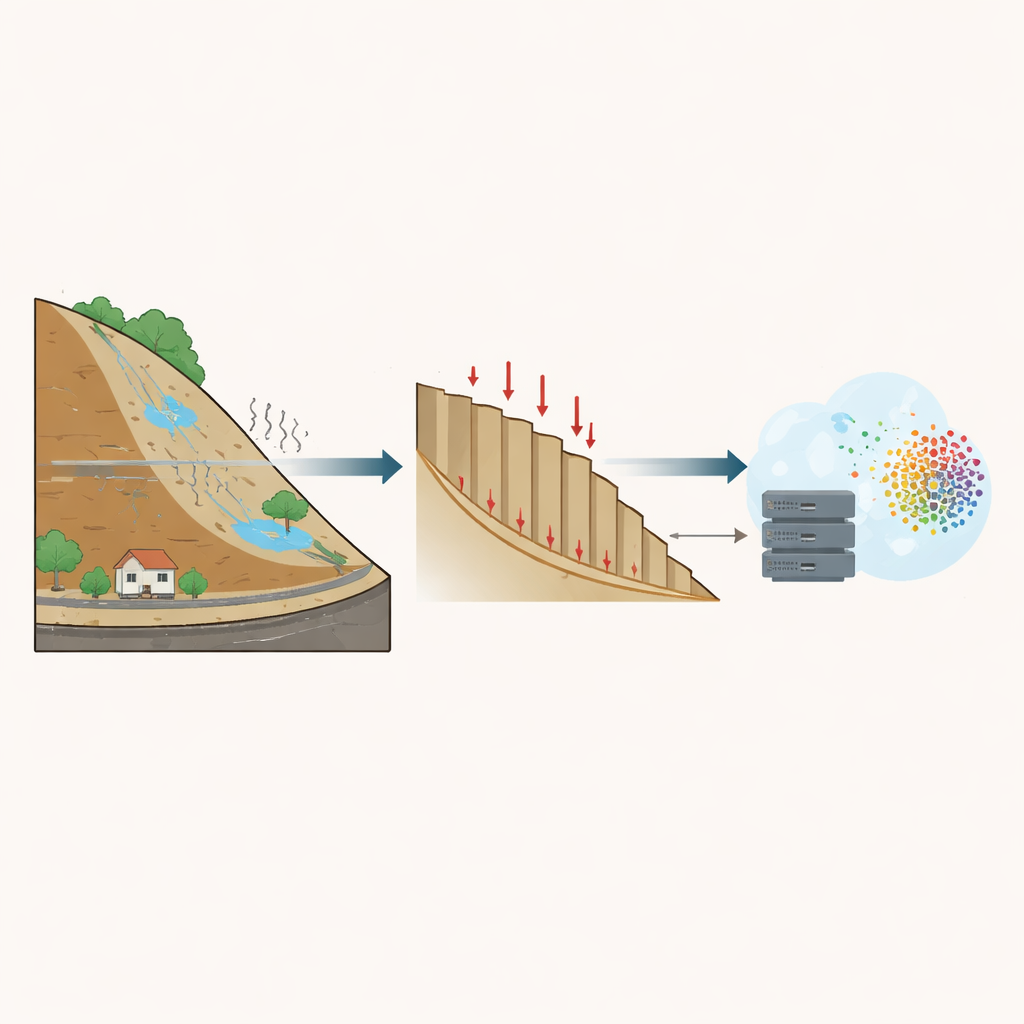
Building a virtual world of slopes
Instead of waiting for rare real-world failures, the researchers created a huge synthetic dataset of about 100,000 “virtual” slopes. Each case varies key ingredients: soil weight, slope height and angle, cohesion and friction (which control shear strength), water pressure, and earthquake intensity, along with a factor that approximates forces between neighboring slices. For each of these artificial slopes, the simplified Morgenstern–Price method computes a factor of safety. The team then cleans and prepares the data, trimming unrealistic extremes, normalizing numerical ranges, and splitting the collection into training and testing sets. This careful preparation ensures that the machine-learning models see a realistic spread of stable, borderline, and unstable slopes and that conclusions are statistically sound rather than artifacts of noisy data.
Letting the data reveal what matters most
With the synthetic slopes in hand, the authors ask which properties most strongly control stability. Using feature-importance measures from tree-based machine-learning models, they perform a global sensitivity analysis. The results align with engineering intuition: the steepness of the slope is by far the dominant factor, followed by its height and the cohesive strength of the soil. Friction angle and water pressure also matter, especially under wet or saturated conditions, while the vertical component of earthquake shaking has a noticeable but smaller effect in the tested range. Other inputs, such as soil unit weight and the scaling factor representing slice interactions, have relatively minor influence within the chosen limits. These findings give practical guidance: designers should invest most effort in measuring and controlling the geometry and shear strength of a slope, and in managing water, which erodes the margin of safety.
Training machines to mimic physics
Next, nine different machine-learning algorithms are trained to predict the factor of safety directly from the slope inputs, using the physics-based calculations as the teaching signal. These include neural networks, decision trees, random forests, and several modern “boosting” methods that combine many simple models into a powerful ensemble. All models undergo systematic tuning and cross-checking with multiple performance scores to avoid overfitting. Many perform very well, but one algorithm, CatBoost, stands out: on unseen test data it reproduces the factor of safety with near-perfect accuracy, while remaining more stable than simpler tree models that tend to memorize the training set. 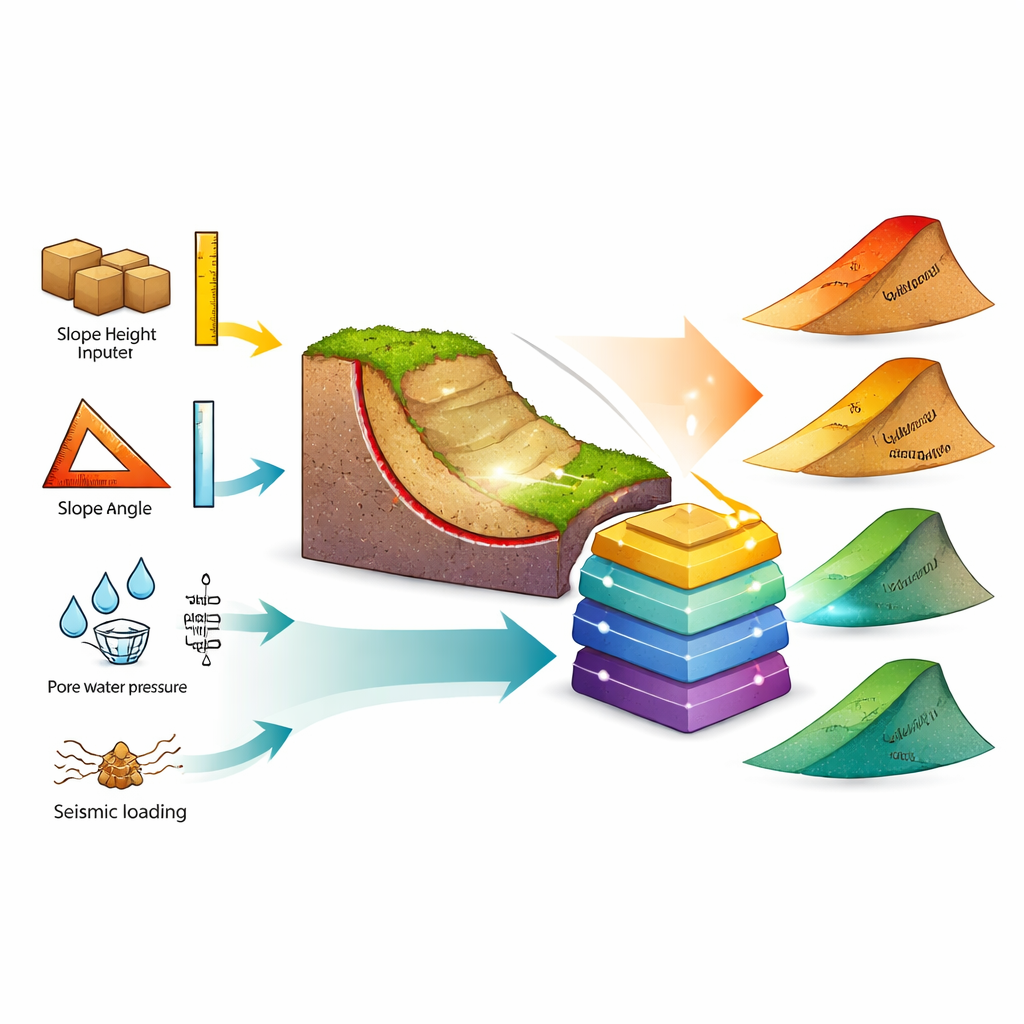
An automated helper, not a crystal ball
Finally, the authors wrap the entire process—from generating synthetic slopes and running the Morgenstern–Price calculations to training, evaluating, and selecting the best machine-learning model—into a reusable Python-based pipeline. This automated framework can very rapidly estimate slope safety across vast combinations of soil, geometry, water, and earthquake conditions, making it attractive for screening designs, exploring “what-if” scenarios, or supporting real-time decision tools. However, the system is only as general as the assumptions behind it: the slopes are treated as two-dimensional and made of uniform soil, and the machine learning learns to imitate the Morgenstern–Price method, not to predict actual field performance directly. The authors therefore see their work as a fast, scalable decision-support tool that complements, rather than replaces, detailed numerical simulations and site-specific investigations.
Citation: Showkat, M., Ghani, S., Paramasivam, P. et al. Automated slope stability assessment using modified Morgenstern-Price method and machine learning integration. Sci Rep 16, 9952 (2026). https://doi.org/10.1038/s41598-026-38670-w
Keywords: slope stability, landslide risk, geotechnical engineering, machine learning, earthquake hazards