Clear Sky Science · en
Copper oxide tailors multifunctional properties of fluorobarioborate glasses for optical dielectric and shielding applications
Clear Shields for Invisible Hazards
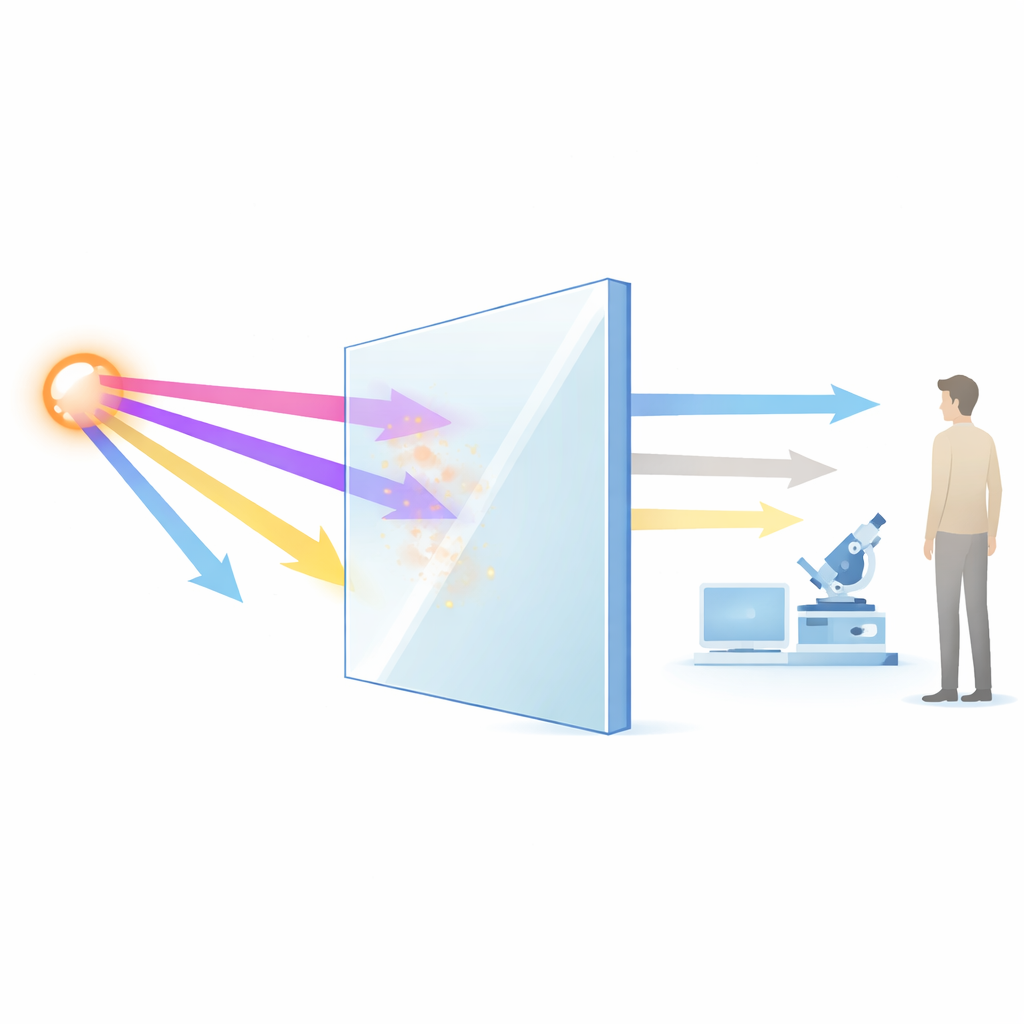
Modern hospitals, research labs, and nuclear facilities rely on thick walls and heavy windows to keep X-rays and gamma rays from harming people. Traditionally, those shields have been made with toxic lead. This study explores a new family of copper‑containing glasses that could do the same job more safely, while staying transparent and even storing electrical energy. These copper fluorobarioborate (CFBB) glasses are designed to block dangerous radiation, handle electrical fields, and pass light in useful ways, all at once.
Building a Safer Type of Glass
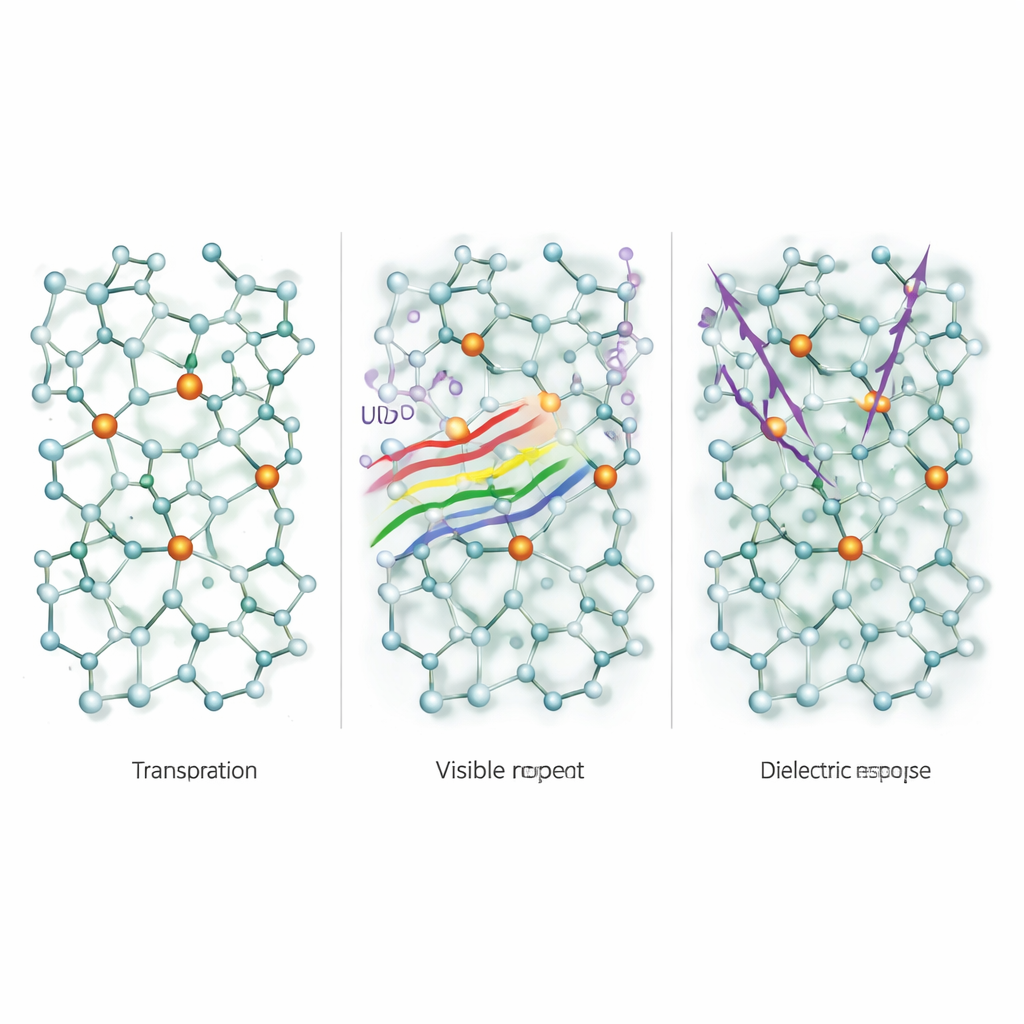
The researchers created CFBB glasses by melting and rapidly cooling a mixture of boron oxide, barium oxide, magnesium fluoride, and a very small amount of copper oxide. By changing the copper content from 0 to 0.5 mol%, they could probe how much copper the glass network can accept without losing its structure. X‑ray diffraction and infrared measurements showed that, up to about 0.3 mol% copper, the glass remains fully amorphous—the atoms are disordered like a frozen liquid, with a stable backbone made of boron‑oxygen units. Only at the highest copper level does a sharp diffraction peak appear, signaling tiny crystals starting to form and marking the practical limit of how much copper the network can comfortably host.
Letting Light Through While Taming It
Optical tests revealed that these glasses stay transparent across the visible range but interact strongly with ultraviolet light. As copper is added, the glass absorbs more in the UV region between about 200 and 350 nm, which is where many damaging wavelengths lie, while the fundamental optical band gap remains almost unchanged around 3.5–3.6 eV. This means copper introduces local “traps” that soak up UV without turning the whole material dark or cloudy. In practice, a window made from this glass could protect eyes and instruments from harsh UV radiation yet still appear clear and color‑neutral, a valuable combination for protective viewports and optical devices.
Quietly Conducting and Storing Charge
The same tiny copper additions also transform the electrical behavior of the glass. Measurements over a wide range of frequencies show that the material moves from being an excellent insulator toward a weak semiconductor as copper content increases. The direct current conductivity rises by roughly three orders of magnitude, mainly through hopping of charge between copper sites and neighboring ions. At low frequencies, the glass with the most copper displays a remarkably high dielectric constant—around 700—due to the way charges pile up and reorient within the disordered network. This kind of response is promising for components that must store electric energy, smooth out signals, or interact with high‑frequency fields while still being optically clear.
Stopping Gamma Rays in Their Tracks
To judge how well these glasses stop high‑energy photons, the team calculated key shielding parameters such as mass and linear attenuation coefficients, effective atomic number, mean free path, and build‑up factors over a broad energy range from 0.015 to 15 MeV. The results show strong attenuation at low photon energies dominated by photoelectric absorption, with performance gradually shifting to Compton scattering as energy rises. Increasing copper content systematically improves shielding: the glass with the highest copper level has the largest attenuation coefficients, the shortest distance a photon travels before interacting, and the smallest half‑value and tenth‑value layers. In other words, thinner panels of these glasses can reduce gamma‑ray intensity to safe levels, making them competitive with traditional lead‑based shields.
One Material, Many Jobs
Taken together, the findings demonstrate that carefully adjusted amounts of copper allow CFBB glasses to combine three desirable traits: clear transmission of visible light with strong UV blocking, tunable electrical response with very high low‑frequency permittivity, and effective gamma‑ray shielding in a lead‑free, glassy matrix. The work also pinpoints a practical copper limit—about 0.3 mol%—beyond which the glass begins to partially crystallize. For lay users, the message is straightforward: it is now possible to envision window‑like materials that let us see and measure what happens inside radiation‑rich environments while quietly protecting both people and electronics, without relying on heavy, toxic lead.
Citation: Abdelghany, A.M., Ramadan, R.M. & Abdelbaky, M. Copper oxide tailors multifunctional properties of fluorobarioborate glasses for optical dielectric and shielding applications. Sci Rep 16, 10902 (2026). https://doi.org/10.1038/s41598-026-38663-9
Keywords: radiation shielding glass, lead-free gamma protection, copper-doped borate glass, dielectric energy storage, transparent UV blocking