Clear Sky Science · en
Effects of particle size and moisture on respirable coal dust generation in pakistan’s informal bituminous mines
Why Coal Dust Matters for Everyone
Far from the giant, mechanized mines often seen in news photos, much of the world’s coal is still dug by hand in small, poorly ventilated tunnels. In Pakistan’s informal coal mines, workers spend long hours in dusty air that can scar their lungs for life. This study takes a close look at a basic but surprisingly tricky question: how do the size of coal particles and the moisture they hold influence how much dangerous dust is created—and how easily that dust can be tamed with water—under the hot, dry conditions common in these mines?
The Hidden World of Coal Dust
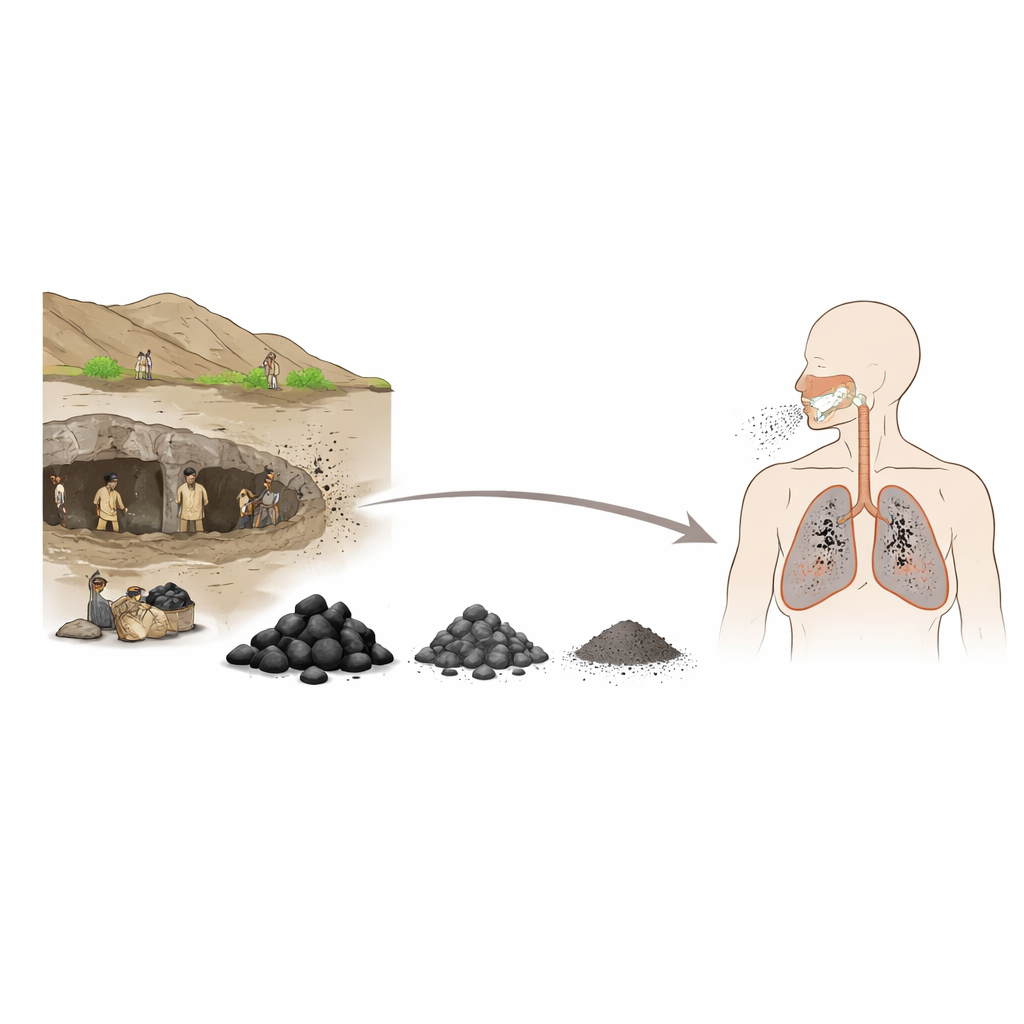
In the Akhorwal coalfield near Darra Adam Khel in northwest Pakistan, coal seams are thin, brittle, and riddled with fractures. Miners work in narrow, unventilated passages using hand tools and simple loading methods. These physical and operational conditions cause the coal to shatter into fine fragments that linger in the air as invisible clouds. The smallest particles are light enough to travel deep into the lungs, where they are linked to diseases such as coal workers’ pneumoconiosis and chronic bronchitis. Pakistan’s coals are also unusual: they contain high amounts of mineral ash and little natural moisture, and they are mined in a semi‑arid climate—features that differ from the coals on which most international dust-control guidelines are based.
From Rock to Dust in the Lab
To understand how this particular coal behaves, the researchers collected run‑of‑mine samples from working faces in Akhorwal and recreated mine-like conditions in the laboratory: high temperature, low humidity, and short drops that mimic shovel-to-cart handling. They then separated the coal into three size groups: coarse (>75 micrometers), medium (45–75 micrometers), and fine (<45 micrometers). For each group, they measured how much water the coal could hold, how the coal changed the acidity (pH) of water, and how readily water spread across compacted coal surfaces using precise droplet “contact angle” measurements. Because Pakistan lacks specialized test chambers for measuring airborne dust directly, the team combined their lab results with published relationships from similar studies to estimate, rather than measure, how effectively moisture could suppress dust.
What Particle Size and Moisture Really Do
The tests revealed a coal that is stubbornly dry and surprisingly water‑repellent. Fine particles did hold somewhat more moisture than coarse ones, reaching at best about 6.6 percent water by weight, but this difference was modest and not statistically strong. All fractions stayed well below the 8–12 percent moisture often seen in international benchmark coals, and below the roughly 8 percent moisture level that many studies suggest is needed for strong dust control. As particles became finer, the water around them shifted toward a near‑neutral pH, which the authors link to the greater exposure and partial dissolution of carbonate minerals such as calcite. Yet even as chemistry changed, the coal’s surfaces remained resistant to wetting: contact angles between about 72 and 109 degrees showed moderate to strong hydrophobic behavior, especially in the finest, most inhalable dust. Compaction, which mimics the pressing and packing that occurs during handling, tended to make surfaces even less welcoming to water.
Limits of Water-Only Dust Control
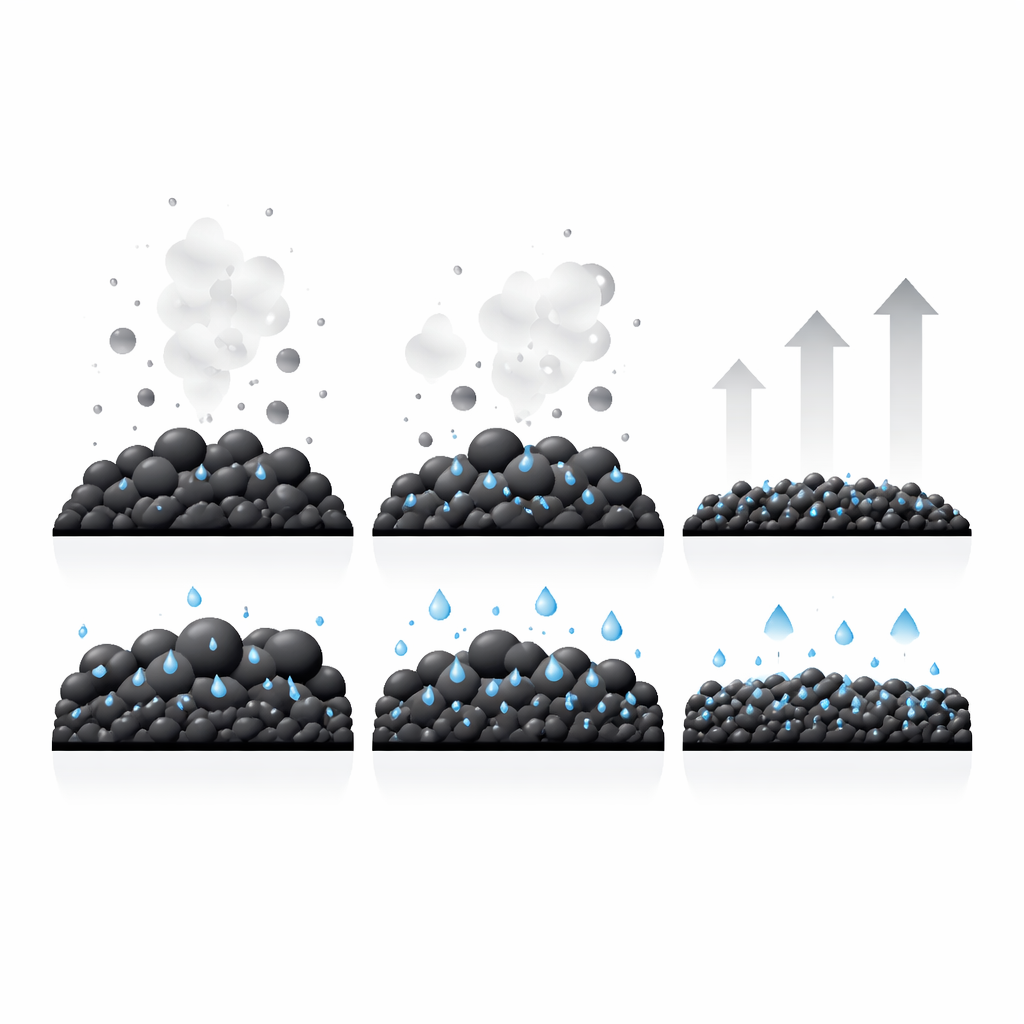
Using established models for high‑ash bituminous coal, the authors inferred that raising moisture from roughly 4 percent to the maximum 6.6 percent would cut dust levels by about 35–58 percent, depending on particle size and disturbance. This is helpful but far from complete protection for workers breathing the air. The combination of semi‑arid mine climate, low natural moisture, and hydrophobic coal surfaces means that added water evaporates quickly and does not form strong, continuous films or liquid bridges between particles. Those missing water “glues” reduce the ability of droplets to bind dust grains together and keep them from becoming airborne, particularly in the finest size range that poses the greatest health risk. The study also notes key limitations: dust levels were not measured directly, and mineral details were inferred partly from earlier work rather than new imaging of the same samples.
What This Means for Safer Mines
For the miners of Darra Adam Khel and similar informal operations across the Global South, the message is clear: simply spraying water is not enough. The coal’s limited capacity to hold moisture and its naturally water‑repellent surfaces put a hard ceiling on what water alone can achieve, especially under hot, dry conditions. The authors argue that more effective dust control will require a smarter mix of strategies: delivering moisture where the finest dust is generated, avoiding unnecessary compaction that hides wettable mineral surfaces, gently adjusting pH, and using nonionic surfactants—soap‑like additives that help water spread and stick on hydrophobic coal. While more field trials and detailed mineral studies are still needed, this work provides a practical scientific foundation for designing low‑cost, locally tailored dust-control measures that could significantly improve respiratory health for miners working at the dusty front lines of the energy economy.
Citation: Khan, S., Song, Z. Effects of particle size and moisture on respirable coal dust generation in pakistan’s informal bituminous mines. Sci Rep 16, 11912 (2026). https://doi.org/10.1038/s41598-026-38661-x
Keywords: coal dust, respirable particles, mine safety, wettability, Pakistan coal mining