Clear Sky Science · en
pH-responsive modified magnetic nanoparticles for treatment of oily wastewater
Why cleaning oily water matters
Oily wastewater from oil production and refining is a growing problem for rivers, seas, and drinking water sources. The oil often appears not as a floating slick but as tiny droplets mixed so finely with water that they form a stubborn milky emulsion. These emulsions are hard to break, making cleanup expensive and energy‑intensive. This study explores a new kind of tiny magnetic particle that can be tuned by simple acidity (pH) changes to pull oil droplets out of water more efficiently and be fished back out with a magnet for reuse.
Tiny magnets built for dirty jobs
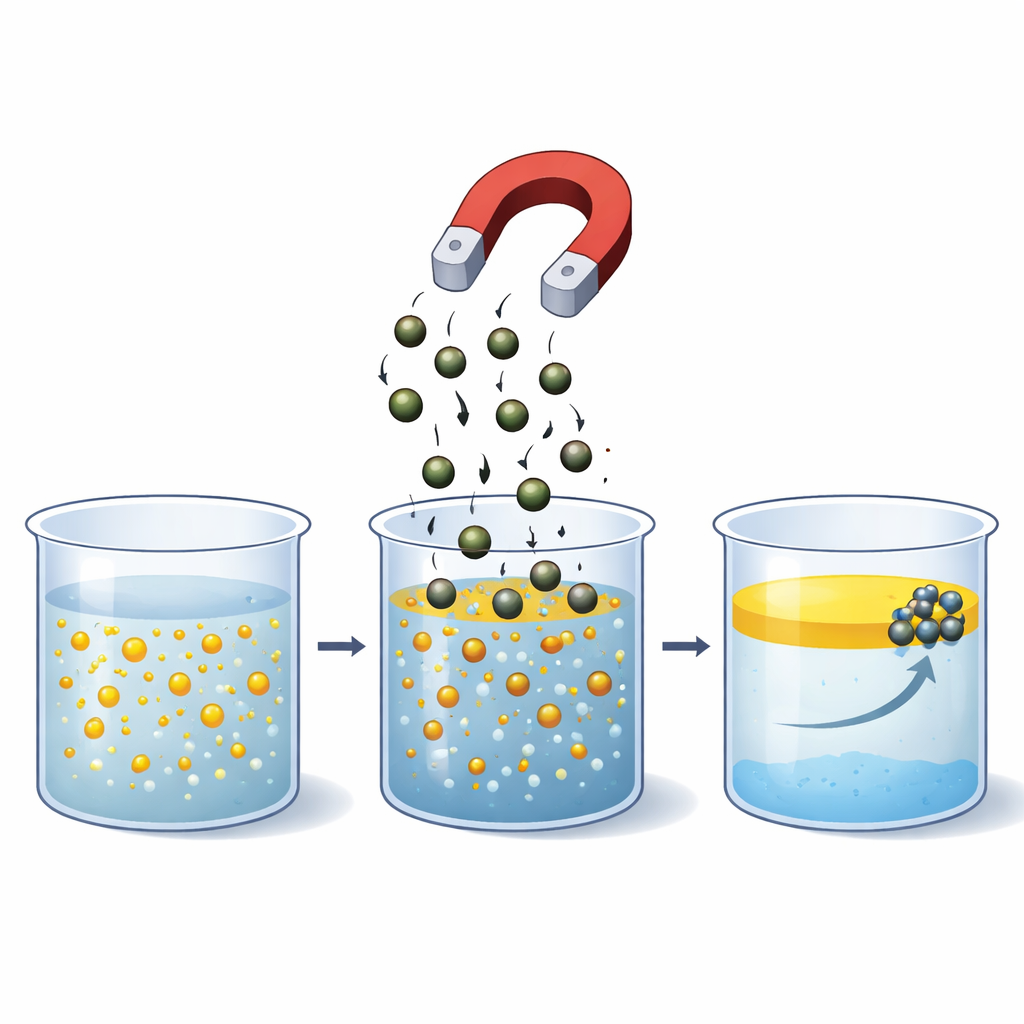
The researchers designed magnetic nanoparticles based on iron oxide, similar to the material inside refrigerator magnets but shrunk to nanometer size. They coated these particles with a modified aniline molecule that has both a water‑loving end and a ring structure that can interact with heavy, sticky components in crude oil called asphaltenes. By changing how much coating they used, they created several versions of the particles (named by their mixing ratios) and compared how well they could clean up oil‑in‑water emulsions under acidic, neutral, and alkaline conditions. The goal was to find a particle that stayed stable, strongly attracted oil droplets, and could then be easily pulled out with a simple magnet.
How the particles catch oil droplets
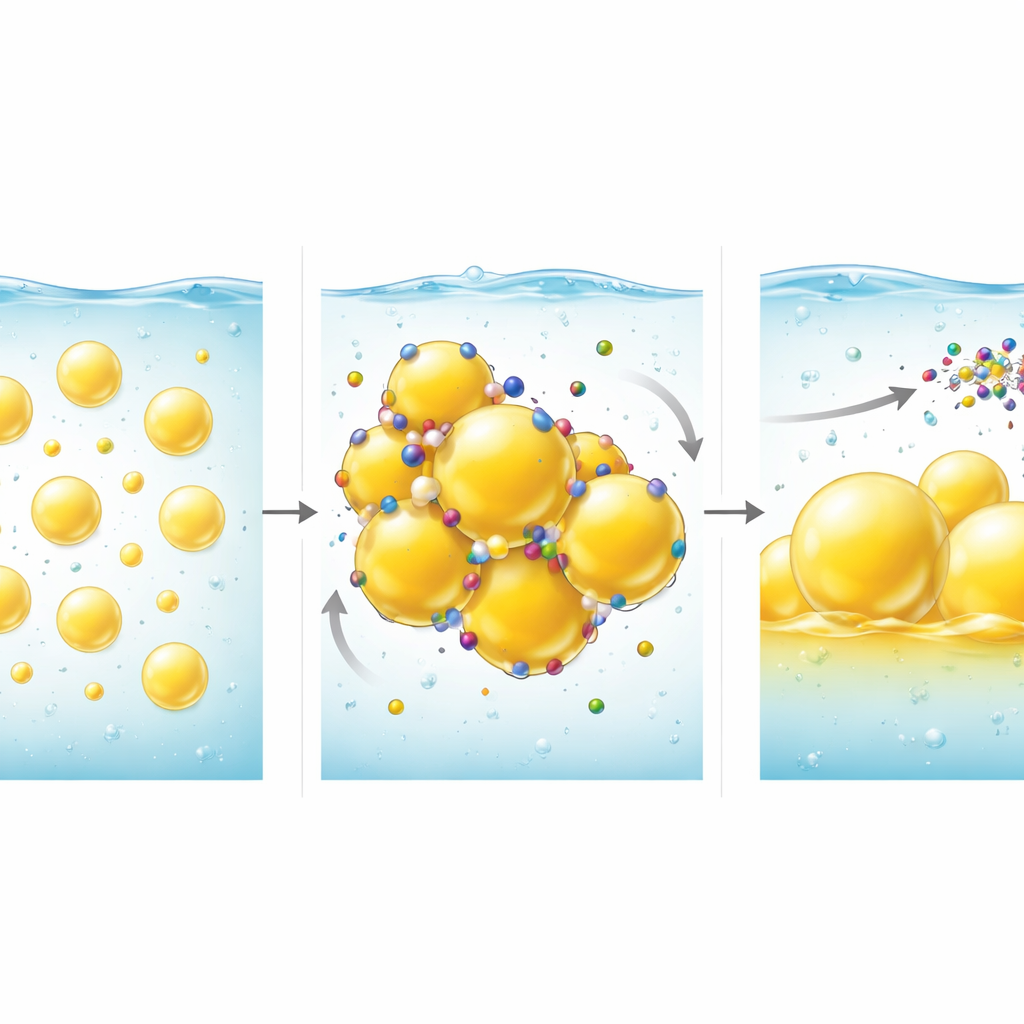
In neutral water, the oily droplets naturally carry a slight negative electric charge. Some of the coated magnetic particles were engineered to carry a positive charge at this pH. When added to the emulsion and shaken, these oppositely charged particles drifted to the droplet surfaces, neutralizing the repulsion that normally keeps droplets apart. Once that barrier was lowered, droplets bumped into each other, merged into larger drops, and rose or settled so the water could be separated. One formulation in particular, called Fe41 in the study, lowered the cloudiness of the treated water to below a common quality threshold, showing that most of the dispersed oil had been removed.
What changes in acidic or basic water
Real wastewater can be more acidic or more alkaline than pure water, so the team examined how their particles behaved when pH changed. In acidic conditions, all the particles became positively charged, so charge alone could no longer explain why one type outperformed another. Here, the version with the thickest aniline‑based coating did best. The authors attribute this to additional interactions between the coating’s ring structure and the aromatic rings in asphaltenes, helping to disrupt the protective film around oil droplets and allowing them to clump. In contrast, at high pH both the droplets and particles tended to be negatively charged, strengthening repulsion instead of attraction. Under these conditions, all particle types showed much weaker cleanup performance, highlighting a challenge for treating strongly alkaline effluents.
Built to be reused
Because these demulsifier particles are magnetic, they can be quickly collected after treatment simply by applying an external magnet, rather than being left behind as a new contaminant. The team showed that their best‑performing neutral‑pH formulation could be used several times in a row. After each cycle, they pulled the particles out with a magnet, rinsed off the adhering oil with a solvent, and used them again, with only a gradual loss in effectiveness. Tests of the material’s structure, surface area, and heat stability confirmed that the coating and magnetic core stayed largely intact through use.
What this means for cleaner water
Overall, the study demonstrates that carefully designed magnetic nanoparticles can break tough oil‑in‑water emulsions effectively, especially around neutral pH, and can be recovered and reused. At neutral conditions, electrical attraction between positively charged particles and negatively charged oil droplets is the main tool; in acidic water, extra grip comes from the coating’s ability to latch onto asphaltene‑rich films. The work points toward future designs that keep a positive or nearly neutral surface charge even in alkaline water, which could make this approach practical for a wider range of industrial waste streams and bring us closer to simpler, more recyclable methods for cleaning oily wastewater.
Citation: Javadian, S., Nobakht, A., Sadrpoor, S.M. et al. pH-responsive modified magnetic nanoparticles for treatment of oily wastewater. Sci Rep 16, 9837 (2026). https://doi.org/10.1038/s41598-026-38651-z
Keywords: oily wastewater, magnetic nanoparticles, oil-in-water emulsion, demulsification, water treatment