Clear Sky Science · en
Enhancing variable frequency drive efficiency using fractional hybrid Particle Swarm Optimization and comprehensive thermal management
Why cooler, smarter motor drives matter
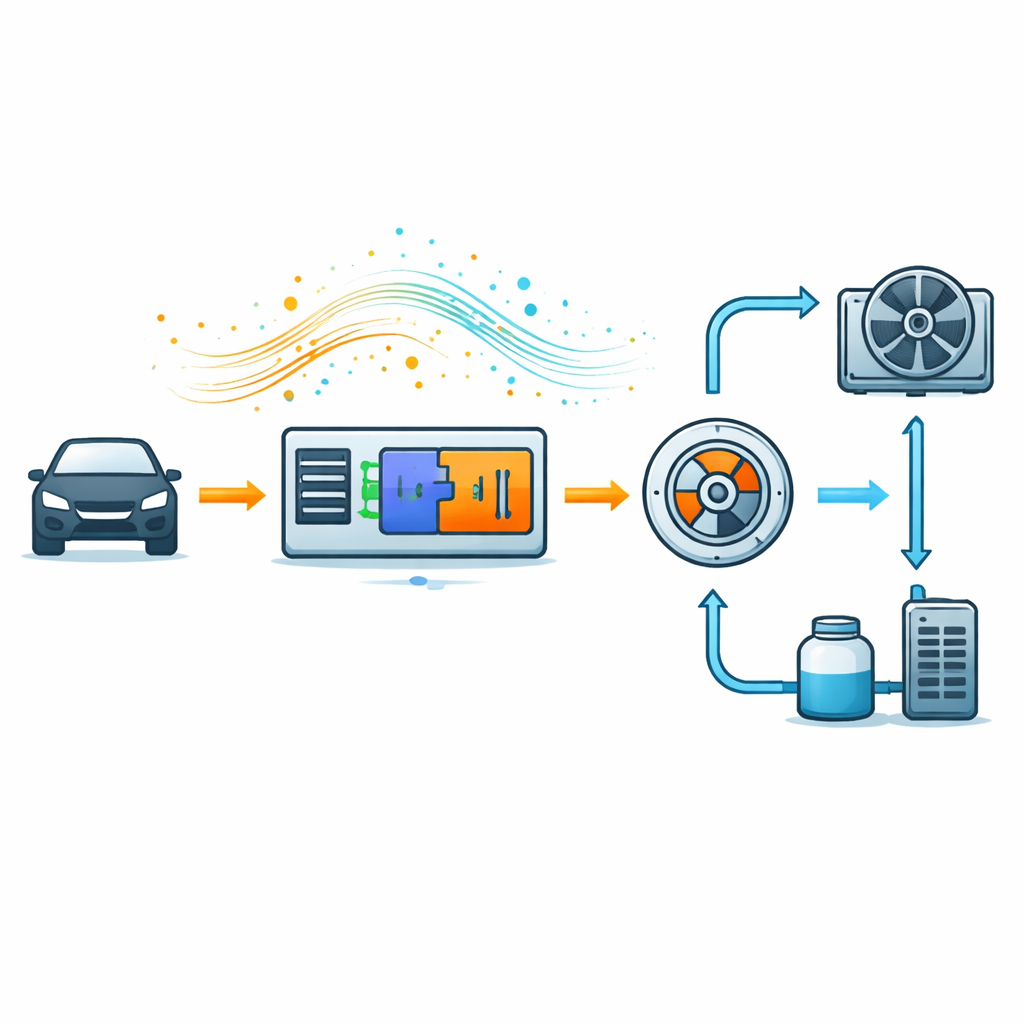
Electric vehicles rely on electronic “brains” that turn battery power into smooth, efficient motion. These electronic drive units work hard, waste some energy as heat, and can run hot enough to shorten their lives or waste precious driving range. This paper explores a way to make such drives both smarter and cooler at the same time, using an advanced tuning method for their control system plus a carefully designed liquid-cooling loop.
Making the motor respond cleanly
At the heart of many electric cars is a permanent magnet synchronous motor driven by a variable frequency drive (VFD). The VFD constantly adjusts voltage and frequency so the motor can deliver the desired speed and pulling power. To do this, it uses a simple but crucial control element, a PI (proportional–integral) controller, which decides how much current to send based on the difference between desired and actual speed. If the PI settings are not well chosen, the motor can overshoot its target speed, wobble before settling, and waste energy. The authors first build a detailed mathematical model of the motor and then design a controller that turns its naturally nonlinear behavior into a more predictable, linear one. This groundwork allows the drive to be tuned precisely instead of by slow trial and error.
Smarter search for better control settings
Finding the best PI settings is like searching a large landscape for the lowest valley. Traditional tuning, or even standard optimization methods, can stop too early in a shallow dip, leaving room for improvement. The study introduces a fractional hybrid particle swarm optimization (FHPSO) method, which imitates a flock of particles exploring the landscape while also remembering where they have been. Fractional calculus provides a kind of “long memory,” letting each particle use information from several past steps, not just the last one. On top of that, a simulated annealing step occasionally allows worse-looking options early on, helping the search escape local traps. Together, these ideas produce controller settings that give quick, smooth responses with very little overshoot.
Keeping the electronics comfortably cool
Even with excellent control, the power switches inside the VFD—mainly MOSFETs and diodes—generate heat whenever they conduct or switch current on and off. The authors develop a detailed thermal model that tracks how these losses raise the temperature of the semiconductor chips, their case, and the surrounding heat sink. They then pair this with a closed-loop liquid cooling system: a heat sink pulls heat from the VFD into a circulating coolant, which a pump sends through a radiator and fan before returning, cooled, to the drive. Simulations and hardware-in-the-loop tests show that without cooling, device temperatures climb above 80 °C, while the cooling loop can hold them to about 29 °C, cutting temperature rise by roughly two thirds. Because efficiency falls as temperature rises, this thermal control directly protects range and reliability.

Putting it all together in realistic tests
The team tests their approach under two driving-style conditions: one with constant speed and load, and another with constant speed but a sudden jump in torque demand. In both computer simulations and hardware-in-the-loop experiments, the FHPSO-tuned controller delivers far less speed overshoot—around 1% compared with over 12% for a simply tuned controller—and settles to the target in a few hundredths of a second instead of three tenths. Torque ripples, current distortions, and magnetic flux fluctuations are all reduced by around three quarters, and electrical waveforms show lower harmonic content, meaning cleaner power. At the same time, the integrated cooling system keeps temperatures low in both operating cases, which preserves efficiency and avoids thermal stress on components.
What this means for future electric vehicles
For a non-specialist, the takeaway is that smarter software and better cooling can make the same electric drive hardware behave like a more powerful, more durable unit. By using a memory-rich search method to tune the controller and by tying electrical behavior to a realistic thermal model, the authors show how to cut overshoot, smooth the motor’s pull, shrink energy losses, and hold temperatures in a safe range. Although the optimization itself is more computationally demanding than traditional methods, it is performed offline, so the final controller runs on-board with no extra burden. This combined approach points toward EV drives that are more efficient, more reliable, and longer-lived without needing major hardware changes.
Citation: Habib, K., Wadood, A., Khan, S. et al. Enhancing variable frequency drive efficiency using fractional hybrid Particle Swarm Optimization and comprehensive thermal management. Sci Rep 16, 11843 (2026). https://doi.org/10.1038/s41598-026-38644-y
Keywords: electric vehicle drives, motor control, power electronics cooling, optimization algorithms, variable frequency drives