Clear Sky Science · en
Application of diamondoids in source and maturity evaluation of light oil: a case study from the Kuqa Depression of the Tarim Basin, NW China
Why this hidden clue in oil matters
Light crude oil and gas condensate are increasingly important energy resources, especially as drilling pushes deeper into Earth’s crust. Yet in many deep reservoirs, the usual chemical “fingerprints” used to trace where oil comes from and how hot it has become are mostly burned away by heat. This study explores a different kind of molecular clue—tiny cage‑like hydrocarbons called diamondoids—to work out the origin, thermal history, and formation pathways of light oils in the Kuqa Depression of China’s Tarim Basin, a key supplier to the country’s West‑East Gas Pipeline.
Tiny cages that survive extreme heat
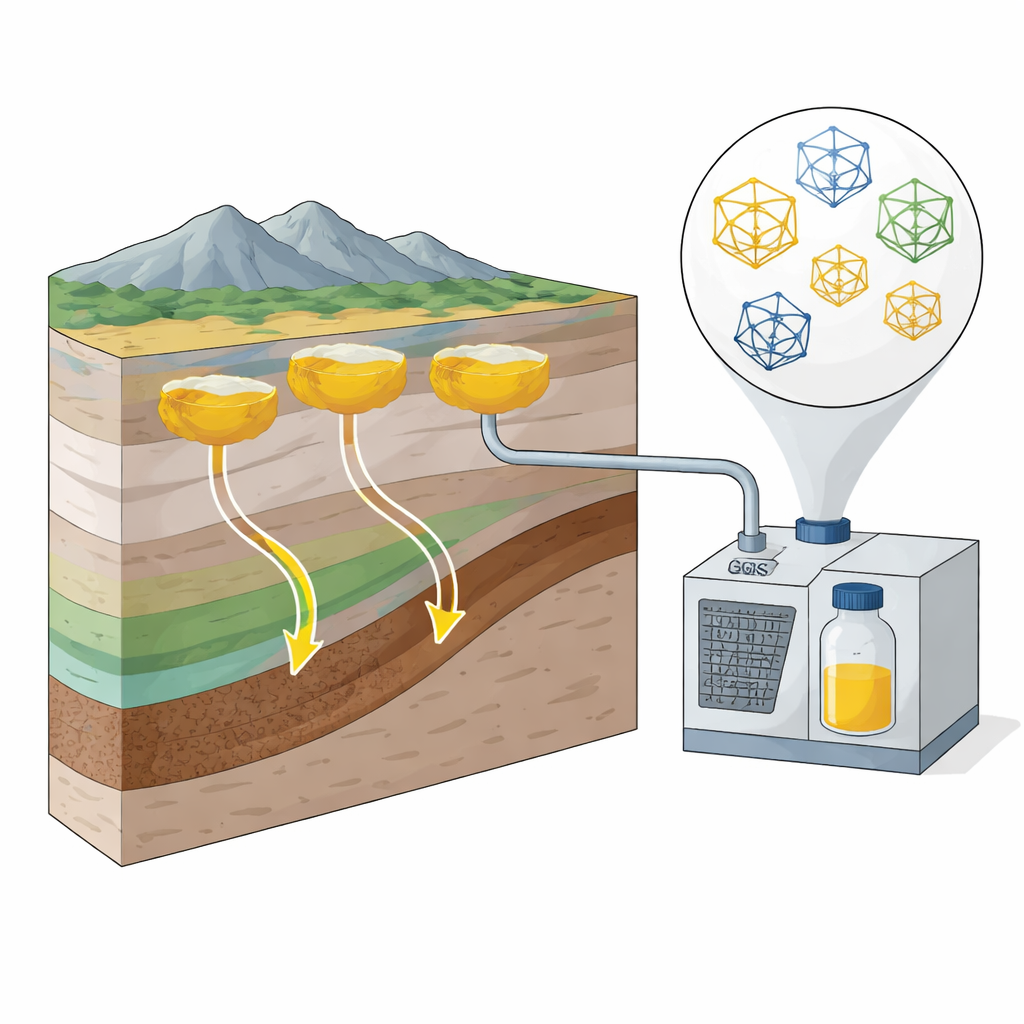
Conventional biomarkers, such as steranes and terpanes, are excellent tracers in moderately mature oils, but they largely vanish as source rocks are heated to the high temperatures typical of ultra‑deep reservoirs. Diamondoids are different. Built from carbon atoms arranged in rigid, diamond‑like cages, they are unusually stable and actually become more concentrated as organic matter is cooked into light oil and condensate. The authors take advantage of this property, using both the overall amounts of diamondoids and the detailed patterns of their isomers—slightly different structural variants—to infer the type of source rock and the level of thermal maturity.
A natural laboratory in a deep Chinese basin
The Kuqa Depression, lying between the Tianshan Mountains and the northern Tarim uplift, hosts thick piles of Triassic and Jurassic sediments that include two major source‑rock families: organic‑rich lake shales and coal‑bearing strata. Over millions of years, these rocks were buried, heated, and squeezed, creating a complex patchwork of oil and gas accumulations at depths exceeding 7,000 meters. The researchers collected 60 mostly light‑oil samples from a wide spread of fields and structural belts. They measured conventional biomarker signatures where possible, and, crucially, used advanced triple‑quadrupole mass spectrometry to quantify dozens of diamondoid species with high precision.
Decoding where the oils came from
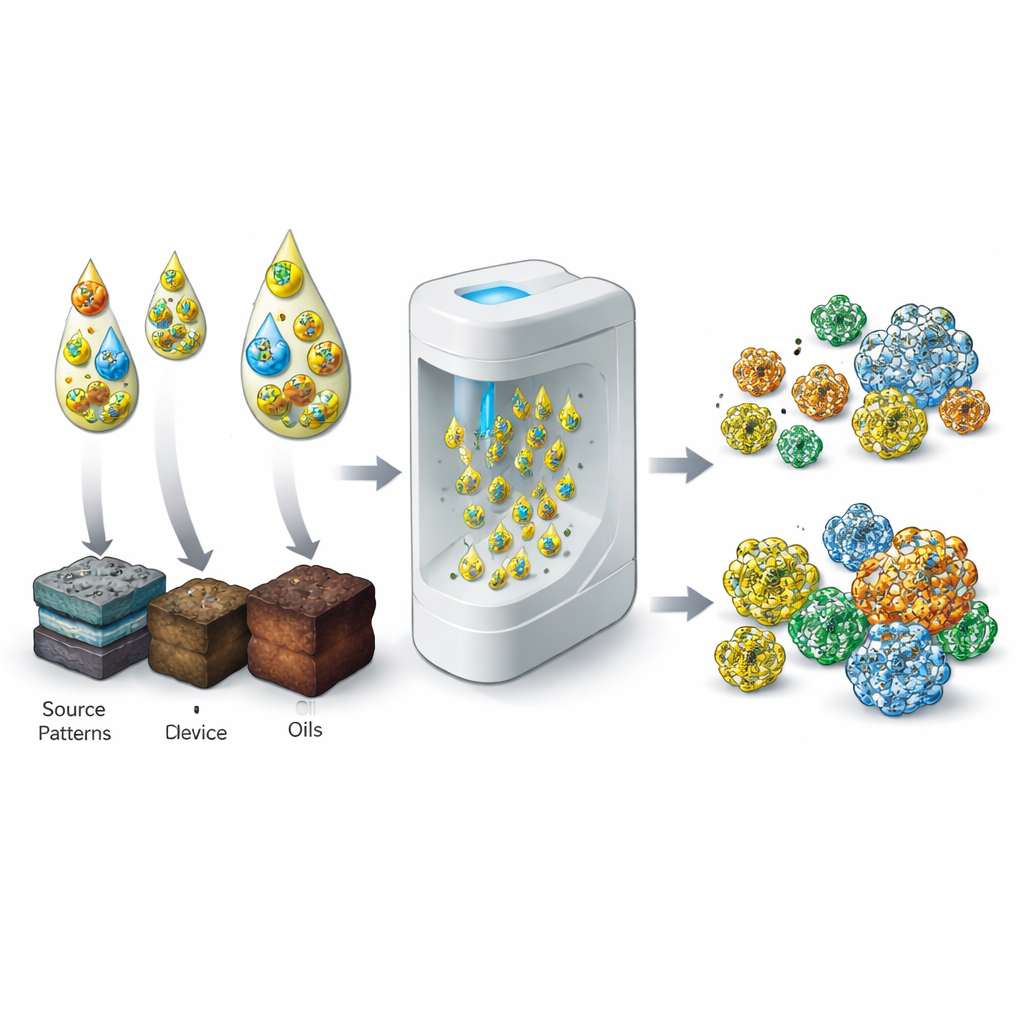
By comparing their field data with results from controlled heating experiments on different kinds of organic matter, the team fed 50 diamondoid‑based indices into multivariate statistical models. These models separate the influence of source rock type from that of temperature. The analysis reveals two dominant families of oils. One originates from lacustrine (lake) shales and is especially common in the Kela, Keshen, Yangtake, and Yaha areas. The other family is derived mainly from coal‑rich rocks and dominates in fields such as Wushi, Bozi, Dabei, Dina, Tuzi, Yingmai, Hongqi, and parts of Dibei and Tudong. In some locations, notably Dibei and Tudong, the diamondoid patterns point to mixing between the two source types, something that standard biomarkers alone had difficulty resolving.
Reading the heat history and unusual cases
The same diamondoid dataset was used to build a maturity scale, expressed as EASY%Ro, a model equivalent to vitrinite reflectance. Across the Kuqa oils, predicted maturities span from about 0.8 to 2.4, covering late oil generation through overmature conditions. Kela oils sit at the high end, with extremely elevated diamondoid concentrations and evidence for contribution from very hot, gas‑associated condensates. Keshen oils have similarly high maturity but surprisingly modest diamondoid levels, implying only a small share of such condensates mixed into more ordinary crude. In the Tuzi area, some oils contain huge amounts of the lighter adamantane‑type diamondoids but relatively fewer heavier ones, a pattern best explained by evaporative or migration fractionation as condensates moved upward from deeper reservoirs. These nuanced interpretations rely on the way different diamondoid groups respond to heating, mixing, and phase separation.
What the findings mean for future exploration
For non‑specialists, the key message is that diamondoids act like robust molecular thermometers and source tags that keep working long after other chemical clues have faded. In the Kuqa Depression, they show that light oils are not a single, uniform resource: some are mainly lake‑derived, some are coal‑derived, many are mixtures, and several have been altered during migration or by contact with gas. Importantly, the diamondoid‑based approach highlights hidden deep condensate sources, particularly beneath Tuzi and Kela, that may represent valuable exploration targets. More broadly, this work demonstrates that analyzing these tiny cage molecules provides a powerful way to reconstruct the origin and evolution of light oils in very hot, deeply buried petroleum systems around the world.
Citation: Zhang, H., Sun, Y., Li, Y. et al. Application of diamondoids in source and maturity evaluation of light oil: a case study from the Kuqa Depression of the Tarim Basin, NW China. Sci Rep 16, 14334 (2026). https://doi.org/10.1038/s41598-026-38619-z
Keywords: light oil, diamondoids, Tarim Basin, oil maturity, source rock