Clear Sky Science · en
The Tantawy technique for modeling fractional KdV and mKdV positron-acoustic solitary waves in an electron-positron-ion plasma with regularized $$\kappa -$$ distribution
Ripples in Space Made of Matter and Antimatter
Out in space, thin gases of charged particles often behave less like smooth air and more like a restless sea, full of tiny, long-lived ripples. This paper explores a special kind of ripple that travels through a mixture of electrons, their antimatter twins (positrons), and heavy ions. By combining a realistic description of how particles move in space plasmas with a powerful new mathematical trick called the Tantawy technique, the authors show how these ripples form, how they change, and why memory of the past matters for their evolution.
What Kind of Plasma Are We Talking About?
The study looks at an idealized but astrophysically relevant plasma made of three main ingredients: heavy positive ions that barely move, a cold population of positrons that carries the inertia of the waves, and two light, fast components—hot positrons and electrons—that respond almost instantly to electric fields. Instead of assuming these electrons follow the textbook bell-shaped energy curve, the authors use a more realistic "regularized κ-distribution" that includes many high-energy particles but keeps the overall energy finite. This choice mimics conditions found in environments like planetary magnetospheres and the solar wind, where satellites routinely observe energetic "superthermal" particles that do not fit simple models.
From Plasma Equations to Solitary Wave Shapes
Starting from standard fluid equations for the three species and the electric field, the authors apply a reduction procedure that filters out fast, small-scale responses and focuses on slow, large-scale ripples known as positron-acoustic waves. Far from special parameter values, the behavior of these waves is captured by a classic equation from nonlinear science, the Korteweg–de Vries (KdV) equation. Its solutions include solitary waves—isolated humps or dips that move without changing shape—whose height and width depend on how nonlinearity (steepening) and dispersion (spreading) balance. By examining the sign of a single coefficient, the authors show that their plasma can support both compressive solitary waves (positive electric potential humps) and rarefactive ones (negative dips), and they map out how this depends on particle densities and temperature ratios. 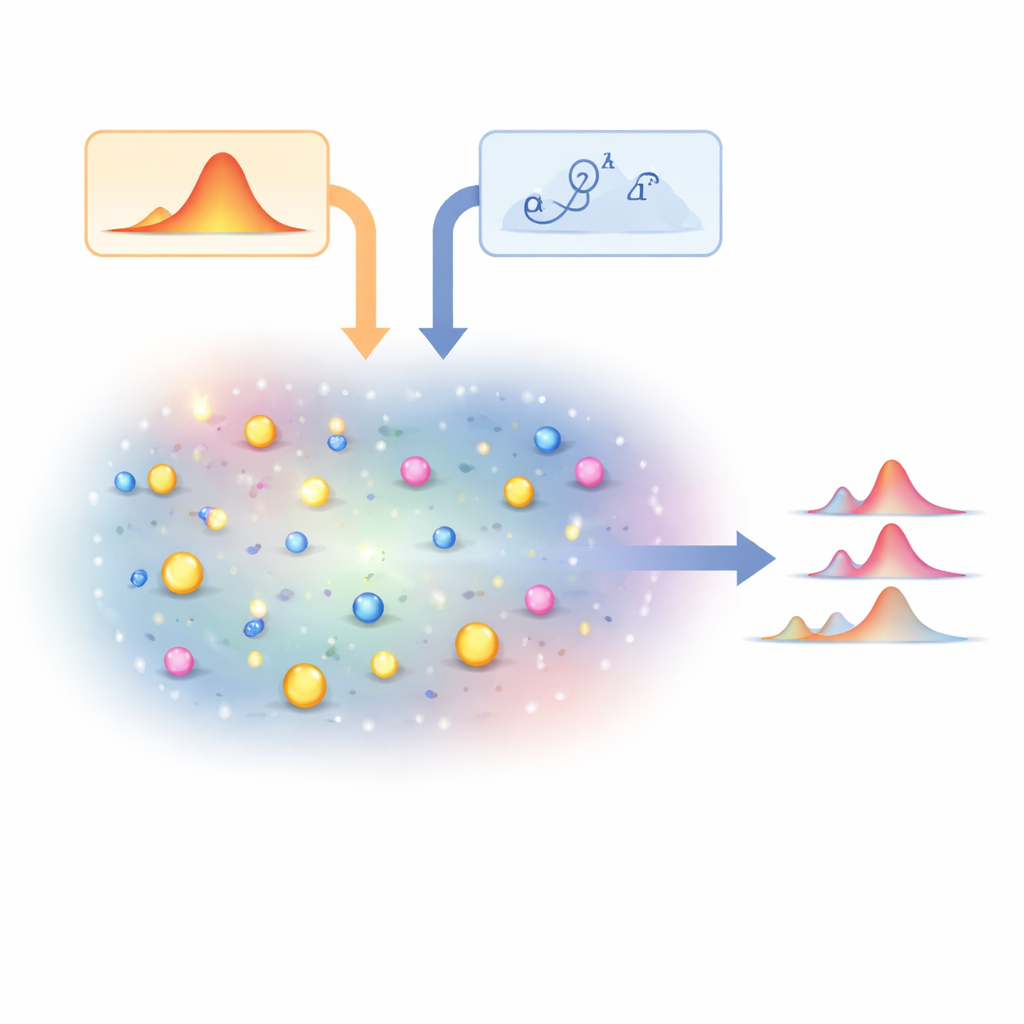
When the Usual Description Breaks and New Waves Appear
At certain "critical" plasma compositions, the leading nonlinear term in the KdV description vanishes, meaning the usual equation no longer captures how the waves behave. Near these points, the system is instead governed by a modified KdV (mKdV) equation with a different type of nonlinearity. Here, a new coefficient decides whether the system produces smooth solitary waves or steep shock-like fronts. The authors derive this equation and show that, depending on densities and the details of the electron energy distribution, the plasma can switch between regimes dominated by gentle solitons or by abrupt shocks, even though the underlying ingredients are the same.
Building Memory into the Waves
Real plasmas often "remember" their past: particles may get trapped, scatter slowly, or exchange energy in ways that depend on their history. To mimic this, the authors replace the ordinary time derivative in the KdV and mKdV equations with a fractional derivative, which makes the wave dynamics depend on a weighted record of earlier times rather than just the present instant. A parameter between 0 and 1 tunes the strength of this memory. Using the Tantawy technique, they construct compact series formulas that approximate these fractional waves with high accuracy and low computational cost. As the memory parameter moves away from the ordinary value of 1, solitary pulses evolve more slowly, their peaks shrink or broaden, and their shapes adjust more gently, capturing effects similar to anomalous transport or weak dissipation in real space plasmas. 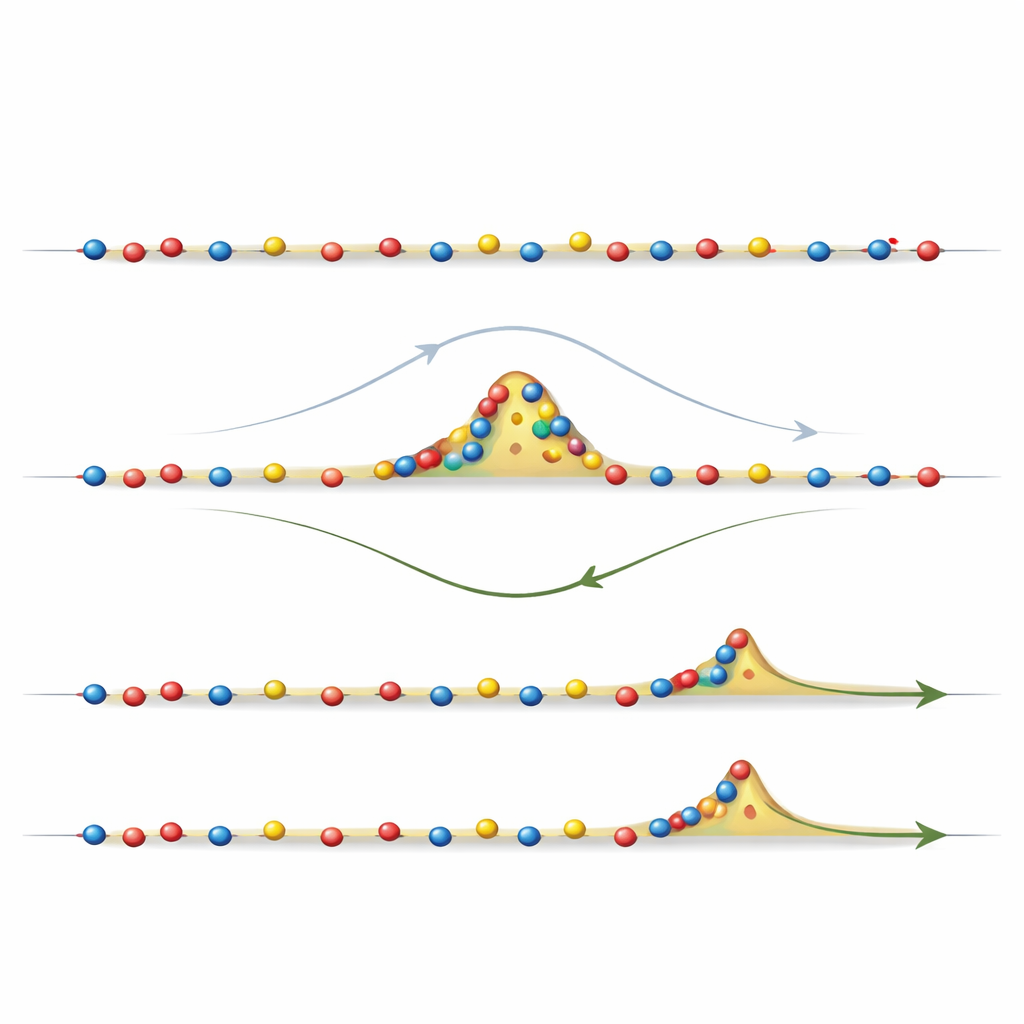
How Plasma Conditions Shape the Ripples
The authors then perform a detailed scan of how key knobs control solitary wave profiles. The cutoff parameter of the κ-distribution affects compressive and rarefactive waves in opposite ways in the KdV regime, but damps both symmetrically in the mKdV regime. Increasing the number of superthermal electrons generally weakens nonlinearity and reduces amplitudes. Changing the fraction of hot positrons or ions can either strengthen or weaken the waves, depending on whether they are humps or dips. Across both integer and fractional models, higher memory (fractional order further from 1) slows the evolution and softens extreme shapes, while the Tantawy technique consistently reproduces known exact solutions with tiny errors, confirming its reliability.
Why This Matters for Space and Astrophysics
Put simply, this work shows that localized electrostatic ripples in realistic matter–antimatter plasmas are highly sensitive to both particle populations and to how strongly the plasma "remembers" its past. By combining a physically grounded particle distribution with a versatile fractional-wave method, the study provides a toolset for interpreting solitary structures seen in regions such as planetary magnetospheres, pulsar surroundings, and the solar wind. For a lay reader, the key takeaway is that even in the near vacuum of space, the details of how particles are energized and how they retain memory can decide whether the plasma forms gentle, long-lived wave packets or sharp, shock-like fronts, and the Tantawy technique offers an efficient way to predict and classify these behaviors.
Citation: El-Tantawy, S.A., Khalid, M., Almuqrin, A.H. et al. The Tantawy technique for modeling fractional KdV and mKdV positron-acoustic solitary waves in an electron-positron-ion plasma with regularized \(\kappa -\) distribution. Sci Rep 16, 10247 (2026). https://doi.org/10.1038/s41598-026-38597-2
Keywords: space plasmas, solitary waves, fractional calculus, electron positron ion plasma, superthermal electrons