Clear Sky Science · en
Bonding performance of polymer waterproof coating and expansive soil
Why keeping soil slopes intact matters
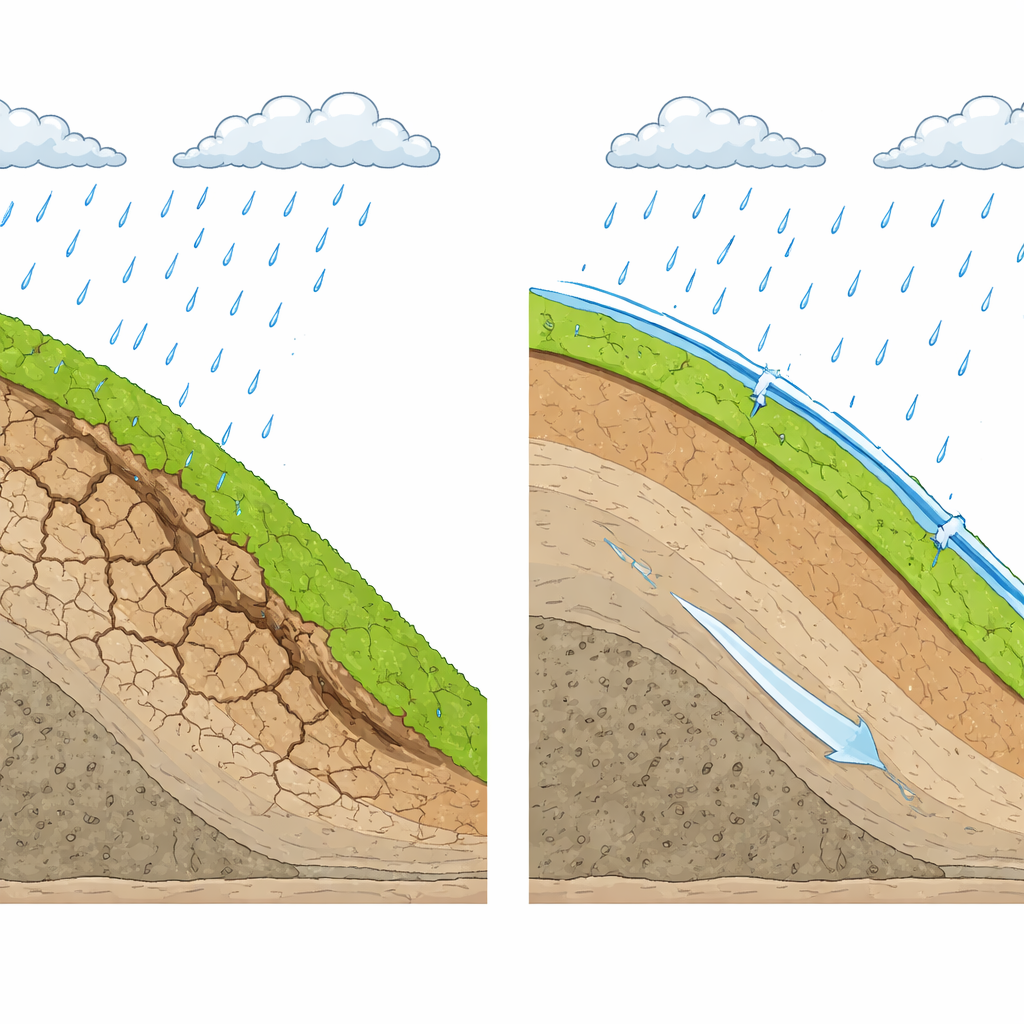
Across the world, roads, railways and buildings are often built on a tricky ground material called expansive soil. When this soil gets wet, it swells; when it dries, it shrinks and cracks. These movements can damage foundations and trigger small landslides on cut slopes along highways, causing huge economic losses each year. This study explores a promising way to shield such slopes using a thin, flexible polymer waterproof coating and, crucially, asks a practical question: under what conditions will that coating stay firmly stuck to the soil for the long term?
A new rain shield for problem soils
Traditional methods for stabilizing expansive soil slopes usually focus on making the soil itself stronger or holding it in place with reinforcements or vegetation. While these approaches help, they do not always stop rainwater from soaking into the slope, which is what drives most swelling and cracking. The researchers instead look at treating the slope surface as the first line of defense, using a rubbery polymer waterproof coating that forms a continuous film on the soil. Earlier model tests showed that such a coating can reduce how much water enters the slope and limit its swelling and shrinking. But if the coating peels away from the soil, water will slip underneath and the protection will quickly fail. That is why this work concentrates on how well the coating bonds to expansive soil and which on-site conditions make that bond stronger or weaker.
How the experiments were carried out
The team used a water-based rubber coating commonly employed to waterproof buildings and infrastructure. After curing, this material stretches up to nine times its original length without breaking and remains watertight under pressure. They collected a representative expansive soil from southern China, carefully measured its physical and mineral properties, and then pressed it into compact blocks in a custom mold. By controlling how much water was in the soil and how firmly it was compacted, they created specimens with different water contents (from fairly dry to quite wet) and densities (from loosely packed to very dense). The coating was brushed onto the soil surface at various thicknesses, allowed to cure under standard laboratory conditions, and then pulled off using a tensile testing machine while recording the maximum force needed to detach it.
What controls how well the coating sticks
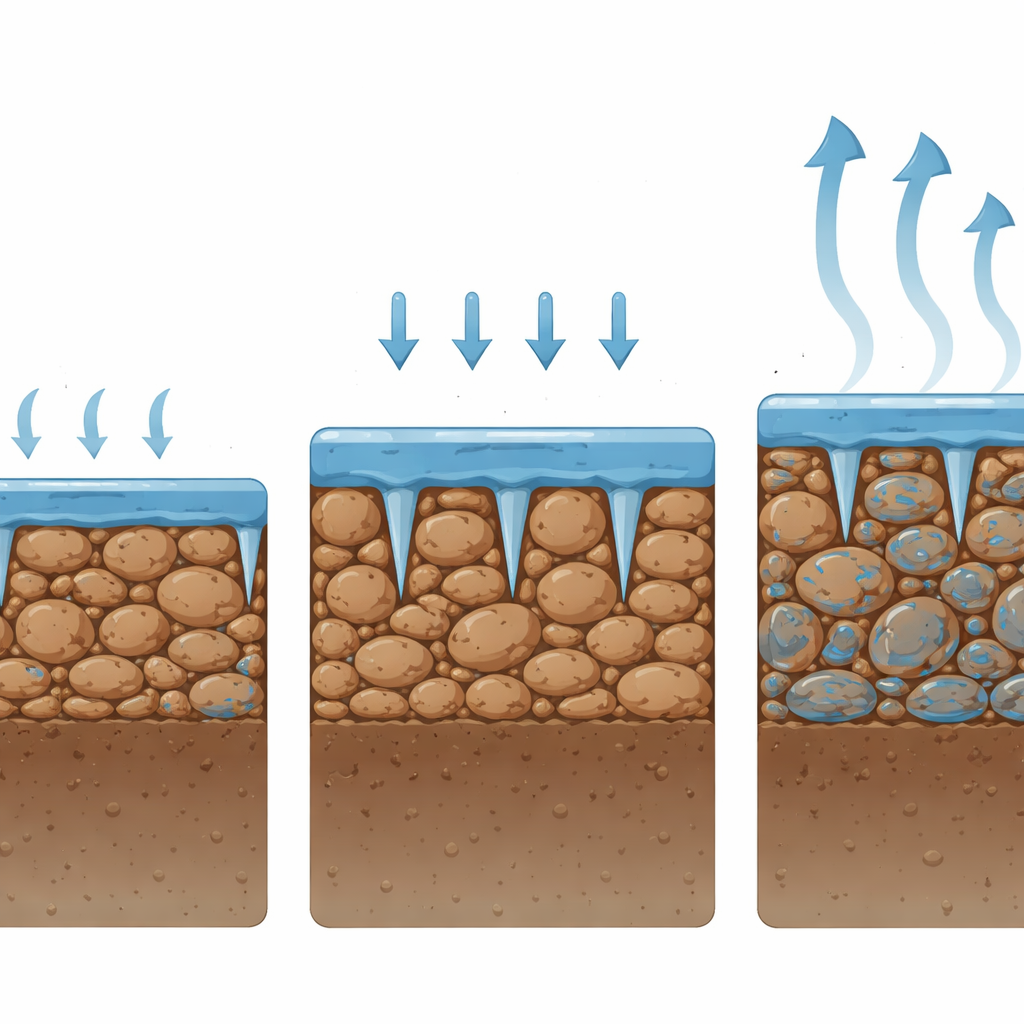
The tests, covering 40 different combinations of conditions and 200 specimens in total, revealed clear patterns. The single most important factor for strong bonding was how densely the soil was compacted. As soil density increased, bond strength rose almost in a straight line, reaching its highest value when the soil blocks were compacted to the upper limit tested. Water content played a subtler role: as the soil became wetter, bond strength first increased and then decreased, peaking near the soil’s “optimum” moisture level—the point where soil typically compacts most efficiently. When the soil became too wet, the internal suction and contact between grains weakened, making it easier for the coating to pull away. Coating thickness had the smallest effect; within the tested range, going thicker did not greatly change the bond, although a thickness of about 1.5 mm performed slightly better overall and offers added durability.
Hidden anchors inside the soil
When the coating was pulled off, it did not simply separate as a flat sheet. Instead, a plug of soil came out with it, shaped like a small inverted cone or trapezoid. The researchers call this the “soil–nail” effect: as the coating tries to separate, this plug acts like a miniature anchor, forcing surrounding soil to resist movement through friction and grain-to-grain contact. The longer this soil plug, the stronger the resistance and the higher the measured bond strength. Conditions that increased bond strength—moderate water content and adequate compaction—also tended to lengthen this plug, enhancing the anchoring effect. In contrast, changing the coating thickness had little influence on the plug length, reinforcing the idea that ground preparation matters more than applying extra material.
Practical guidance for safer slopes
Viewed in everyday terms, the study shows that a polymer waterproof coating can act as an effective rain shield for expansive soil slopes, but only if the soil beneath it is properly prepared. The most reliable recipe the authors propose is straightforward: adjust the soil moisture close to its optimal level, compact the soil so its density reaches at least the recommended threshold, and apply a coating about 1.5 mm thick. Under these conditions, the coating sticks firmly, the hidden soil anchors are well developed, and rainwater is more likely to remain at the surface rather than seeping deep into the slope. While further work is needed to confirm performance under long-term wet–dry cycles and in other types of expansive soils, these findings offer a practical, science-based guide for engineers seeking durable, surface-focused protection for vulnerable slopes.
Citation: Ma, M., He, B., Huang, H. et al. Bonding performance of polymer waterproof coating and expansive soil. Sci Rep 16, 12994 (2026). https://doi.org/10.1038/s41598-026-38572-x
Keywords: expansive soil, waterproof coating, slope stability, soil compaction, rainfall infiltration