Clear Sky Science · en
Multiscale neural features of tonal bilingualism: linking regional differences in brain network degree centrality to neurotransmitter-gene signatures in Bai-Mandarin bilinguals
Why tones can reshape the brain
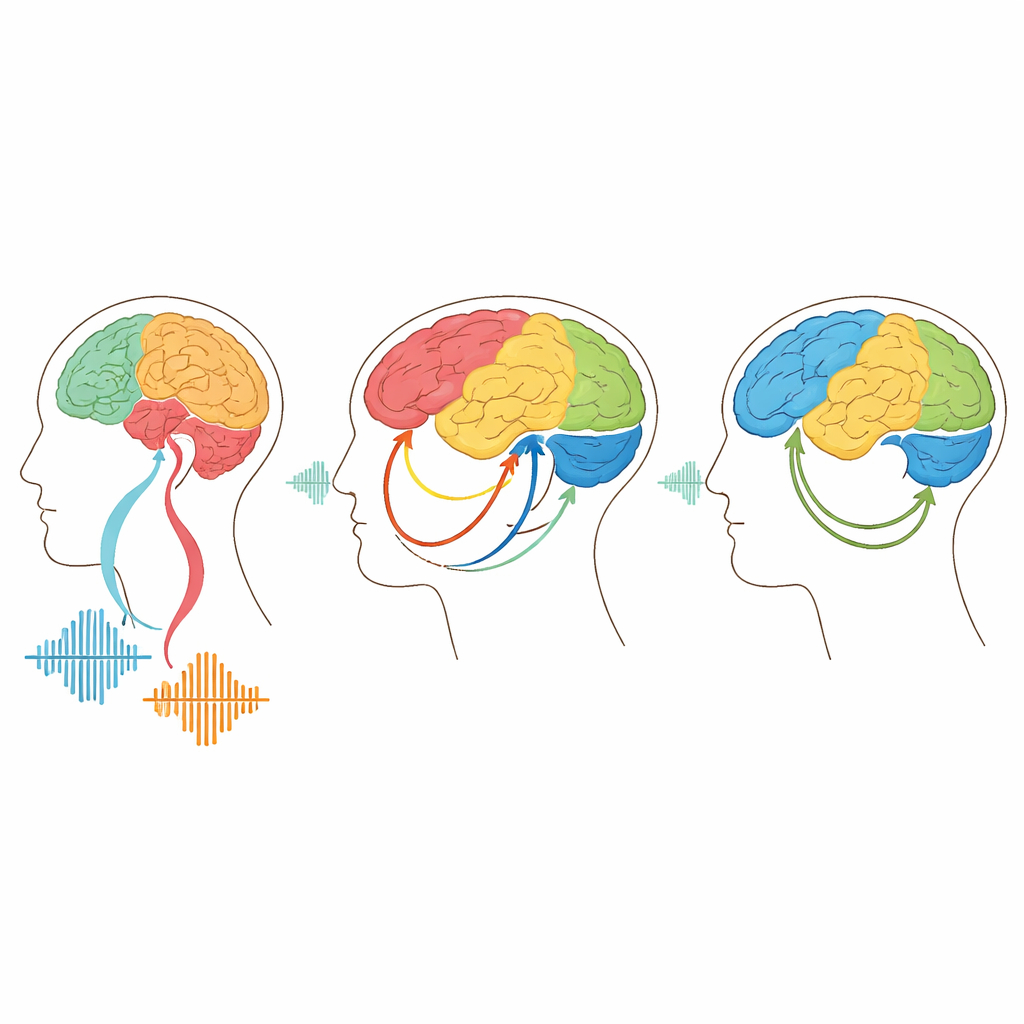
Many people grow up speaking just one language, but millions navigate two or more every day. For speakers of tonal languages—where a change in pitch can flip a word’s meaning—this juggling act places especially fine-grained demands on hearing and attention. This study looks at Bai–Mandarin bilinguals in southwest China to ask a striking question: does lifelong use of two tonal languages leave a distinct fingerprint on the brain’s wiring, chemistry, and even gene activity compared with speaking Mandarin alone?
Two tonal worlds in one mind
Bai and Mandarin both use pitch to distinguish words, but Bai has more tones and more complex sound patterns. People in the Bai community typically hear Bai at home and Mandarin in school from birth, reaching high skill in both. That makes them an ideal group for isolating the effects of managing two tonal systems, without the usual complications of learning a second language later in life. The researchers compared 30 Bai–Mandarin bilinguals with 28 Mandarin monolinguals who shared similar age and education, then scanned their resting brains using functional MRI to see how different regions talk to each other when the mind is at ease.
Hidden hubs in the brain’s language and social networks
Instead of tracking activity during a specific task, the team focused on “degree centrality,” a measure of how many connections each tiny brain region has—essentially, how much of a hub it is. Bai–Mandarin bilinguals showed fewer connections in several classic language-related areas on the left side of the brain: a frontal region important for sound-to-meaning mapping, a parietal region linked to learning new words and rules, and a temporal region that helps represent speech sounds and their meanings. At the same time, they showed more connections in the medial prefrontal cortex, a midline area tied to self-reflection, emotion, and understanding others. These shifts were concentrated in high-level control networks that support attention, planning, and inward-focused thought, suggesting that tonal bilingualism subtly rebalances the brain’s communication routes rather than simply “adding more.”
Brain chemistry behind tonal expertise
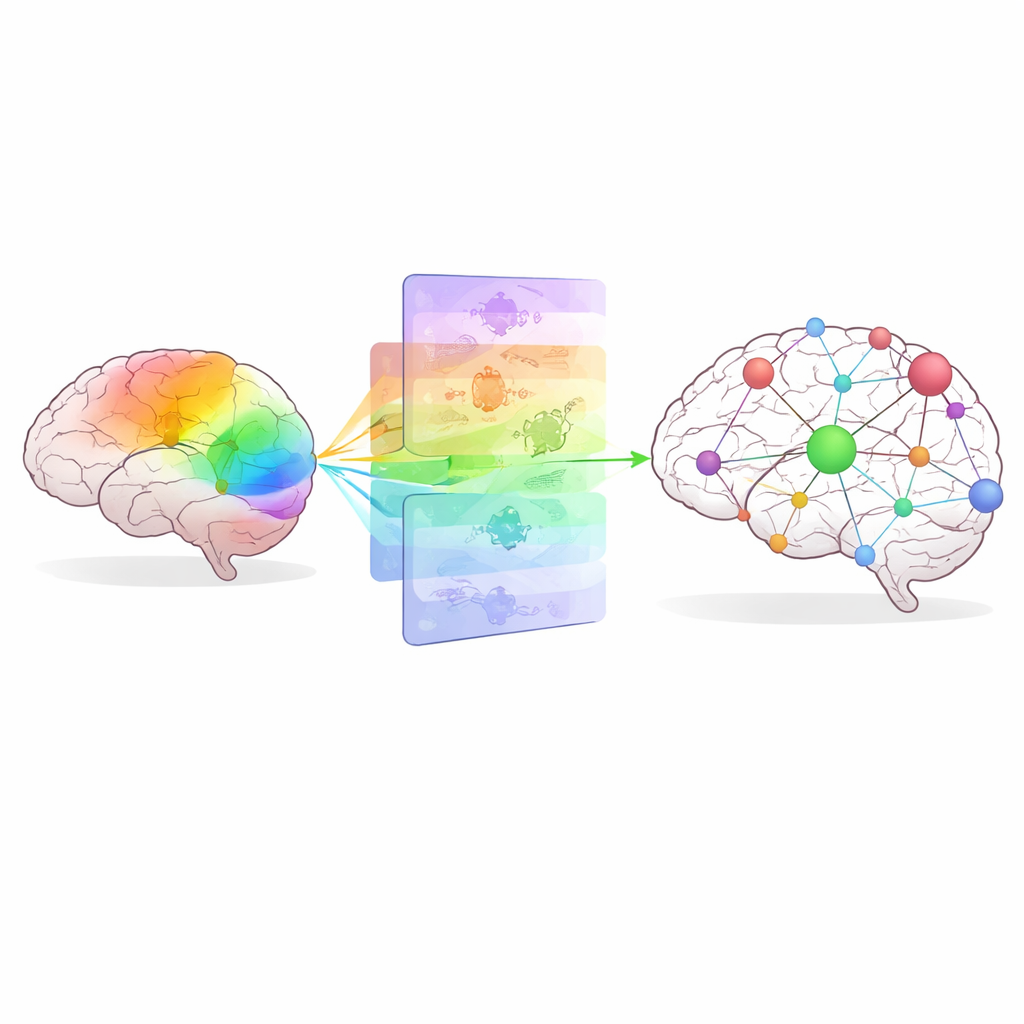
To dig deeper, the authors overlaid these connectivity differences with maps of brain chemicals measured in a large independent group of volunteers. They asked whether regions that change most in bilinguals are also rich in particular neurotransmitters, the molecules that let nerve cells signal one another. They found that differences between groups were partly explained by systems that use serotonin and dopamine—often linked to mood, reward, and learning—as well as by GABA, the brain’s main inhibitory signal, and several others. Regions where bilinguals had stronger hub-like roles tended to align with higher densities of certain dopamine and serotonin markers, while regions with reduced connectivity were more tied to inhibitory and regulatory systems. This pattern hints that balancing two tonal languages depends on fine-tuned interactions between circuits that excite, inhibit, and reward specific patterns of activity.
From genes to cells to networks
The analysis did not stop at chemistry. Using a detailed atlas of gene activity from donated human brains, the researchers looked for genes whose expression patterns across the cortex mirrored the observed connectivity shifts. They identified 1,801 genes whose spatial activity tracked these differences. Many are involved in getting proteins to the right place in cells, shaping cell branches, and building or refining nerve connections—processes central to brain development and plasticity. These genes were especially prominent in brain networks that handle flexible thinking and control. When the team examined which cell types expressed these genes, they found enrichment in excitatory and inhibitory neurons, microglia (the brain’s immune-like caretakers), and oligodendrocytes, which help insulate nerve fibers. Together, this points to a coordinated, multi-cellular tuning of circuits in people who constantly navigate two tonal sound systems.
What this means for everyday speakers
Put simply, the study suggests that growing up bilingual in two tonal languages nudges the brain toward a leaner, more efficient language network and a more connected “social” hub in the frontal midline. These large-scale changes appear to be supported by differences in brain chemistry and in the activity of hundreds of genes that shape how brain cells grow, connect, and communicate. While the work cannot yet prove cause and effect, it offers a multilevel picture—from genes to networks—of how language experience can sculpt the brain. For lay readers, the key message is that the sounds and structures of the languages we live in are not just tools for communication; over many years, they help build the very circuits that support how we think, feel, and relate to the world.
Citation: Zhang, L., Xu, H., Yang, Y. et al. Multiscale neural features of tonal bilingualism: linking regional differences in brain network degree centrality to neurotransmitter-gene signatures in Bai-Mandarin bilinguals. Sci Rep 16, 12787 (2026). https://doi.org/10.1038/s41598-026-38523-6
Keywords: tonal bilingualism, brain connectivity, language and genes, neurotransmitters, resting-state fMRI