Clear Sky Science · en
Inspection of stability of a general roll-damping of a ship via non-perturbative approach
Why ship rolling matters for everyone
When a ship rolls from side to side in heavy seas, the motion can be uncomfortable at best and dangerous at worst, leading to cargo loss, damage, or even capsizing. This article investigates how and when rolling stays under control, using a new mathematical method to describe the ship’s motion more accurately. The work aims to give ship designers and operators better tools to predict unsafe conditions and improve the devices that keep vessels upright and their cargo – and passengers – safe.
How a ship behaves when it rolls
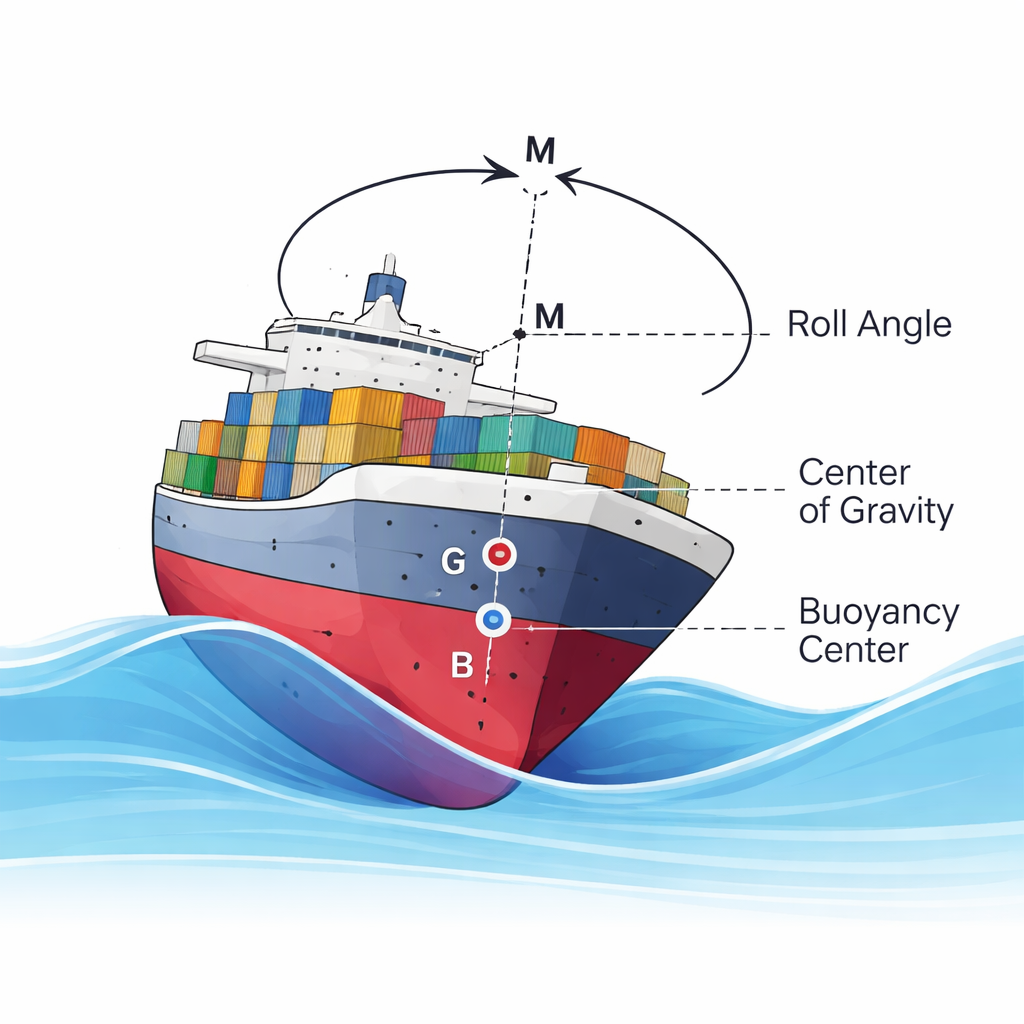
Rolling motion is the side-to-side rocking of a vessel around its long axis. Even in calm weather, ships are constantly pushed by waves, and their response depends on their shape, mass distribution, and how water flows around the hull. The authors focus on a simplified but realistic description with one main motion: the roll angle. In this picture, the ship’s behavior results from four ingredients: inertia (the tendency to keep moving), restoring forces (buoyancy trying to bring the ship back upright), damping (energy lost to waves and friction), and the external push of the sea. Unlike basic textbook models that assume small motions and gentle forces, real ships experience strong, nonlinear effects that can lead to sudden jumps in roll angle, resonances, and even chaotic, unpredictable behavior.
A new way to tame a messy problem
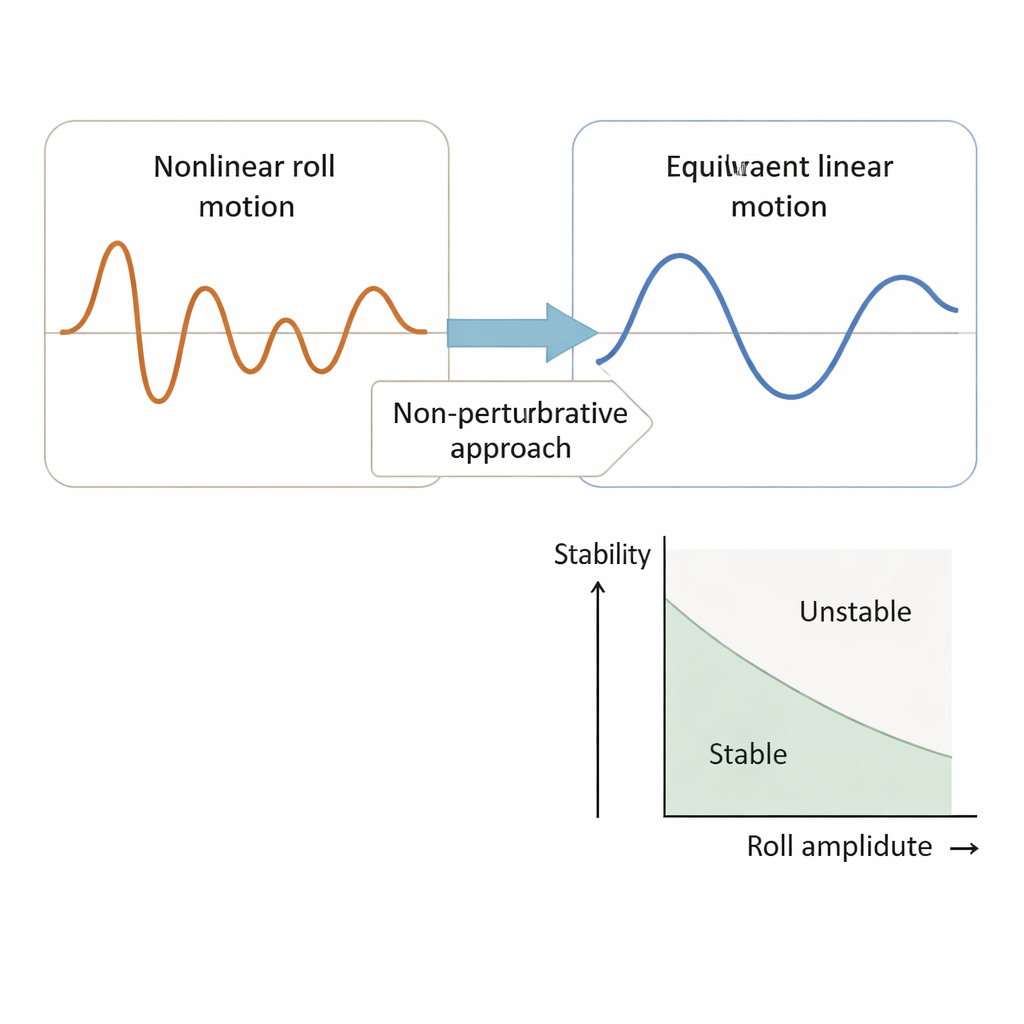
Most traditional approaches treat these nonlinear effects using perturbation techniques, which rely on expanding complicated equations into series and keeping only the first few terms. This can work when the motion is very small but quickly breaks down as seas become rougher. The authors adopt a different strategy called a non-perturbative approach (NPA). Instead of directly solving the difficult nonlinear equation, they cleverly construct an equivalent linear equation whose behavior closely tracks the real system over each cycle of motion. This is done by averaging how energy is stored and dissipated over time, leading to “effective” damping and stiffness values that include the influence of all nonlinear terms. Numerical simulations show that this equivalent linear model reproduces the original nonlinear ship motion with striking accuracy, while being far easier to analyze.
Probing stability, resonance, and the edge of chaos
With the simpler equivalent model in hand, the authors explore when the ship’s roll motion remains bounded and when it becomes risky. They examine how key parameters – such as natural roll frequency, different kinds of damping, and higher-order restoring forces – shape the regions of stable and unstable behavior. Increasing linear and nonlinear damping generally enlarges the safe zone, because more energy is drained from the roll. In contrast, strengthening certain restoring-force terms or shifting the natural frequency can shrink the stable region and promote large, sudden rolls, especially when wave forcing nearly matches the vessel’s preferred rhythm. Using a well-known technique called the multiple time-scales method, the team derives approximate formulas for the roll amplitude near resonance and studies how small changes in forcing frequency or strength can trigger big responses.
From smooth motion to chaos in heavy seas
The study goes beyond steady oscillations to map how the system transitions from regular to chaotic motion as wave forcing grows. By computing bifurcation diagrams, phase portraits, and Poincaré maps – standard tools in nonlinear dynamics – the authors show that the roll motion can pass through a sequence of period-doubling steps before becoming fully chaotic. At low forcing, the ship settles into a regular, repeatable pattern with a single dominant roll amplitude. As the forcing amplitude increases, the motion first repeats every two or four cycles, then becomes irregular and highly sensitive to initial conditions. Identifying these thresholds helps define operating ranges where ships should avoid certain speed–heading combinations or sea states to prevent dangerous roll amplification.
What this means for safer ships
For a non-specialist, the main message is that ship rolling is not just a simple back-and-forth rocking; it is a complex dance between wave forcing, hull shape, and energy loss mechanisms. The non-perturbative approach developed here offers a practical shortcut: it replaces a hard nonlinear problem with a carefully tuned linear one that still captures the essential physics. This makes it easier to predict when rolling will remain mild and when it might escalate toward resonance or chaos. In the long run, such methods can guide better hull designs, smarter roll-damping devices, and clearer operational guidelines, helping ships navigate rough seas with a larger safety margin.
Citation: Moatimid, G.M., Mohamed, M.A.A. & Abohamer, M.K. Inspection of stability of a general roll-damping of a ship via non-perturbative approach. Sci Rep 16, 7471 (2026). https://doi.org/10.1038/s41598-026-38505-8
Keywords: ship rolling, roll damping, nonlinear dynamics, stability analysis, parametric resonance