Clear Sky Science · en
Rhizosphere microbiome dynamics and hormonal interactions regulating tiller development in sugarcane cultivars
Why the soil around sugarcane roots matters
Sugarcane is not just a source of table sugar; it also feeds biofuel production and supports rural economies around the world. How many stalks a sugarcane plant produces — a trait called tillering — largely determines how much sugar farmers can harvest. This study asks a deceptively simple question: why do some sugarcane varieties make many side shoots while others do not? The authors show that the answer lies in a three‑way conversation between the microbes living around the roots, the nutrients the plant takes up, and the growth hormones flowing inside the plant.
Different root neighborhoods for high and low tillering
The researchers compared four sugarcane cultivars grown in the same nursery: two that naturally produce many tillers and two that make far fewer. They collected soil tightly clinging to the roots — the rhizosphere — and used DNA sequencing to map which bacteria were present. High‑tillering varieties hosted more diverse microbial communities with richer networks of interactions, including groups known to help recycle carbon, nitrogen, and phosphorus. Low‑tillering varieties, by contrast, had simpler, more uneven communities dominated by microbes adapted to stress, such as those linked to heavy‑metal resistance or oxidative damage. 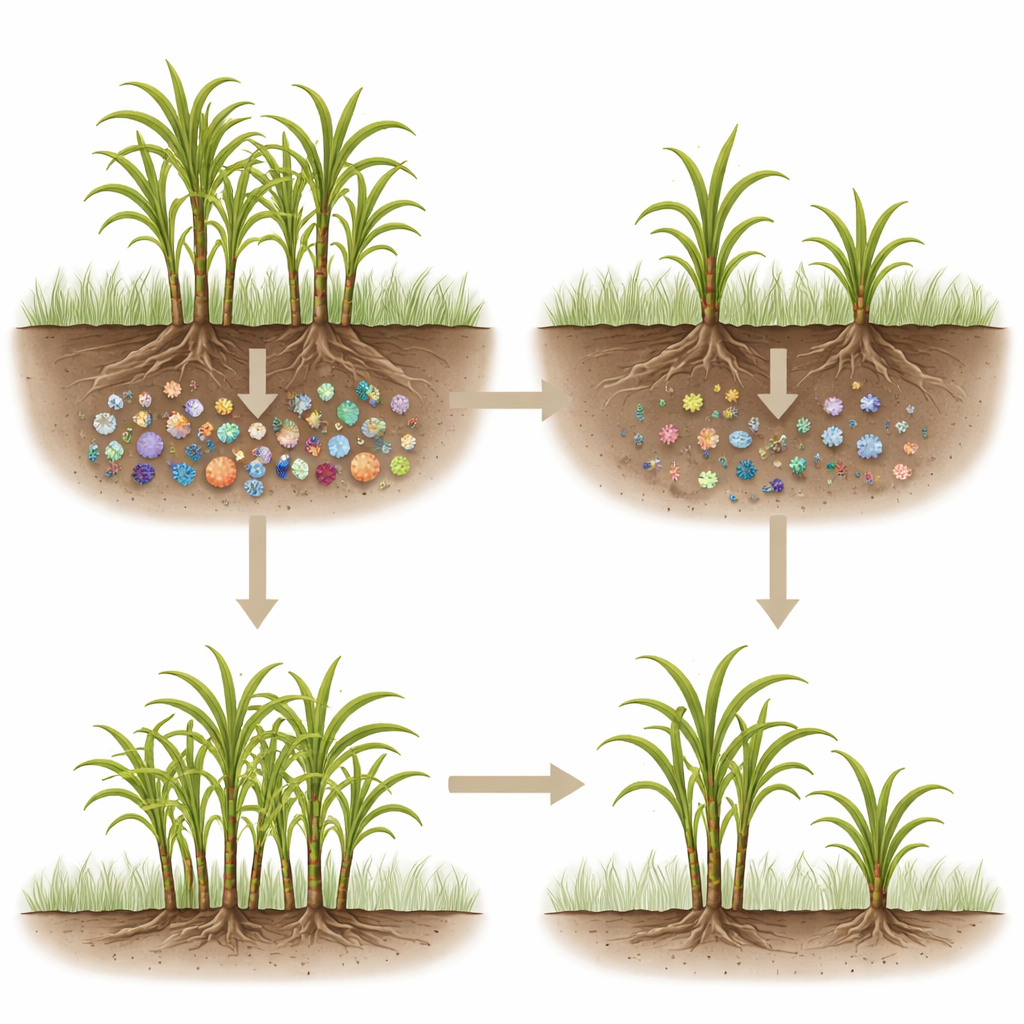
Microbial jobs: feeding and signaling the plant
Beyond who was there, the team inferred what these microbial communities were capable of doing. In soils around high‑tillering plants, predicted functions were enriched for nitrogen fixation, phosphorus solubilization, and the breakdown of complex carbohydrates. These activities can convert otherwise unavailable nutrients into forms that roots can absorb, effectively extending the plant’s own nutrient‑gathering system. The same communities also appeared geared toward producing auxin‑like compounds, hormones that can stimulate root growth and bud activation. In low‑tillering plants, predicted functions skewed toward stress defenses such as detoxifying metals and surviving oxidative bursts, which may help microbes cope with harsh conditions but contribute less to feeding or signaling the plant.
Inside the plant: hormone balance and nutrient stockpiles
To connect the outside world at the roots to the inside of the plant, the authors measured hormone levels and mineral nutrients in stems and tiller buds. High‑tillering cultivars had more of the classic growth‑promoting hormones auxin and active cytokinins in their buds, creating an internal environment that favors the awakening and elongation of side shoots. Low‑tillering cultivars instead accumulated higher levels of abscisic acid, a hormone associated with stress responses and bud dormancy, and carried more inactive forms of cytokinins. Nutrient measurements told a similar story. High‑tillering varieties contained more nitrogen and phosphorus — key building blocks for new tissues — while low‑tillering plants accumulated higher levels of micronutrients like zinc and manganese, often linked with stress adaptation rather than rapid growth. 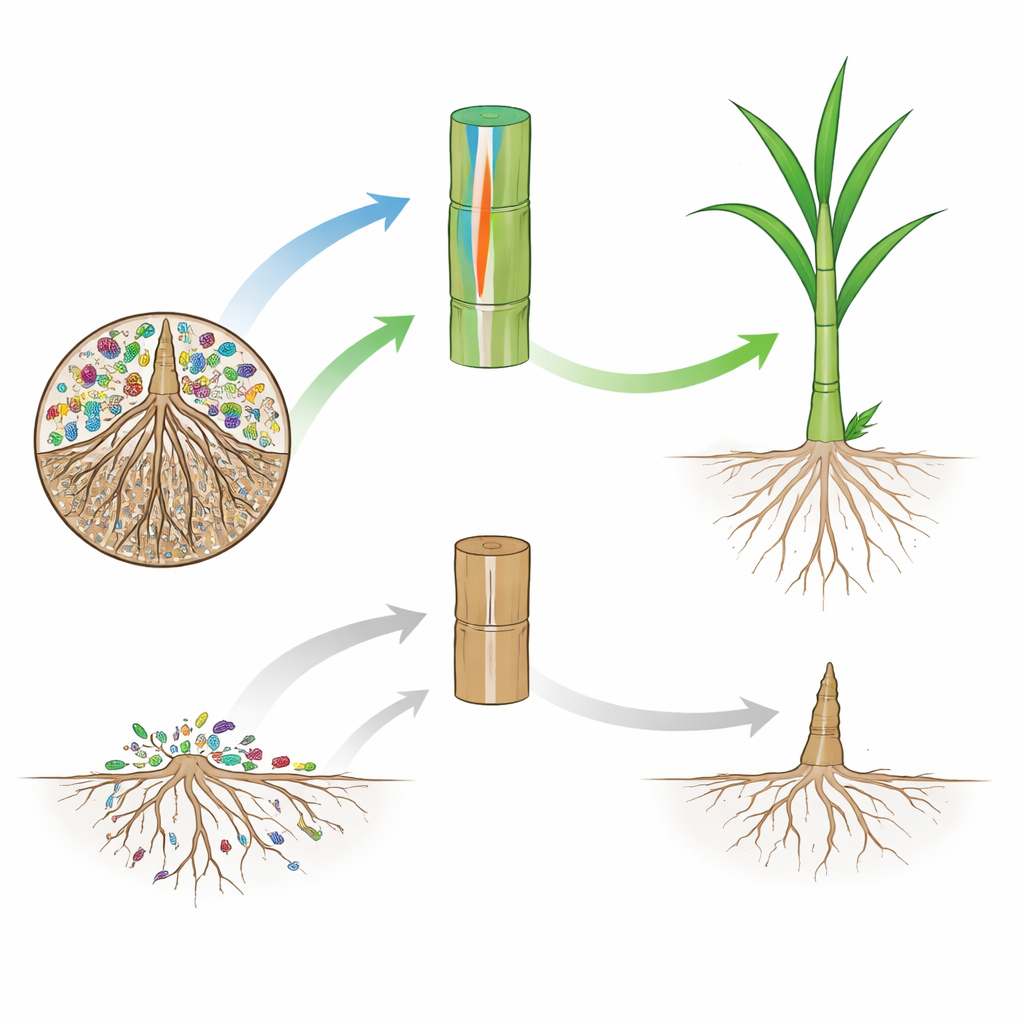
Networks linking microbes, nutrients, and growth signals
By combining all of these data in network analyses, the study revealed that specific clusters of microbes were strongly associated with particular nutrient and hormone patterns in different plant tissues. In high‑tillering cultivars, one microbial module correlated with higher nitrogen, phosphorus, and potassium in stems and elevated auxin in buds — a combination favorable for tiller formation. In low‑tillering cultivars, a different module tracked with greater abscisic acid in stems and higher calcium and manganese in buds, consistent with a more defensive, growth‑restraining state. These relationships are correlative rather than proof of cause and effect, but they outline how plant genetics, soil life, and internal chemistry can reinforce one another over time.
What this means for future sugarcane fields
In plain terms, high‑tillering sugarcane varieties seem to live in richer microbial neighborhoods that help them capture nutrients and send growth‑friendly signals to their buds, while low‑tillering varieties sit in more stressed communities that align with “stay dormant” messages. The work suggests that boosting sugarcane yields will require more than fertilizer and breeding alone. By deliberately managing the rhizosphere — through variety choice, soil amendments, or beneficial microbial inoculants — growers may be able to shift the balance toward cooperative root microbes, healthier nutrient profiles, and hormone patterns that encourage plants to produce more productive stalks.
Citation: Lu, Q., Chen, S., Shan, B. et al. Rhizosphere microbiome dynamics and hormonal interactions regulating tiller development in sugarcane cultivars. Sci Rep 16, 14500 (2026). https://doi.org/10.1038/s41598-026-38474-y
Keywords: sugarcane tillering, rhizosphere microbes, plant hormones, soil nutrients, plant–microbe interactions