Clear Sky Science · en
Anti-amoebic and biocompatible properties of nephrite-embedded contact lenses
Why a New Kind of Contact Lens Matters
For millions of people, contact lenses are part of everyday life. Yet in rare cases, lenses can open the door to a serious eye infection caused by a tiny organism called Acanthamoeba, which can threaten sight and be very hard to treat. This study explores an innovative idea: building a protective mineral, nephrite, directly into soft contact lenses to help stop these microbes from sticking to the lens in the first place, while still keeping the lens safe and comfortable for the eye.
The Hidden Risk on the Lens Surface
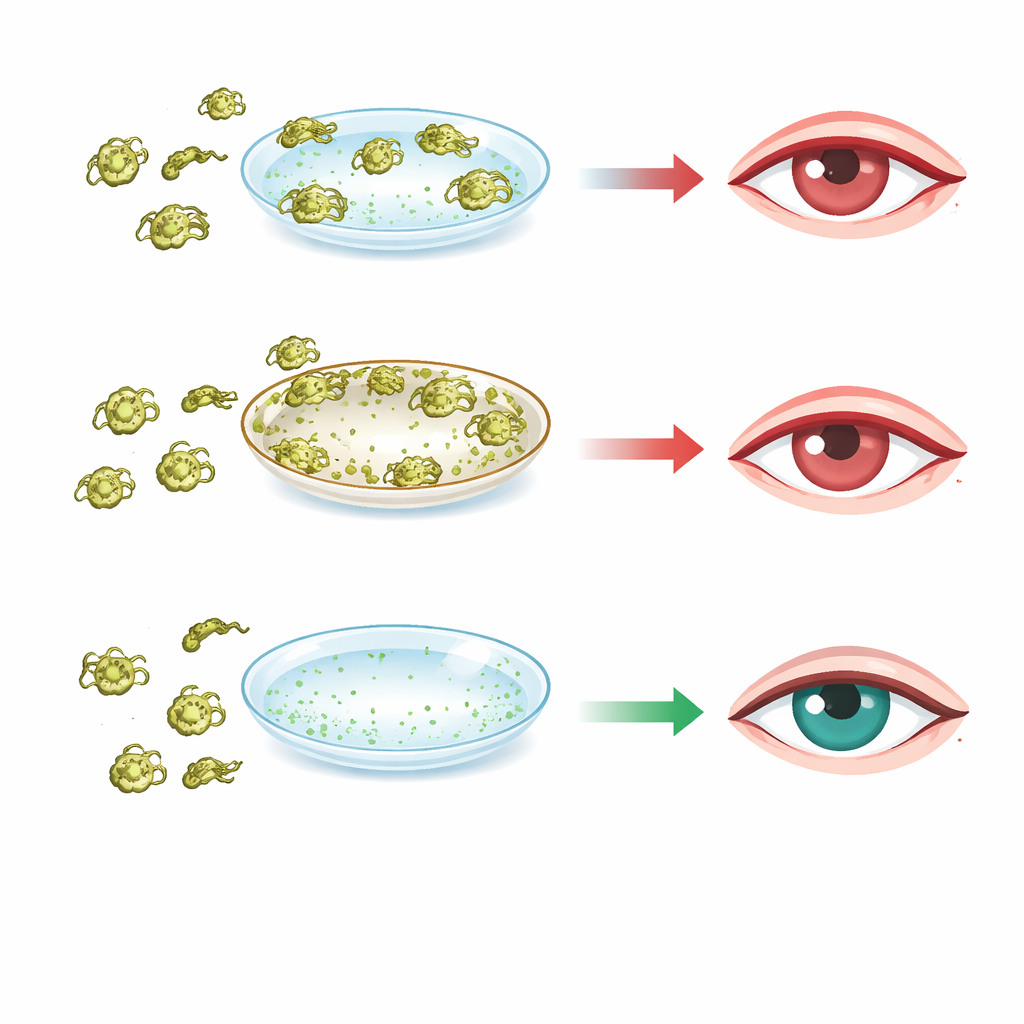
Acanthamoeba lives almost everywhere—in soil, tap water, swimming pools, and even air. Most of the time it is harmless, but when its active form, called a trophozoite, latches onto a contact lens and then the cornea, it can trigger Acanthamoeba keratitis, a painful and sometimes blinding infection. Treatment is difficult because the organism can transform into a hardy cyst that resists many drugs. Since the very first step in disease is the microbe attaching to the lens surface, the authors reasoned that a lens material that naturally discourages attachment could offer powerful, built-in protection.
Building Mineral Protection Into Soft Lenses
The researchers compared three soft lens types: a standard clear lens, a cosmetic lens with a colored pattern, and a newly designed lens containing tiny nephrite particles. Nephrite is a calcium–magnesium–iron silicate mineral known from earlier work to have antimicrobial and anti-inflammatory effects. To keep vision clear and the eye safe, the team used a manufacturing method that traps a thin layer of nephrite powder inside the lens polymer, away from direct contact with the cornea and outside the central line of sight. Microscopy confirmed that the mineral particles were well dispersed within the lens material and that the central optical zone remained highly transparent.
How the Lenses Fared Against the Microbe
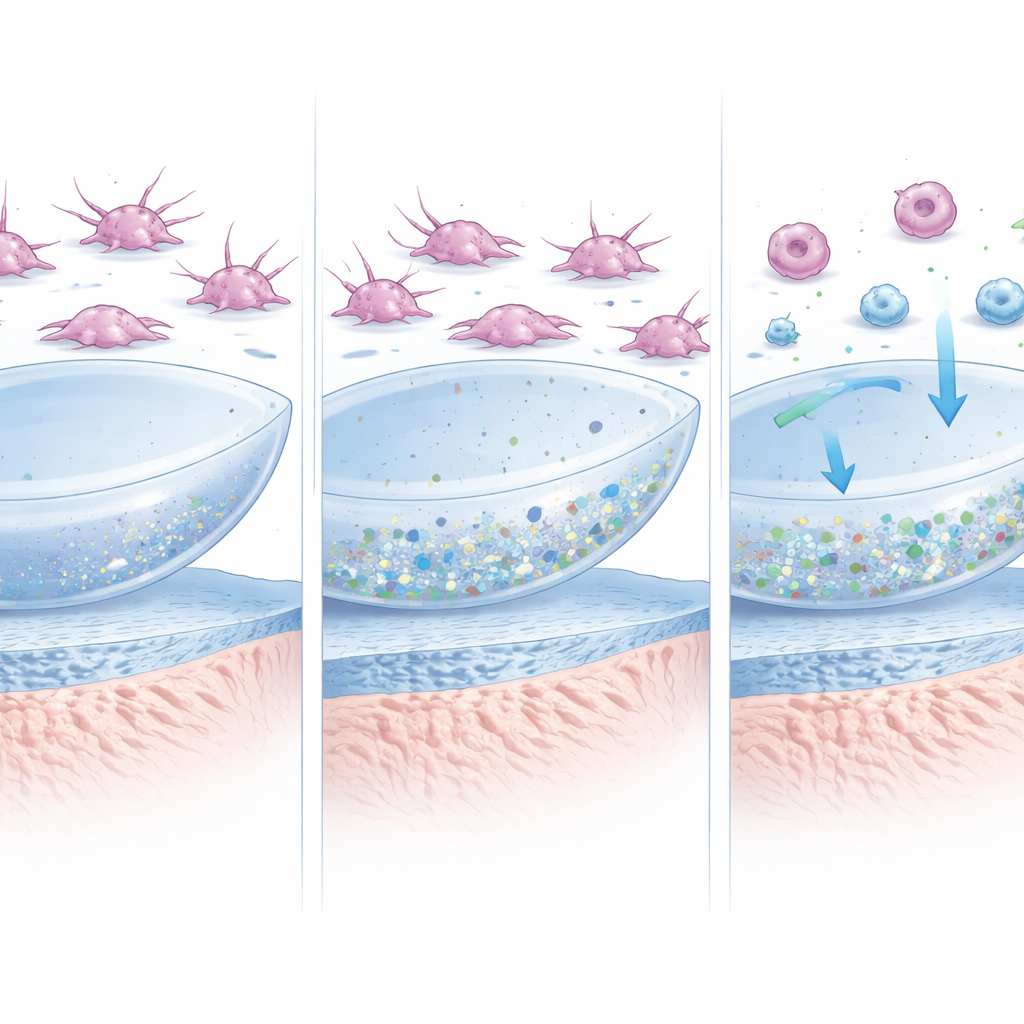
To test how well the lenses resisted Acanthamoeba, the scientists grew the organisms in the lab and exposed each lens type to a controlled number of trophozoites. Under the microscope, the cosmetic lenses attracted the most attached microbes, the clear lenses somewhat fewer, and the nephrite-embedded lenses the least. In fact, the mineral lenses cut adhesion by more than 70 percent compared with cosmetic lenses. High-resolution images showed another striking difference: on regular and cosmetic lenses, the amoebae spread out with many arm-like projections, signaling firm grip and active behavior. On nephrite lenses, they appeared more round and shrunken, with fewer projections—signs of stress or early transition toward the tougher cyst form, which is less actively invasive.
Balancing Protection and Eye Safety
An important question was whether adding mineral particles would make the lens surface rougher in a way that might either attract more microbes or irritate the eye. Surface scans did show that nephrite lenses were rougher than clear ones, though smoother than cosmetic lenses. Yet, despite this added texture, they still had far fewer microbes attached, suggesting that chemical or ionic effects from the mineral, rather than roughness alone, were key. To check safety, the team placed each type of lens on rabbit eyes for 24 hours. Afterward, the corneas were clear, with no signs of swelling, scarring, or inflammation, and the inner cell layer of the cornea remained healthy. The nephrite lenses performed as safely as standard clear lenses in these short-term tests.
What This Could Mean for Everyday Lens Wearers
In plain terms, this work suggests that weaving a bioactive mineral into the body of a contact lens can make it less welcoming to dangerous microbes without harming the eye, at least over a day of wear in animals. The nephrite-embedded lenses reduced the ability of Acanthamoeba to stick and showed hints of pushing the organism toward a less aggressive state, all while keeping the cornea intact and clear. Although longer and broader studies are needed before such lenses reach the market, this approach points toward a future where contact lenses themselves help guard against severe infections, rather than relying only on cleaning solutions and careful handling.
Citation: Park, J.H., Cho, C.H., Ahn, J.H. et al. Anti-amoebic and biocompatible properties of nephrite-embedded contact lenses. Sci Rep 16, 11114 (2026). https://doi.org/10.1038/s41598-026-38469-9
Keywords: contact lens infection, Acanthamoeba keratitis, antimicrobial biomaterials, nephrite mineral, eye safety