Clear Sky Science · en
Predicting porosity in composite high-pressure hydrogen vessels using augmented fuzzy cognitive AI and manufacturing process parameters
Why tiny bubbles matter in hydrogen tanks
High-pressure hydrogen tanks are a backbone of future clean mobility, from fuel‑cell cars to industrial storage. These vessels must be both very strong and very light, which is why they are built from layers of carbon‑fiber composite wrapped around a plastic liner. But inside these layers, tiny voids—called porosities—can form. Too many, or in the wrong place, and a tank that should last for years could fail. This study explores how an interpretable form of artificial intelligence can learn from real factory data to predict how many porosities will appear in a tank, and which parts of the winding process matter most for keeping them under control.
Building a safer hydrogen shell
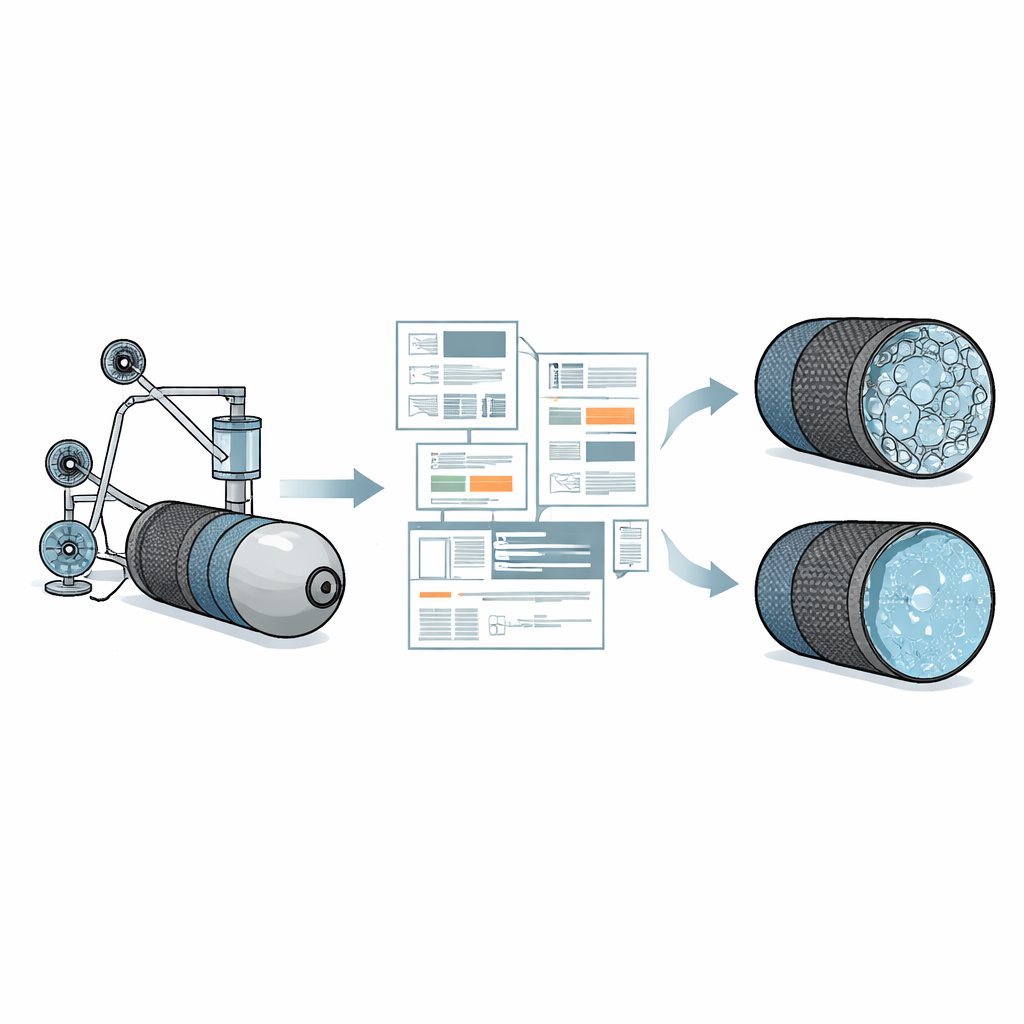
The tanks examined in this work are so‑called Type IV hydrogen vessels, used in vehicles and stationary systems. They consist of a polymer liner wrapped with many layers of carbon fibers soaked in resin, a process known as wet filament winding. During winding, dozens of parameters can be tuned: how tightly each fiber spool is pulled, how fast the inner mandrel rotates, the angle at which fibers cross the surface, how quickly layers are deposited, and how much resin a small metal blade spreads over the fibers. Certification rules allow some level of porosity, but excessive voids weaken the structure and can threaten safety. Because the physical interplay between all these factors is extremely complex, the authors turned to data‑driven modeling instead of trying to write down a full physics equation.
Transparent artificial intelligence for high‑risk systems
European regulations classify decisions about hydrogen tank safety as high‑risk uses of AI. That means models cannot be black boxes: engineers and regulators must be able to understand how predictions are made. Methods such as deep neural networks or large ensembles of decision trees can be accurate, but their internal logic is essentially opaque. The authors therefore used XTRACTIS, a so‑called Augmented Fuzzy Cognitive AI. Rather than hiding its reasoning, XTRACTIS automatically builds sets of human‑readable IF…THEN rules that link selected process variables to outcomes. It also scores how simple or complex a model is, rewarding versions that rely on fewer inputs and rules while still predicting well.
From factory measurements to learned rules
Gathering data on real tanks is expensive because each full‑scale vessel costs several thousand euros and must be scanned by 3D X‑ray tomography. The study therefore worked with just 12 tanks, divided into 180 individual winding layers. For each layer, 58 potential predictors describing tensions, speeds, angles, resin control and other design choices were available, along with X‑ray‑measured porosities. The team focused on predicting the logarithm of the number of pores rather than the raw count, which smooths out extreme values. XTRACTIS explored thousands of model configurations and used a rigorous cross‑validation strategy, repeatedly training and testing on different splits of the data to avoid overfitting. It then distilled the best ensemble of models into a single, simpler rule‑based “virtual expert.” On unseen test layers, this expert reproduced pore counts with good accuracy, with prediction errors under about 8 percent and a strong correlation between predicted and observed values.
What the model reveals about making better tanks
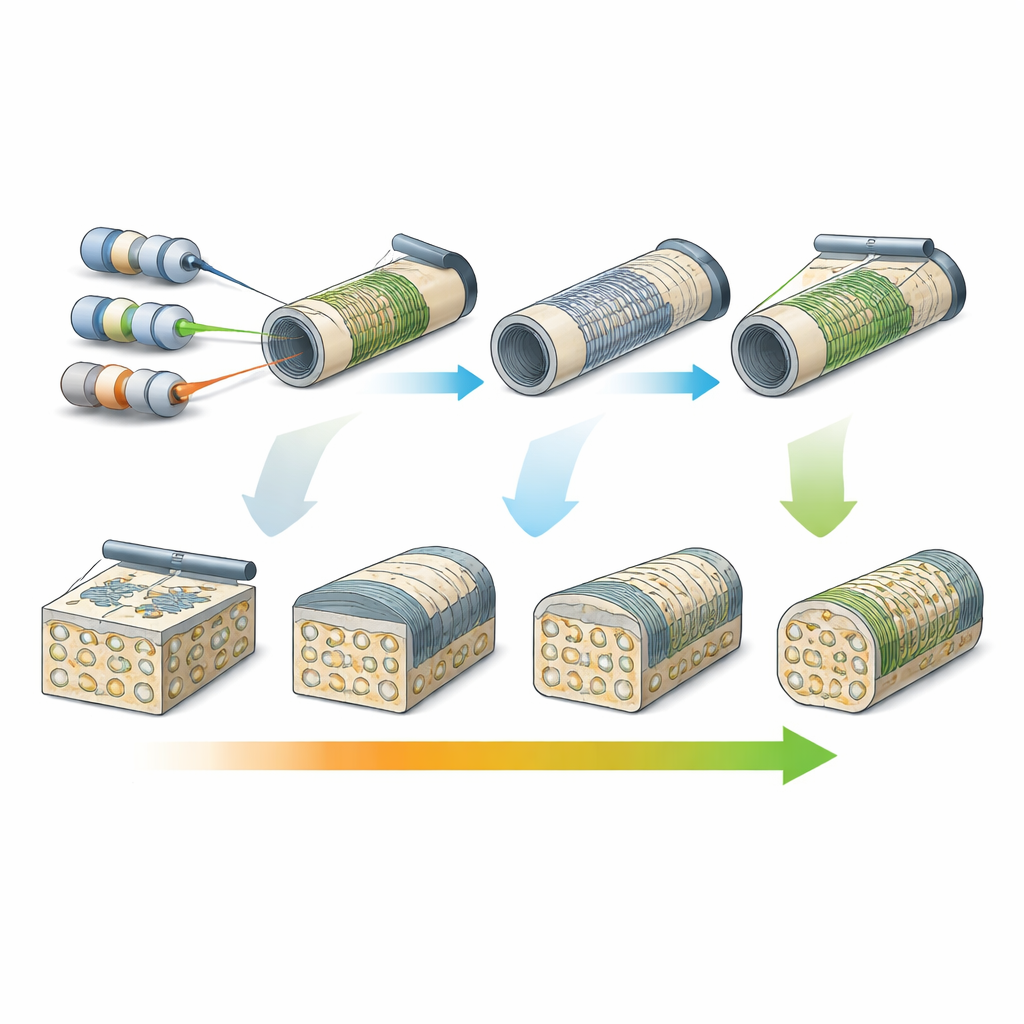
Because the final model is expressed as a small set of fuzzy IF…THEN rules, its behavior can be read almost like engineering guidelines. The rules show that keeping fiber tension uniform and within a healthy range is crucial: when tensions on different fiber spools vary too much, some regions become slack while others are over‑tight, creating conditions for extra voids. The rotation speed of the mandrel and the winding angle jointly shape how densely and evenly fibers pack; too low a speed and too shallow an angle give poor compaction and resin distribution. Another key element is resin control through the doctor blade and the total volume of each layer. Well‑tuned resin flow prevents both dry fiber zones and resin‑rich pockets, each of which encourages bubbles. The model also suggests that smaller, more stable fiber spools may help keep tensions steady, further reducing porosity.
Limits of the data and lessons for quality control
The researchers also tried to train models to classify each layer into low versus medium‑or‑high porosity rate, a measure often used on the factory floor. Both XTRACTIS and an opaque boosted‑tree algorithm performed poorly on truly new data in this task. Later checks revealed that the porosity rate labels themselves were noisy, because all pores had been assumed spherical and automatically assigned to layers in a simplified way. This mislabeling likely blurred the boundary between classes. The contrast is instructive: where the target values are reliable, transparent AI can perform well even with limited data; where the labels are doubtful, no algorithm can salvage them. Overall, the study shows that interpretable fuzzy‑rule models can both guide engineers toward safer process settings and highlight weaknesses in measurement and data preparation.
A clearer path to safer hydrogen storage
In plain terms, this work demonstrates that an explainable AI system can learn from a modest amount of factory data to anticipate how many microscopic voids will form inside a hydrogen tank’s composite shell, and to pinpoint which knobs on the production line matter most. The resulting rules translate complex mathematics into understandable process advice: keep fiber tensions steady, choose suitable winding speeds and angles, and carefully control resin flow and layer volume. While more and better data will be needed to refine these insights and validate them on new tanks, the approach offers a promising blueprint for making hydrogen storage safer, not by replacing engineers, but by giving them a transparent partner that turns scattered measurements into actionable understanding.
Citation: Achour, L., Zalila, Z., Aboura, Z. et al. Predicting porosity in composite high-pressure hydrogen vessels using augmented fuzzy cognitive AI and manufacturing process parameters. Sci Rep 16, 9894 (2026). https://doi.org/10.1038/s41598-026-38447-1
Keywords: hydrogen storage, composite materials, manufacturing defects, explainable AI, filament winding