Clear Sky Science · en
Computational investigation on the hydrodynamic performance of a vertically submerged plate-type wave energy converter under variable relative openings
Why waves can power our future
Ocean waves carry a huge amount of clean energy, but most devices that try to harvest it are complex and costly. This study looks at a surprisingly simple idea: a thin vertical plate hidden under the sea surface that reshapes the water flow so it can drive a turbine more efficiently. By probing how waves interact with this plate and a shaped seabed beneath it, the researchers explore a new way to draw more power from each passing wave.
A hidden plate beneath the waves
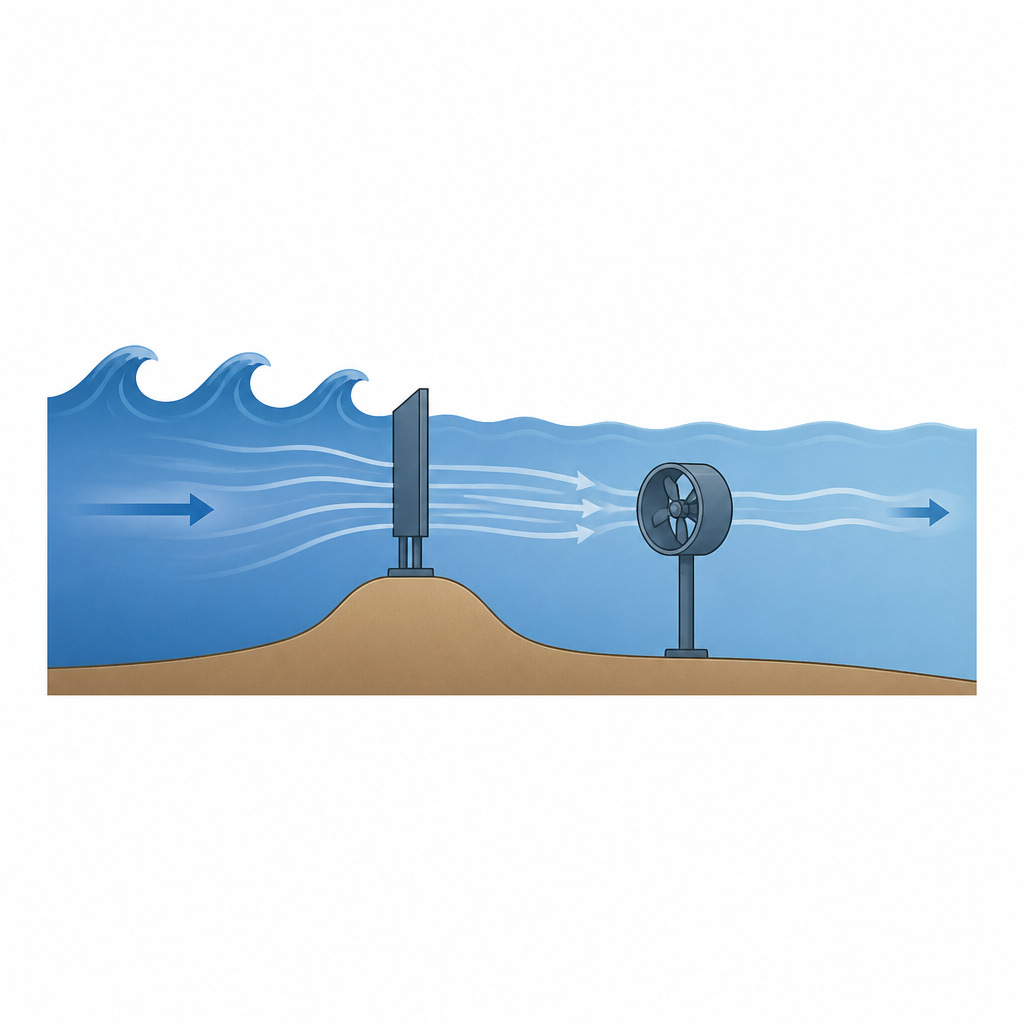
The device at the heart of this work is a stationary submerged thin vertical plate placed just below the water surface. Waves approaching the plate are partly reflected and partly forced to speed up as they squeeze through an opening between the plate and the seabed. Downstream, this faster flow can drive an axial turbine, similar in spirit to a small underwater windmill. The key design question is how large that opening should be, and how the seabed shape below the plate influences the amount of useful energy that ends up in the fast-moving water.
Building a digital wave tank
Instead of experimenting at sea, the team built a detailed computer model of a wave tank using ANSYS Fluent software. They simulated two layers of fluid, air above and water below, and generated realistic waves at one end of the tank while absorbing them at the other to avoid unwanted reflections. Within this numerical tank they placed the submerged plate, sometimes over a flat bottom and sometimes over a raised trapezoid-shaped seabed that created a narrowed passage under the plate. By tracking both the water surface and the flow speed around the plate, they were able to estimate how much of the incoming wave power could be converted into useful flow power for the turbine.
Testing different openings and seabeds
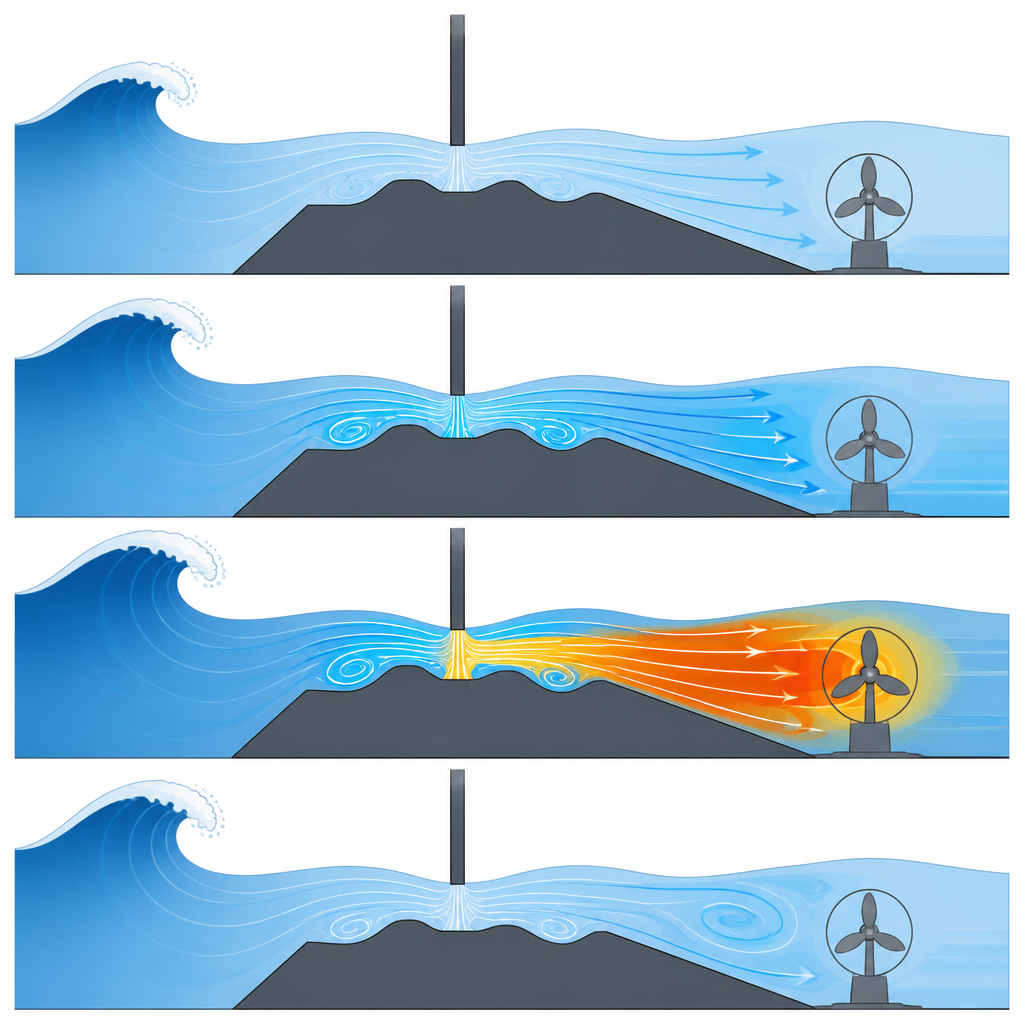
The researchers varied two main ingredients: the height of the gap under the plate, called the relative opening, and the strength of the waves, expressed through their height and period. They also compared flat and uneven seabeds by changing the height of the trapezoid structure under the plate. Their simulations showed that as waves interact with the shaped seabed, the water is funneled and accelerated beneath the plate, forming strong jets and swirling patterns that carry more kinetic energy. This effect was much weaker over a flat seabed, where the flow stayed more uniform and less energetic.
Finding the sweet spot for flow and efficiency
By examining the flow speed beneath the plate for many combinations of wave height and period, the team identified conditions where the water velocity and thus the potential power were highest. They found that both the steepness of the waves and the size of the opening matter. For relatively steep waves, the axial flow speed peaked at a specific wave period of about 1.87 seconds. Crucially, a relative opening of 50 percent produced the best hydrodynamic efficiency, meaning the largest share of wave power was converted into fast, turbine-ready flow. With this opening and a trapezoid seabed, the device outperformed the flat-bottom case and other gap sizes by a clear margin.
What this means for wave energy
In simple terms, this study shows that a modest change in underwater geometry can significantly boost how well a wave energy device works. A thin submerged plate paired with a carefully sized opening and a shaped seabed can concentrate wave energy into a strong jet of water for an axial turbine. The results suggest that a 50 percent opening height, combined with certain wave conditions, offers the best balance between allowing water through and squeezing it enough to speed it up. While real oceans are more irregular than a digital wave tank, the findings give designers a clear starting point for building compact, efficient, and potentially cheaper wave energy converters that better match the natural shape of the seafloor.
Citation: Yadav, S.S., Roy, S. & Rathore, P.K.S. Computational investigation on the hydrodynamic performance of a vertically submerged plate-type wave energy converter under variable relative openings. Sci Rep 16, 14854 (2026). https://doi.org/10.1038/s41598-026-38433-7
Keywords: wave energy, renewable ocean power, submerged plate converter, seabed topography, computational fluid dynamics