Clear Sky Science · en
A novel dual-dimensional contrastive self-supervised learning-based framework for rolling bearing remaining useful life prediction
Why predicting wear before it happens matters
From wind turbines and bullet trains to factory robots, countless machines rely on rolling bearings—small metal components that keep shafts turning smoothly. When a bearing fails unexpectedly, the result can be costly downtime or even dangerous accidents. This study introduces a smarter way to estimate how much useful life a bearing has left, using vast amounts of vibration data and modern artificial intelligence. The approach is designed to be more accurate, more robust to noisy conditions, and far less dependent on expensive human labeling than many current methods.
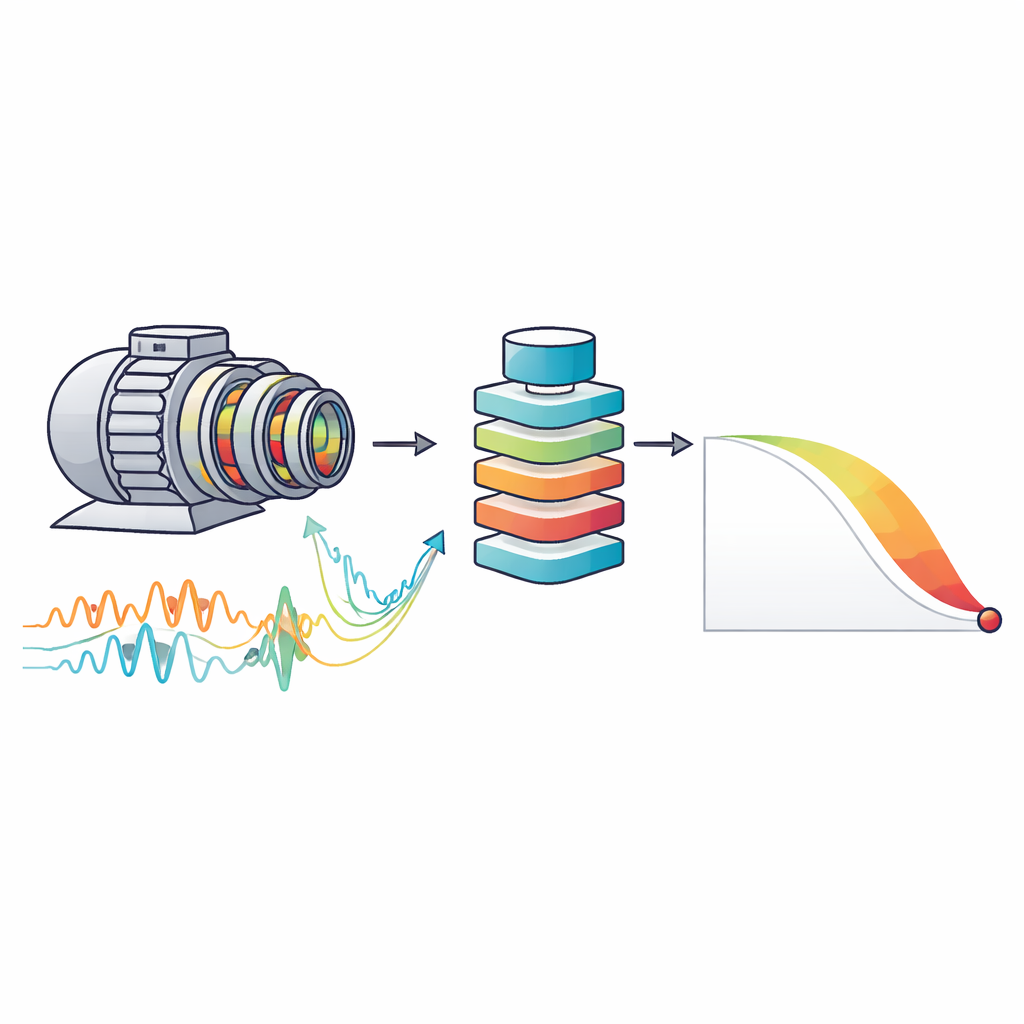
Listening to tiny vibrations to foresee failure
As a bearing ages, microscopic cracks and wear gradually change the way it vibrates. Engineers mount sensors on machines to record these vibration signals and try to infer how close the bearing is to failure—a quantity known as remaining useful life. Traditionally, this has been done either with physics-based formulas that require deep expert knowledge or with statistical models that need lots of complete failure data. More recently, deep learning systems have been trained to map raw signals directly to life estimates. However, these systems often act like black boxes: they may fit the data but produce internal representations that are jagged, inconsistent over time, and hard to interpret, which undermines reliability in real-world use.
Teaching machines to learn from unlabeled data
The authors propose a new framework, called DCSSL, that leans on self-supervised learning—a way for neural networks to teach themselves from unlabeled data. Instead of starting from hand-entered life labels, the model first studies raw vibration recordings and learns to predict missing parts of the signal from its surroundings and to distinguish one bearing’s state from another’s. This pre-training is guided by a contrastive strategy: the system is shown two slightly different slices of the same underlying signal and encouraged to treat them as related, while treating slices from different bearings or times as distinct. In doing so, it discovers smooth, progressive patterns that reflect how mechanical health changes over time, long before any explicit lifetime numbers are introduced.
Zooming in on time and across bearings at once
A key innovation is the “dual-dimensional” nature of the learning objective. First, along the time axis, the model is trained to understand how the condition of a single bearing evolves: overlapping segments of the same signal are cropped, and some time points are deliberately masked. The network must reconstruct the missing behavior from nearby points, nudging it to capture gradual degradation rather than random noise. Second, across different bearings, the system learns to tell apart their individual trajectories, even if they age in slightly different ways. By balancing these two pressures—smooth change over time and clear separation between machines—the learned representation becomes both interpretable and predictive of future wear.
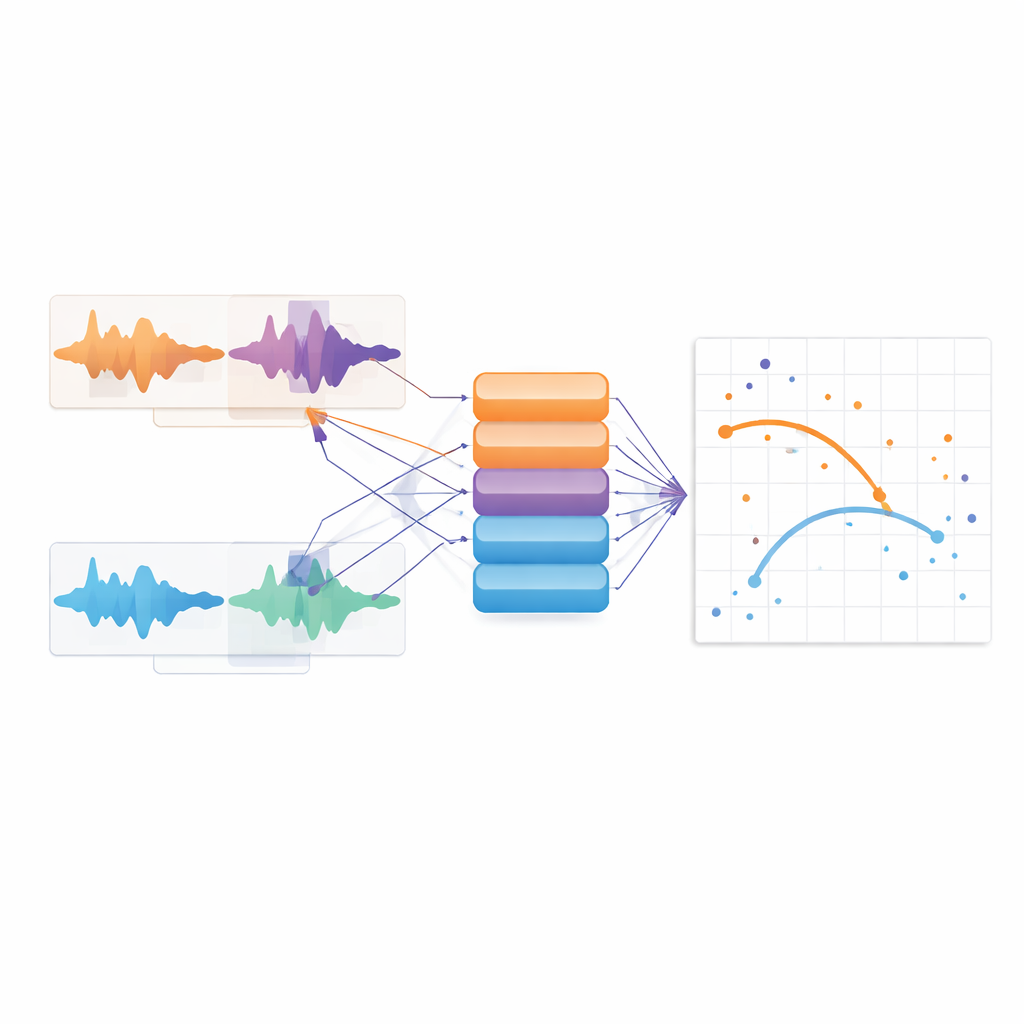
A faster, more faithful view of degradation
To model sequences efficiently, the framework uses a dilated causal convolution network. Unlike conventional recurrent models that can be slow and hard to train, this structure can “see” far back in time while still respecting cause and effect—present estimates only depend on current and past signals, not future ones. After the self-supervised stage, a simple prediction layer is attached and fine-tuned on a smaller set of vibration recordings that do have known failure times. The authors tested their method on a widely used bearing benchmark, where bearings are run until failure under controlled loads and speeds. Compared with several leading deep learning baselines, the new approach consistently produced lower errors and more stable predictions, particularly avoiding extreme misjudgments near the start or end of life.
What this means for real machines
For a non-specialist, the bottom line is that DCSSL delivers a clearer, smoother estimate of how a bearing is wearing out, and it can do so using far more of the data that is already being collected but not manually labeled. Its predictions track the real degradation curve more faithfully: flat during healthy operation, then steadily dropping as damage accumulates, without erratic jumps. This makes it easier for engineers to schedule maintenance before problems become critical, cutting downtime and improving safety. While the current study focuses on one dataset and fixed operating conditions, the underlying idea—letting machines teach themselves degradation patterns before learning to predict lifetime—offers a promising route toward more reliable, data-efficient health monitoring across many types of industrial equipment.
Citation: Shen, Z., Yang, C., Cheng, L. et al. A novel dual-dimensional contrastive self-supervised learning-based framework for rolling bearing remaining useful life prediction. Sci Rep 16, 13364 (2026). https://doi.org/10.1038/s41598-026-38417-7
Keywords: bearing remaining useful life, self-supervised learning, contrastive learning, vibration condition monitoring, predictive maintenance