Clear Sky Science · en
Water geochemistry in the Bozhi-Dabei area, Tarim Basin and its implications for natural gas accumulation in deep basin
Why the water under a gas field matters
Deep beneath deserts and mountain belts, vast stores of natural gas are locked in rocks kilometers below our feet. We usually think only about the gas itself, but this study shows that the water trapped and produced with that gas can act like a secret archive. By reading the chemical and isotopic fingerprints of these waters in the Bozhi–Dabei gas field of China’s Tarim Basin, the authors reconstruct how rain, ancient seas, and buried organic matter worked together over millions of years to fill a giant deep reservoir with gas.
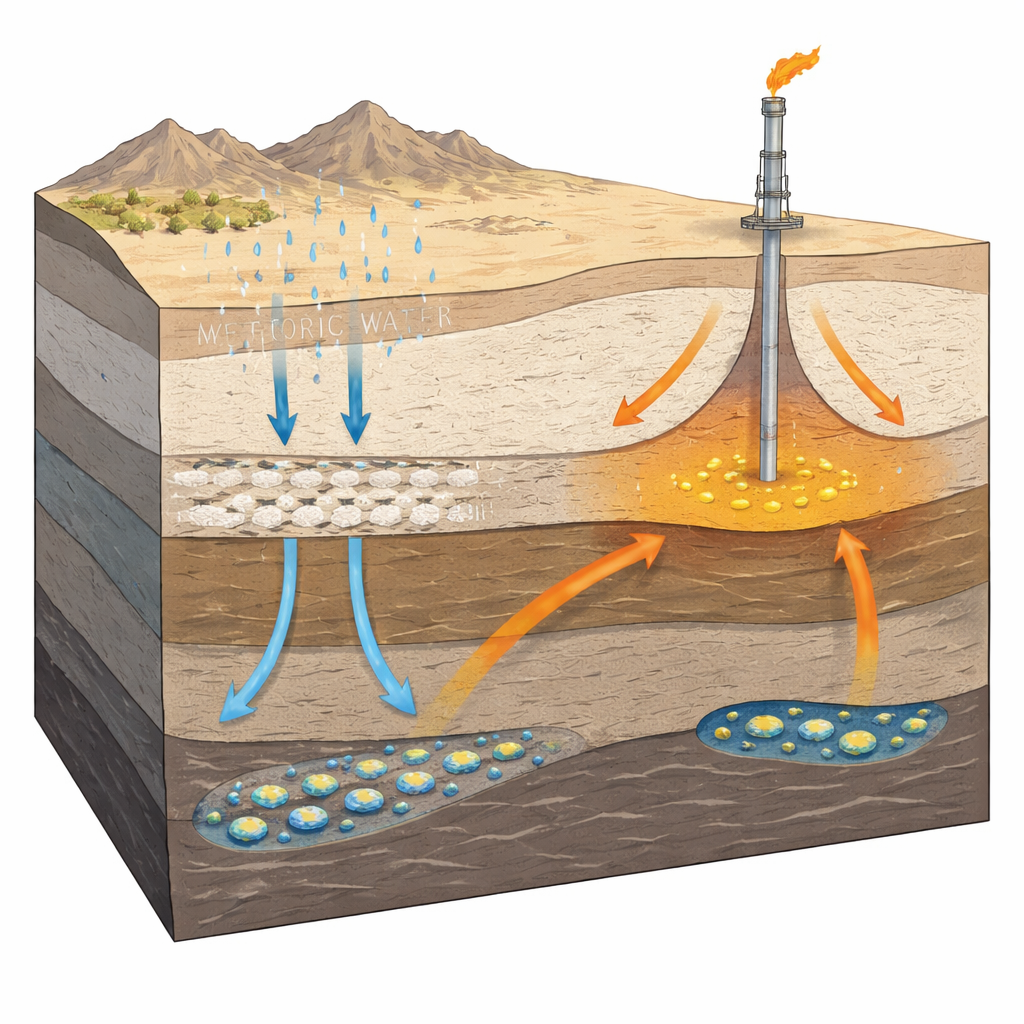
Two very different kinds of underground water
The researchers sampled water from wells drilled 4 to 7 kilometers deep into Cretaceous sandstone layers. They found that not all produced water is the same. One part is “formation water” that has been sitting in the rocks for geological time, carrying a heavy load of dissolved salt and other ions. The other part is “condensed water” that forms when hot gas cools as it rises toward the surface, creating a much fresher, more dilute liquid. By comparing total dissolved solids, major ions, and hydrogen–oxygen isotopes, the team could separate salty, long‑resident formation water from this lighter condensed water, and identify wells where the two were mixed.
From rain and salt beds to a deep brine
The chemistry of the formation water points to two main origins. Most of it began as ordinary rain and river water that seeped down from the surface and later flowed through thick layers of rock salt. As it dissolved the salt, it picked up large amounts of sodium and chloride, becoming a concentrated brine. A smaller but crucial portion came from seawater that once flooded the region during Triassic and Jurassic times. That seawater later evaporated and became trapped in organic‑rich muds. There, as buried plant material turned into oil and gas, the pore water picked up high levels of iodine, a trace element closely tied to organic matter. Eventually, this iodine‑rich brine migrated upward together with natural gas into the sandstone reservoirs.
Following iodine to track gas migration
Because iodine has a long‑lived radioactive form, iodine‑129, it can serve as a natural clock. The authors measured iodine‑129 in the formation waters and built a model to estimate when the iodine‑rich brine, and the gas that traveled with it, entered different parts of the field. Although the absolute ages are imprecise, the relative pattern is clear: some wells in the eastern part of the field were charged earlier, with less mature gas, while others received later pulses of more “dry” gas richer in methane. This sequence matches the history of large thrust faults that slice through the region; as individual faults opened over time, they provided new pathways for gas‑bearing brines to rise from deep source rocks into the reservoir.
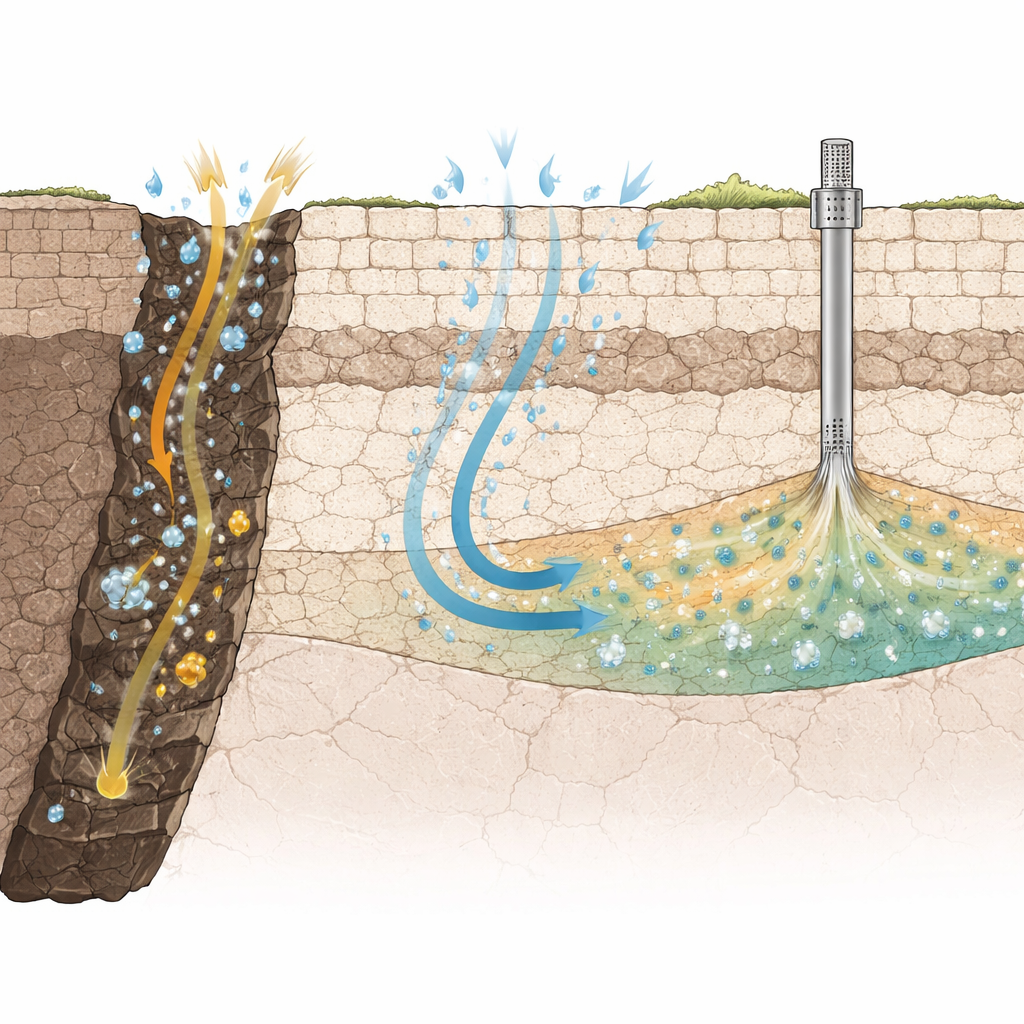
A changing mix shaped by deep geology
The study also reveals that the chemistry of the trapped water has continued to evolve. As brine moved through sandstones rich in various minerals, it exchanged elements with the rock, enriching the water in components such as lithium and potassium. At the same time, repeated episodes of oil and then gas entering the reservoir displaced earlier fluids and mixed them with newly arriving brines and, more recently, with condensed water formed during production. The end result is a complex but interpretable blend that records both the movement of fluids and the shifting structure of the basin over tens of millions of years.
What this means for deep gas exploration
For a non‑specialist, the key message is that water in deep gas fields is far more than a nuisance by‑product. In the Bozhi–Dabei field, its dissolved salts and isotopes show that rainwater, ancient seas, and organic‑rich rocks all contributed to the present‑day reservoirs, and that gas arrived in several distinct waves guided by growing faults and thick salt seals. By treating formation water as a geological storyteller—especially using tracers like iodine‑129—scientists can better pinpoint where gas came from, how and when it moved, and why some deep structures hold large gas accumulations while others do not.
Citation: Chen, J., Fan, Y., Jia, W. et al. Water geochemistry in the Bozhi-Dabei area, Tarim Basin and its implications for natural gas accumulation in deep basin. Sci Rep 16, 11039 (2026). https://doi.org/10.1038/s41598-026-38393-y
Keywords: formation water, deep natural gas, Tarim Basin, iodine isotopes, fluid migration