Clear Sky Science · en
Advanced analysis and detection of cervical cancer using NASNetLarge
Why this matters for women’s health
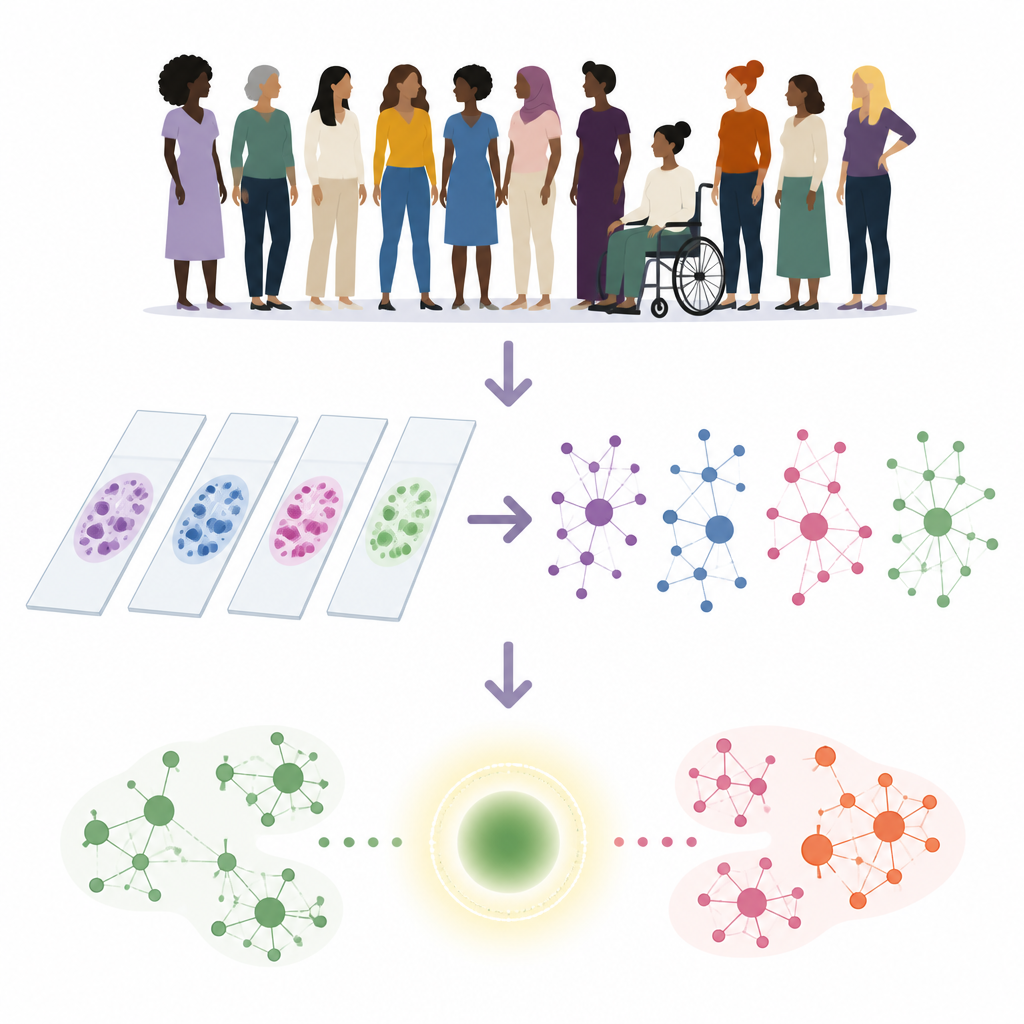
Cervical cancer is one of the leading causes of cancer deaths among women worldwide, yet it is highly treatable when found early. Traditional screening relies on experts visually inspecting Pap smear slides, a painstaking task that can miss subtle warning signs. This study explores how a modern form of artificial intelligence can turn Pap smear images into structured patterns a computer can read, aiming to spot risky cell changes more consistently and quickly than the human eye alone.
A fresh look at Pap smear images
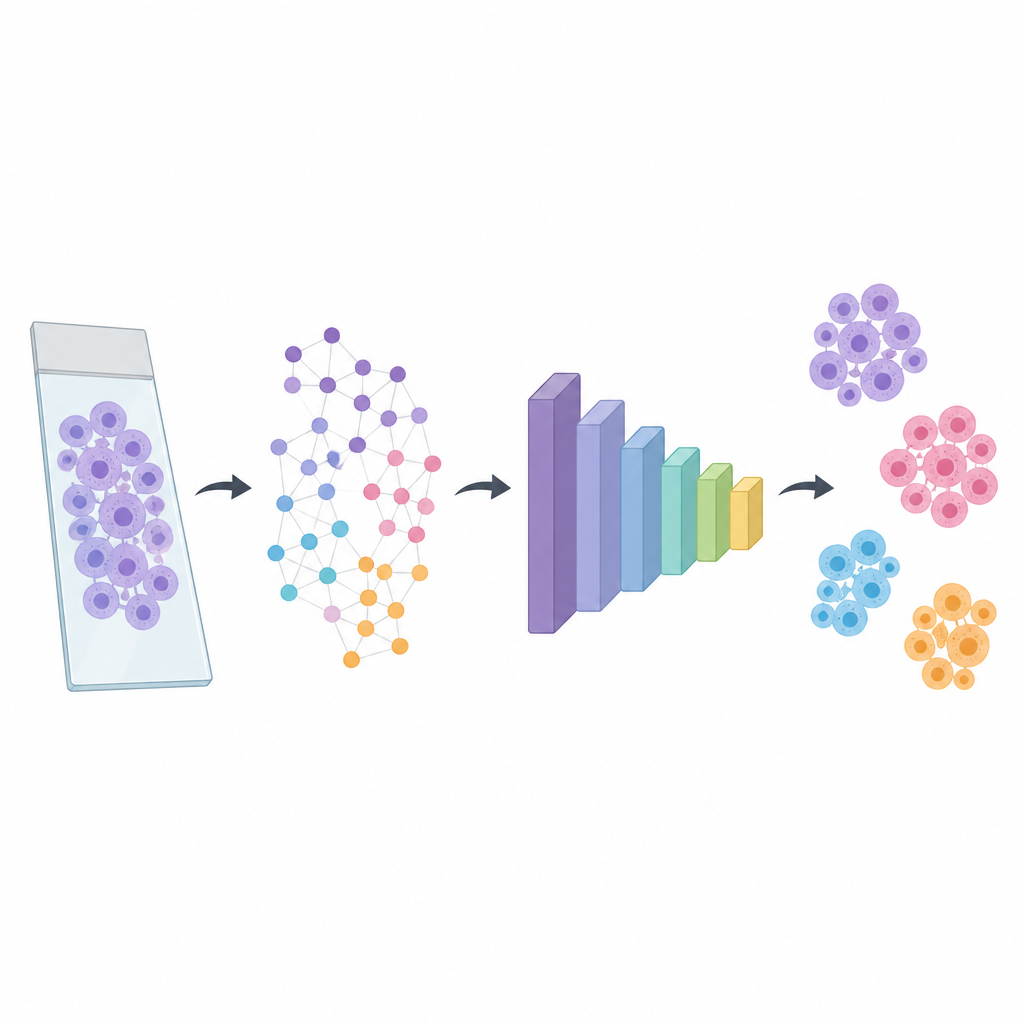
The researchers focus on Pap smear images from a public dataset of 300 samples, evenly divided into five types of cervical cells ranging from normal to clearly abnormal. Instead of feeding these images directly into a standard image-recognition system, they first convert each slide into a map of tiny regions and their relationships. In this map, each cell-like region becomes a point and the spatial links between regions become connecting lines. This graph-style picture captures not just how cells look, but how they are arranged, which often holds important clues about disease.
How the smart model learns from patterns
To read these graph-based pictures, the team uses NASNetLarge, a powerful deep learning model originally trained on millions of everyday photographs. Through a technique called transfer learning, they keep the model’s built-in ability to recognize complex visual patterns but retrain its final layers to tell apart the five cervical cell categories. They also expand the small dataset by creating varied versions of each image using flips, rotations, zooms and shifts. This process helps the model see many believable examples, reducing the risk that it simply memorizes the training data instead of learning general rules.
Seeing what the computer pays attention to
Beyond raw accuracy, the study asks whether the model is looking at the right parts of the image. The authors use a visualization method that highlights the zones most responsible for each decision, overlaying heatmap-like colors on the graph pictures. These views show that the model focuses on clusters and boundaries that pathologists also regard as important. This makes its behavior easier for clinicians to interpret and trust, and it hints that the graph-based representation successfully captures meaningful structure rather than random noise.
How well the system performs
Trained on the graph-transformed Pap smear images, NASNetLarge reaches about 94% accuracy on the training data and 98.33% accuracy on held-out validation data, with high scores for precision, recall and F1 across all five cell types. An ablation study shows that skipping the graph conversion step drops accuracy to about 83%, underlining the value of encoding cell relationships. The model is also tested on a separate colposcopy image collection and again achieves very high accuracy, suggesting that the approach can generalize beyond the original dataset while remaining feasible to run on modest hardware.
What this could mean for future screening
In simple terms, the study shows that turning Pap smear images into structured maps and analyzing them with a tailored deep learning model can classify cervical cells with strong accuracy and low error rates. While the work still needs larger and more diverse datasets before use in everyday clinics, it points toward tools that could support clinicians by flagging suspicious slides, standardizing quality and extending expert-level screening to regions with limited specialists. For patients, that could ultimately translate into earlier detection and more timely treatment of cervical cancer.
Citation: Bilgaiyan, S., Swain, A., Das, S. et al. Advanced analysis and detection of cervical cancer using NASNetLarge. Sci Rep 16, 14875 (2026). https://doi.org/10.1038/s41598-026-38341-w
Keywords: cervical cancer, Pap smear, deep learning, medical imaging, AI screening