Clear Sky Science · en
Machine learning methods for designing a carbon dot based photoluminescent multimodal nanosensor
Why tiny glowing dots could help clean our water
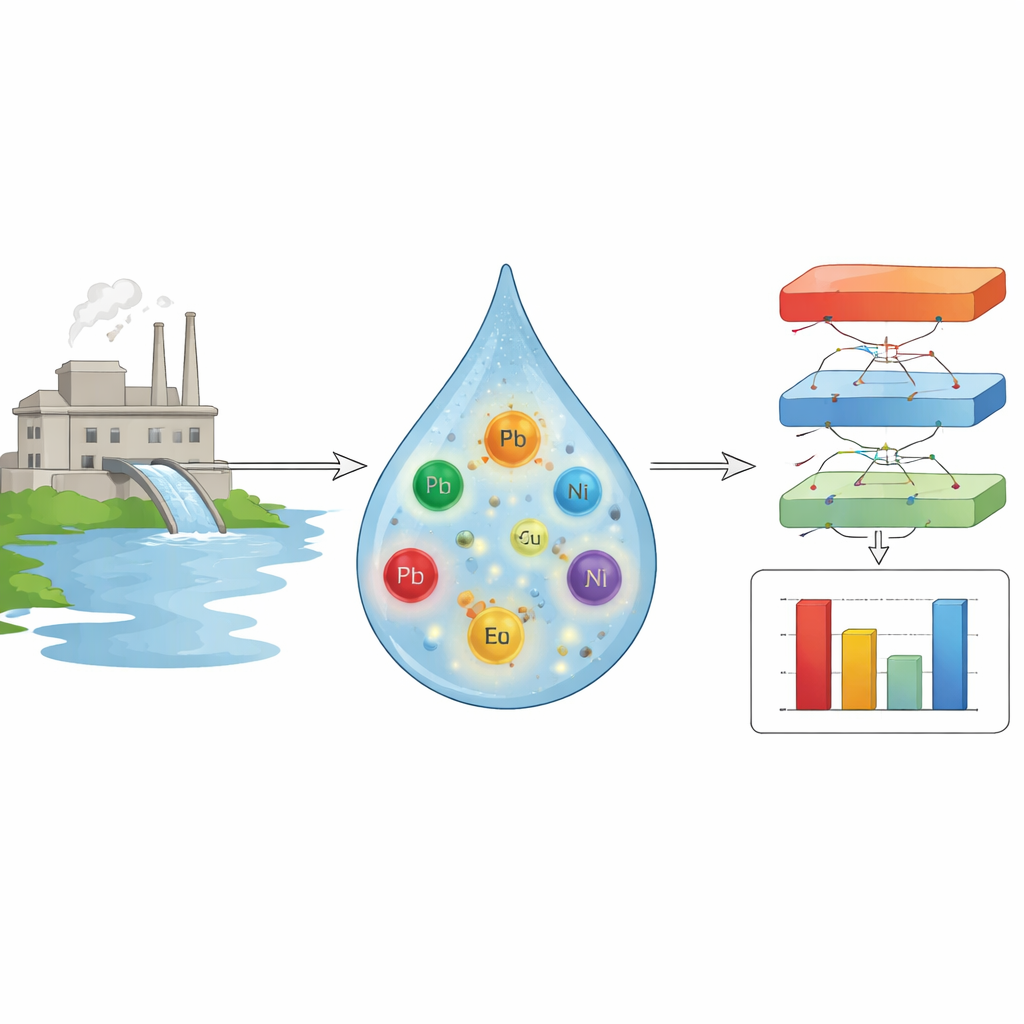
Heavy metals and excess nitrate in water are invisible to the naked eye, yet they can quietly damage ecosystems and human health. Checking for many different ions at once usually means slow, lab‑based tests and bulky instruments. This paper describes a new kind of “smart” optical sensor built from carbon dots—nanoscale glowing particles—combined with modern machine learning. Together they form a compact system that can read out the mix of several harmful ions in water from a single flash of light.
Building a light‑based water watchdog
The heart of the sensor is a solution of carbon dots made from inexpensive starting materials: citric acid and ethylenediamine, processed in a simple high‑temperature water‑based reaction. These particles are only about 10 nanometers across and shine strongly when illuminated, a property known as photoluminescence. Their glow is very sensitive to the chemical environment. When various metal ions and nitrate are present in water, they dim and subtly reshape the emitted light in ways that depend on which ions are there and at what concentrations. The authors prepared thousands of water samples containing fixed amounts of carbon dots and different mixtures of six heavy‑metal ions (copper, nickel, cobalt, lead, aluminum, chromium) plus nitrate, covering a range relevant to industrial wastewater.
Turning complex colors into clear numbers
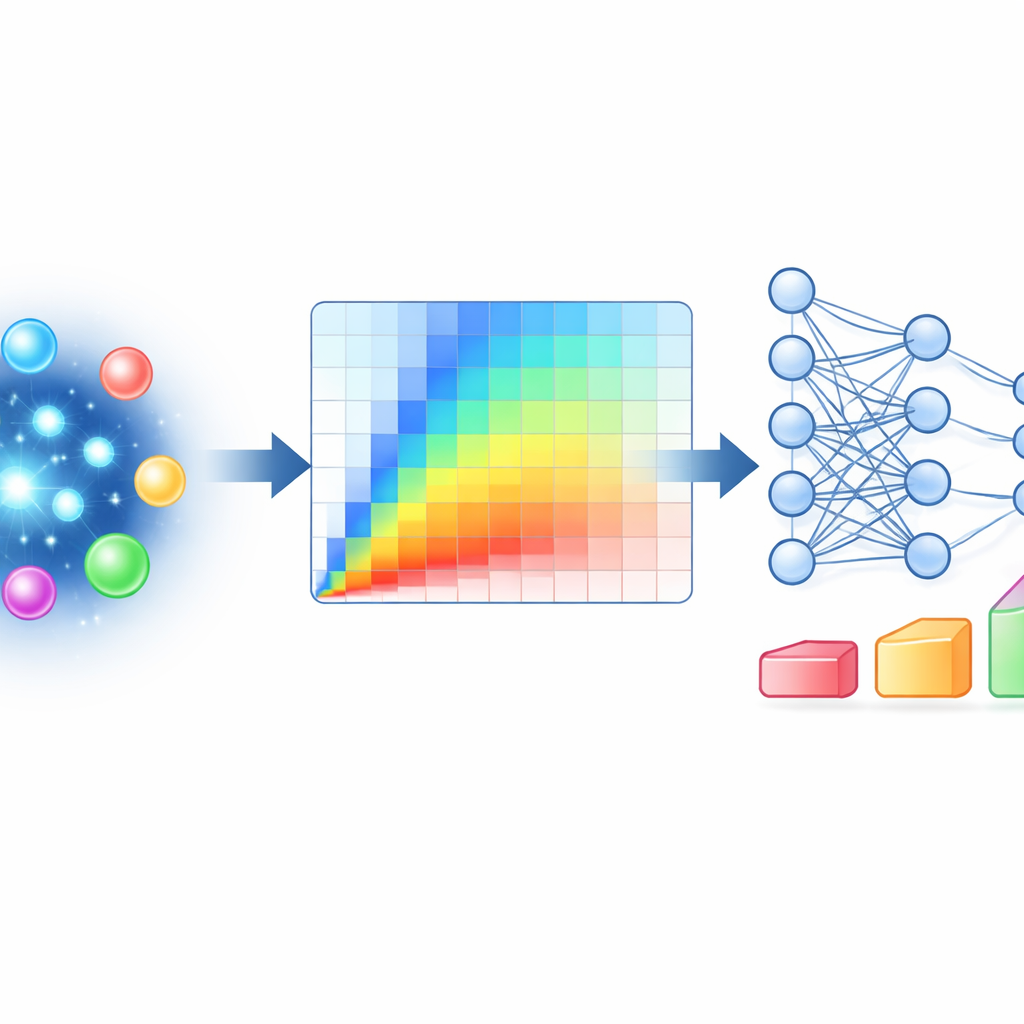
Instead of measuring just a single color of light, the team recorded full “excitation–emission maps” for each sample: two‑dimensional spectra showing how strongly the dots glowed for many combinations of input and output wavelengths. Each map contained more than five thousand data points and served as a fingerprint of the water’s ionic composition. The challenge is that these fingerprints overlap: all the ions tend to quench the glow and shift it toward redder colors, but to slightly different degrees. Rather than trying to untangle this analytically, the researchers trained a suite of machine‑learning models to learn the hidden patterns connecting spectral fingerprints to the seven ion concentrations.
Neural networks as spectral code‑breakers
The authors compared several types of models: conventional multilayer perceptron networks, one‑ and two‑dimensional convolutional neural networks, gradient‑boosted decision trees, linear regression, and a newer design called Kolmogorov–Arnold networks, which are easier to visualize. They also tested how much spectral detail the models really needed, from a single emission spectrum to the full two‑dimensional maps. Convolutional networks, which are particularly good at spotting patterns in images, performed best when fed the complete maps, achieving mean absolute errors well below 2 millimoles per liter for all metals and about 2.4 millimoles per liter for nitrate. This level of precision is sufficient to monitor typical ranges found in metal‑plating and other industrial effluents.
Reusing knowledge with transfer learning
Gathering large, high‑quality datasets like these is laborious. To reduce this burden, the team explored transfer learning: reusing a network trained on a simpler six‑ion problem to speed up learning on the more complex seven‑ion task that adds lead. They took multilayer perceptron models already trained to read six ions and fine‑tuned them on the larger dataset. The adapted networks reached essentially the same accuracy as models trained from scratch, but in roughly half the training time, cutting computational cost without sacrificing performance. Interestingly, transfer learning even helped estimate lead concentrations, although lead was absent from the original six‑ion task, suggesting that the networks had captured general rules about how the overall glow pattern encodes ion effects.
Peeking inside an explainable model
While most neural networks act as black boxes, Kolmogorov–Arnold networks can be drawn as combinations of simple one‑dimensional curves, making them more transparent. To exploit this, the authors first boiled the rich spectra down to a handful of physically meaningful parameters, such as peak intensity, peak position, width, and overall area in two directions. Training a Kolmogorov–Arnold network on these features yielded accuracy comparable to more standard methods, though not as high as the convolutional models using full spectra. Crucially, the researchers could inspect how the model’s output changed with each feature. For chromium, for example, the network correctly linked higher predicted concentration to a red‑shifted and broadened peak and to a drop in overall brightness—trends that match direct experimental observations.
What this means for real‑world water monitoring
In practical terms, this work demonstrates a single, compact, light‑based nanosensor that can simultaneously estimate the levels of six heavy metals and nitrate in water, with accuracy good enough for rapid checks of industrial and wastewater streams. The sensor relies on cheap, stable carbon dots and on machine‑learning models that can be refined and interpreted over time, including by reusing knowledge through transfer learning. If translated into robust devices, such systems could offer continuous, real‑time tracking of water quality at lower cost and complexity than many traditional lab methods, helping to catch dangerous contamination before it reaches people and ecosystems.
Citation: Chugreeva, G., Laptinskiy, K., Guskov, A. et al. Machine learning methods for designing a carbon dot based photoluminescent multimodal nanosensor. Sci Rep 16, 11808 (2026). https://doi.org/10.1038/s41598-026-38266-4
Keywords: carbon dots, water contamination, machine learning sensors, heavy metal detection, photoluminescence spectroscopy