Clear Sky Science · en
Investigation of the cutting effects on high-temperature granite based on cerchar abrasivity test
Why Hot Rocks Matter for Clean Energy
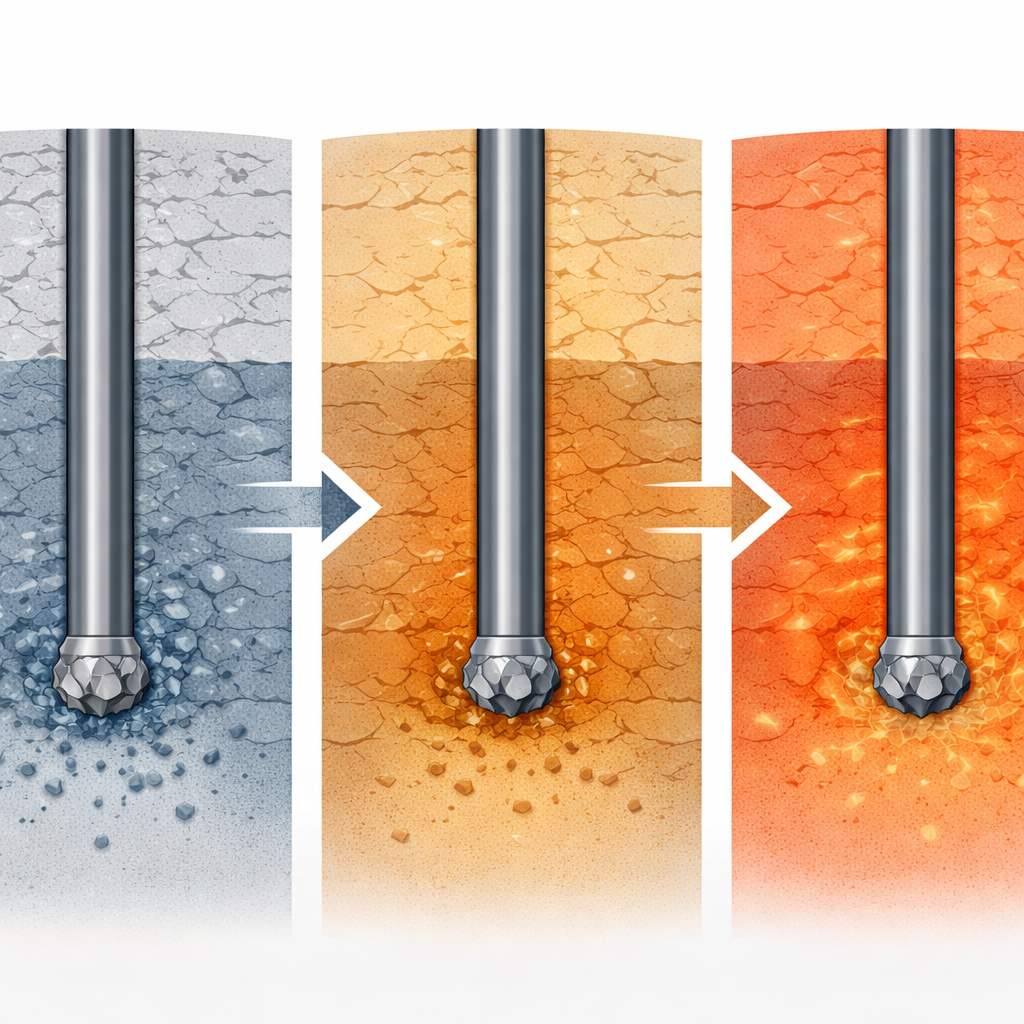
Deep beneath our feet, at depths of more than three kilometers, lie rocks so hot they can boil water into steam. Tapping this heat—known as hot dry rock geothermal energy—could provide clean, steady power without burning fossil fuels. But there is a catch: to reach these deep, hard rocks, drill bits must grind through tough granite under extreme temperatures, and the bits wear out quickly. This study looks closely at how heating granite changes the way it cuts and wears tools, offering clues on how to drill more efficiently and cheaply for geothermal energy.
Hard Rock, High Heat, and Drilling Costs
Hot dry rock is a promising energy source because it is clean, widely available, and constantly renewed by Earth’s interior heat. To use it, engineers must drill injection and production wells into deep granite, then circulate water through fractures to bring heat to the surface. Much of the cost of such projects comes from drill bits wearing out in the hot, abrasive rock. To manage these costs, engineers need to understand how “scratchy” the rock is and how hard it pushes back on the drilling tools. The researchers use a standard test called the Cerchar abrasivity test, in which a steel stylus is pressed onto a rock surface and dragged a short distance, mimicking a tiny cutting action of a drill bit.
Testing Granite from Room Heat to Red-Hot
The team studied Luhui granite from China, cutting it into small blocks and heating different groups to temperatures between 25 °C (room temperature) and 500 °C in a furnace. After heating and slow cooling, each block was scratched five times by a steel stylus under a fixed load. Sensors measured two key things during each scratch: the cutting force resisting the motion and the vertical movement of the stylus, which reveals how deep it cuts into the rock. Afterward, the worn tip of the stylus was examined under a microscope, and its flattened area was used to calculate the Cerchar Abrasivity Index, a standard measure of how strongly a rock grinds away a tool.
How Heat Changes Rock and Tool Wear
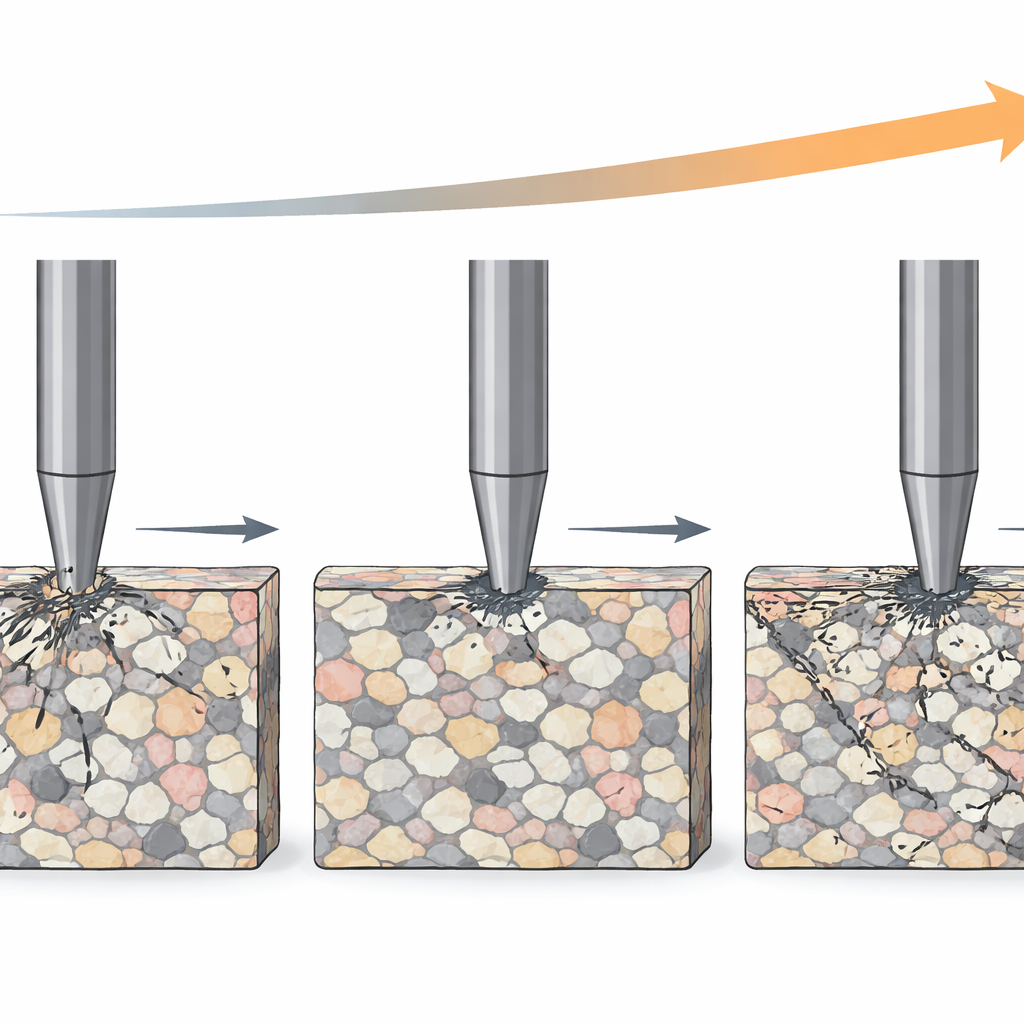
As the granite was heated, its abrasiveness generally fell. At room temperature, the rock was highly abrasive, giving a relatively high Cerchar index and demanding high cutting forces from the stylus. By 100 °C, the index dropped noticeably, likely because moisture inside the granite evaporated, leaving pores and tiny cracks that reduced the real contact area between hard minerals and the steel tip. Between 200 °C and 400 °C, the abrasivity changed only slightly, but at 500 °C it dropped again as intense thermal cracking broke up the rock’s grain structure. The average force required to slide the stylus showed a similar pattern: highest when the rock was cold, much lower after heating, with a small irregular bump around 400 °C. Microscopic images showed that when the stylus ran into very hard minerals such as quartz and biotite, the cutting force spiked and bright metal fragments from the stylus sometimes stuck to the mineral surfaces, revealing local, intense wear.
Scratch Depth and Surprising Opposite Trends
The depth of the scratches did not simply increase as the rock weakened. Instead, the stylus cut deepest at room temperature and then made shallower grooves as the rock was heated up to about 300 °C. This is attributed to thermal expansion that packs mineral grains closer together and temporarily strengthens the rock. At higher temperatures, especially between 400 °C and 500 °C, many microcracks formed along grain boundaries, softening the granite and allowing the stylus to penetrate slightly deeper again. When the researchers compared scratch depth with instantaneous cutting force, they found a strong negative link: when the force jumped up—often when the stylus hit a very hard grain—the cutting depth dropped, and when the stylus cut deeper, the force fell. In simple terms, the steel point either digs in relatively easily or skates over very hard spots with high resistance but little penetration.
What This Means for Future Geothermal Drilling
The study shows that heating granite to several hundred degrees creates networks of tiny fractures that make the rock less abrasive and reduce the forces acting on cutting tools. For geothermal projects in hot dry rock, this means that, below about 500 °C, naturally heated deep granite may actually wear drill bits less than expected from its strength alone. The authors suggest that monitoring average cutting force during drilling could serve as a practical indicator of rock abrasiveness in real time, helping engineers adjust bit type and operating conditions to extend tool life and cut costs. While many other factors still need to be explored, these findings bring us closer to drilling into Earth’s deep heat in a more efficient and economical way.
Citation: Yang, Q., Zhang, H., Rui, X. et al. Investigation of the cutting effects on high-temperature granite based on cerchar abrasivity test. Sci Rep 16, 13476 (2026). https://doi.org/10.1038/s41598-026-38206-2
Keywords: geothermal drilling, hot dry rock, granite abrasivity, drill bit wear, high temperature rock