Clear Sky Science · en
Research on cooling load prediction and allocation optimization for refrigeration system in indoor ice rink: evidence from China
Why keeping ice rinks cold really matters
Indoor ice rinks are far more energy-hungry than ordinary sports halls because they must hold a sheet of ice steady while people skate, train, and compete. As more ice arenas are built for public recreation and winter sports, their electricity use and climate impact grow. This study looks at how to keep the ice in good condition while using less energy, by predicting how much cooling an ice rink will need in the next few hours and then sharing that work smartly across several refrigeration machines.
What drives the chill in an ice rink
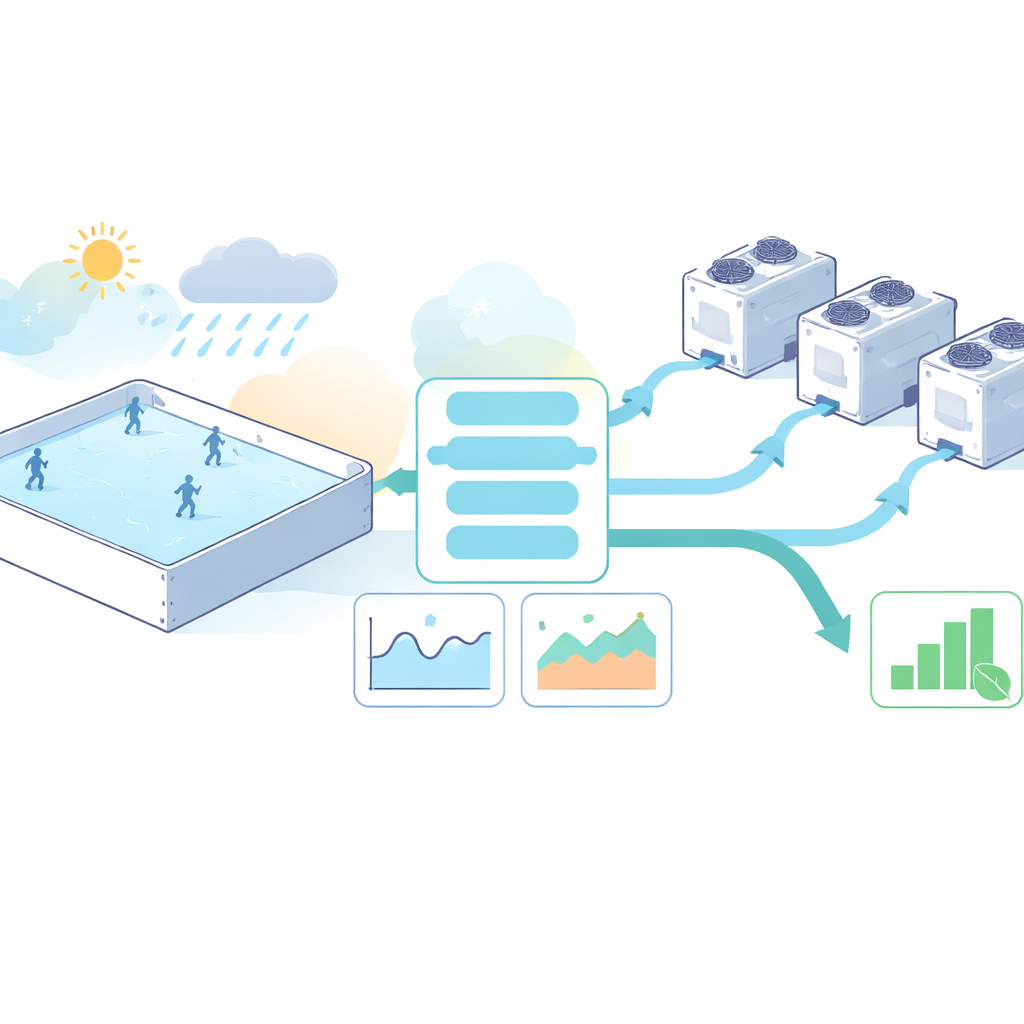
Keeping an ice sheet frozen is like balancing heat coming in from many directions with cold taken away by the refrigeration system. Heat seeps up from the ground, flows in from the warmer air above the ice, shines down from the sun through the building shell, and arrives as body heat from skaters and hot water used to resurface the ice. The authors first list these influences and use a statistical method called grey relational analysis to see which ones move most closely with the cooling demand. For a large public rink in Beijing, the strongest drivers turn out to be how many people are skating, how humid the outdoor air is, how much soft scattered sunlight falls on the building, and the outside air temperature.
Teaching a computer to foresee cooling needs
Because these influences rise and fall over the day and week, the cooling demand behaves like a complicated time pattern rather than a simple straight line. The team trains a kind of deep learning model, known as a long short-term memory network, to learn this pattern from past data. They feed in the most important factors picked by the earlier analysis, along with the recent history of the rink’s own cooling use. The model looks back over the previous 24 hours to predict the next value, capturing regular daily rhythms as well as sudden peaks when more skaters arrive or the weather changes.
Making the prediction engine smarter and leaner
The researchers test several versions of their prediction engine to see which design choices help the most. Stacking two layers of the learning units improves how the model captures both short blips and longer swings in demand. Adding simple calendar clues such as time of day, day of week, holidays, and event times further sharpens its sense of when loads are likely to rise. In contrast, a popular training trick called batch normalization, which often helps with other deep networks, actually harms this time-based task by blurring the delicate relationships between one moment and the next. The best version of the model cuts prediction errors by more than ten percent compared with a simpler design and clearly beats a traditional neural network that does not handle time as well.
Sharing the work among chillers
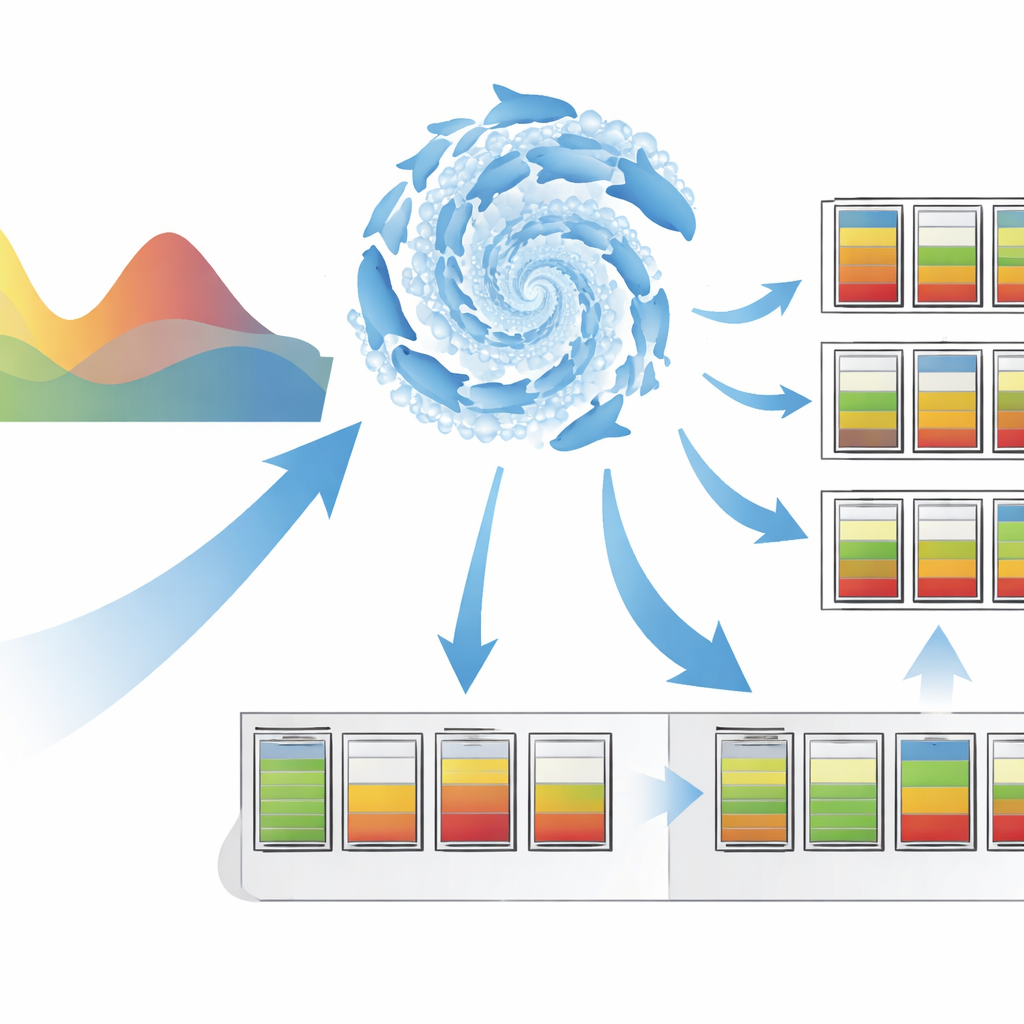
Most ice rinks rely on several refrigeration units sized for the worst-case heat wave, yet they usually run at partial power. How that load is divided makes a big difference to energy use, because each machine has a sweet spot where it operates most efficiently. Using the short-term load forecasts, the authors build a mathematical model that decides how hard each chiller should run so that, together, they meet the cooling need with the lowest total electricity use. To solve this puzzle, they apply a search method inspired by the hunting behavior of humpback whales, which alternates between exploring widely and homing in on a promising solution.
How much energy the smart control can save
The study compares this whale-based strategy with two simple rules used in practice: turning chillers on in a fixed order, and splitting the load evenly across all machines. Across low, medium, and high cooling-demand days, the whale approach consistently uses the least energy, with savings of about 6–8% over the basic methods in the case-study rink. It also outperforms two other well-known optimization tools, genetic algorithms and particle swarm optimization, by finding better solutions faster and with fewer calculation steps. In low-load periods it often runs only one unit, while during busy hours it adjusts the mix of units and their part loads to avoid wasteful operation.
What this means for future ice rinks
In plain terms, the work shows that “looking ahead” just a few hours and then planning how to share the cooling effort among machines can noticeably cut the power bill for an ice rink without changing the building or the equipment. The proposed method ties together a forecasting engine and a smart scheduler in a way that could be retrained for other rinks or even for cold stores and food plants. With more data and possible integration into automatic control systems, approaches like this could help indoor ice sports grow while keeping their environmental footprint under better control.
Citation: Du, Z., Liu, Y., Xue, Y. et al. Research on cooling load prediction and allocation optimization for refrigeration system in indoor ice rink: evidence from China. Sci Rep 16, 10117 (2026). https://doi.org/10.1038/s41598-026-38121-6
Keywords: indoor ice rink, energy-efficient cooling, machine learning, refrigeration control, optimization algorithm