Clear Sky Science · en
Enhancing contact electrification using nanofluids during liquid intrusion and extrusion in nanoporous materials
Turning Tiny Particles into Power Helpers
Everyday actions like pouring water, pumping oil, or raindrops hitting a window quietly move electrical charge where liquids touch solids. This study shows that by sprinkling a very small amount of specially designed nanoparticles into water, we can greatly boost that hidden electricity without changing the device itself. The work points toward simple, low-cost ways to harvest wasted mechanical motion—such as vibrations, shocks, or waves—and turn it into useful power for sensors and other small electronics.
Why Rubbing Liquids and Solids Matters
Whenever a liquid wets and then leaves a surface, some electrical charge is exchanged at the contact. This “contact electrification” is involved in technologies that range from water filters and microfluidic lab chips to energy harvesters called triboelectric nanogenerators. In one class of these devices, a liquid is pushed in and out of extremely small pores in a solid, and the repeated wetting and drying of the inner surfaces produces tiny bursts of current. These devices are attractive for capturing low-frequency motions—such as the up‑and‑down movement of a car shock absorber—but so far their electrical output has been modest, limiting practical use.
Adding a New Ingredient to the Liquid
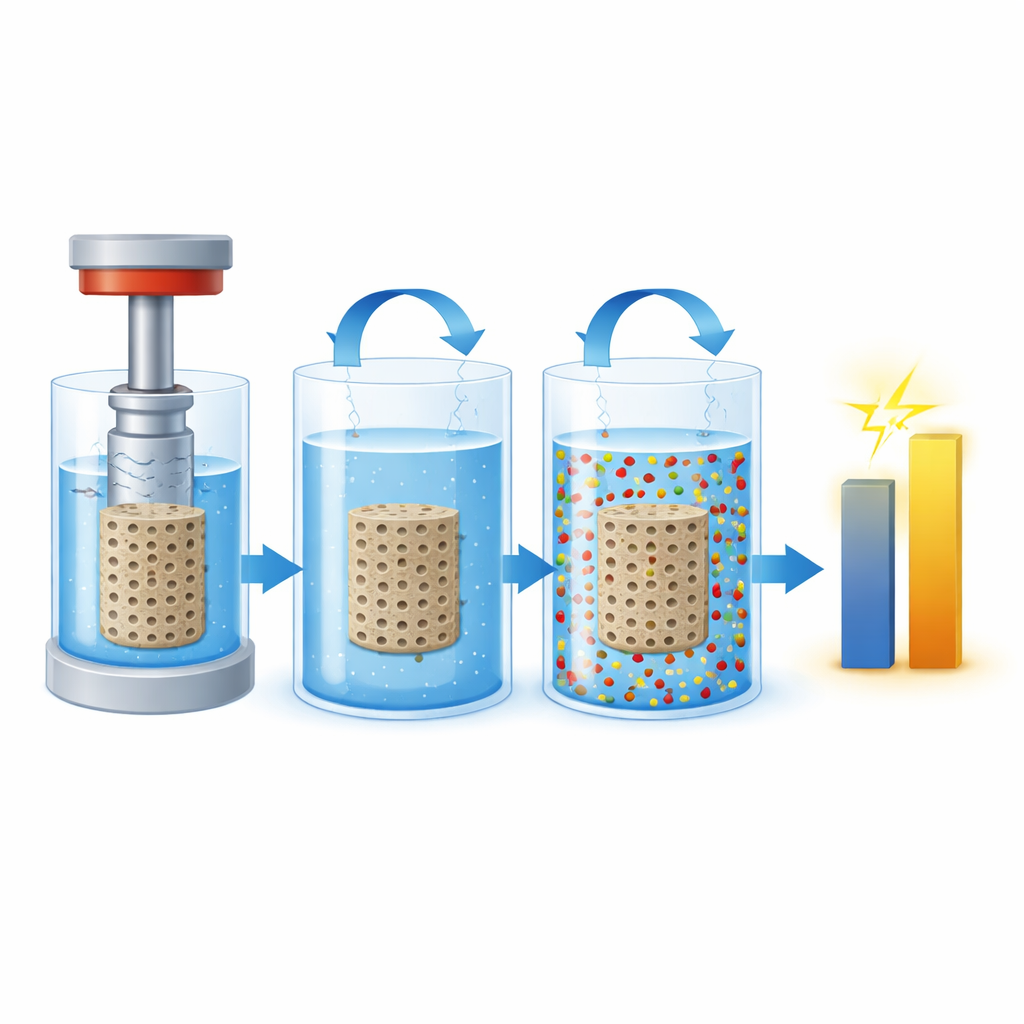
The authors asked a deceptively simple question: instead of redesigning the solid material or the moving parts, what if we just change the liquid? They created “nanofluids” by dispersing a small concentration of fullerenol nanoparticles—soccer‑ball‑shaped carbon molecules covered with oxygen‑bearing groups—into water. First, they dipped and lifted a solid plate in different nanofluids to see how much voltage was generated. Suspensions containing fullerene‑based particles nearly doubled the peak voltage compared with pure water, while another type of nanoparticle (quantum dots) showed no meaningful benefit. This early test suggested that the right kind of nanoparticle could directly enhance the liquid–solid charging process rather than merely altering acidity or other basic properties.
Testing in Tiny Pores Under Pressure
The team then moved to their main platform: devices where water is forced into and out of nanoporous solids under pressure. They used two very different materials. One was a mesoporous silica (WC8) with pores large enough for the fullerenol particles to enter and leave freely. The other was a metal–organic framework called ZIF‑8, whose pores are so narrow at the entrance that the nanoparticles are effectively locked out; only the water can pass through. By cycling pressure while monitoring current and voltage through an external resistor, they measured how much electrical energy was produced in each case, both with pure water and with the nanofluid.
How Much Extra Energy They Found
In both materials, the nanofluid dramatically outperformed pure water. For the silica, the energy harvested per cycle increased by more than a factor of ten, and the peak power density more than doubled. For ZIF‑8, the improvement was even stronger: the energy per cycle grew by over an order of magnitude, and the power density approached the best values reported for much more complex silicon‑based devices—despite using an otherwise simple setup. Interestingly, the nanoparticles also changed how the liquid entered and left the pores, shifting the pressure needed for intrusion and extrusion in opposite directions for the two materials, which reflects whether the particles are allowed inside the pores or remain in the surrounding liquid.
How the Nanoparticles May Do the Job
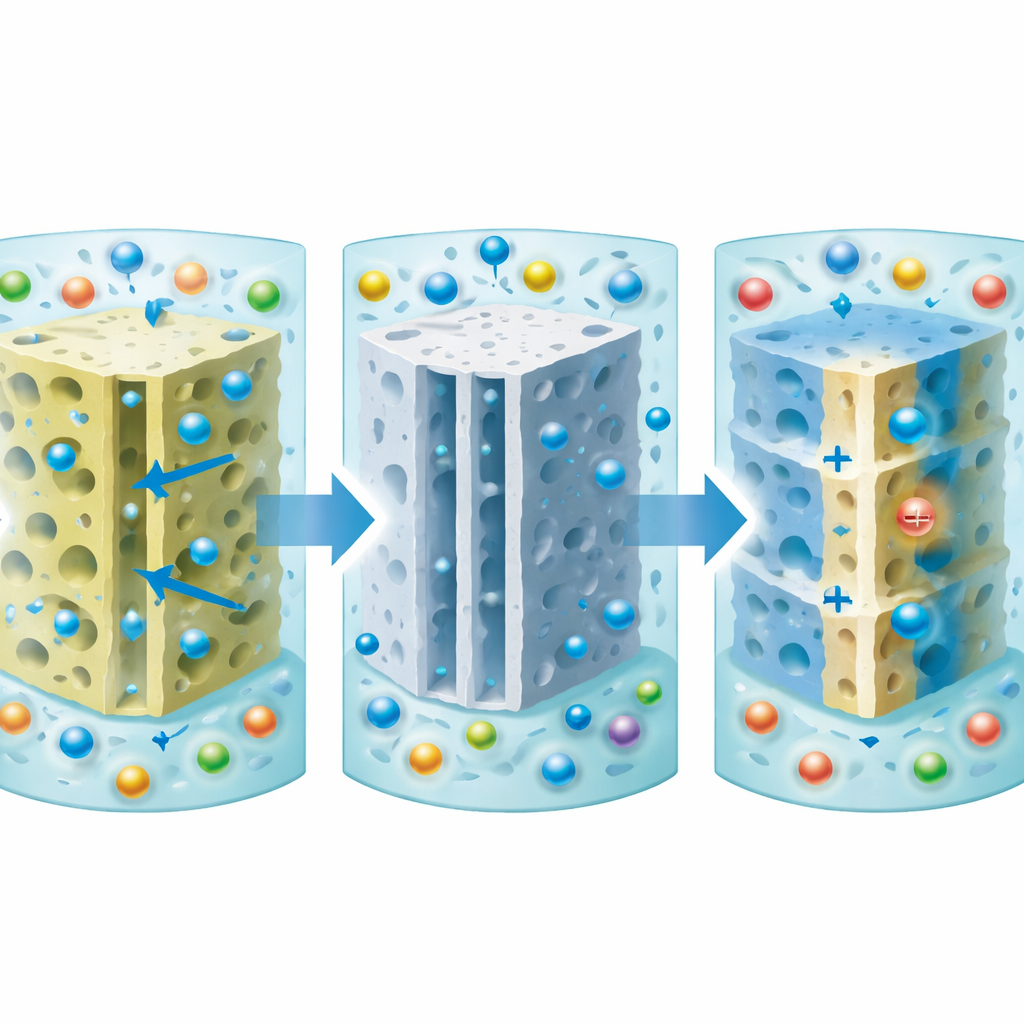
The authors propose that the nanoparticles behave as mobile charge carriers that add a new “solid–solid” contact pathway inside the liquid. Because fullerenol strongly attracts electrons, collisions between particles and pore walls can transfer charge in addition to the usual liquid–solid events. In the silica, particles roam both inside and outside the pores, increasing the total charge moved per cycle, although their motion is somewhat hindered in the confined spaces. In ZIF‑8, the particles stay in the bulk liquid, where they can move more freely, which may help explain its higher instantaneous power despite pore inaccessibility. Other effects—such as subtle changes to how layers of ions arrange at the surface—could also play a role, and the authors emphasize that the detailed mechanism remains to be fully worked out.
What This Means for Future Devices
In plain terms, this study shows that simply replacing water with a carefully chosen nanofluid can make a pore‑based energy harvester more than ten times more powerful, without redesigning the solid structure or the way it is driven. That makes the approach attractive for scaling up and for retrofitting existing concepts in energy harvesting and sensing. By treating the liquid not just as a passive medium but as an electrically active component, engineers gain a new, flexible handle for tuning performance. The work suggests a future in which tiny, robust generators powered by everyday motions could be optimized just by tailoring the nanoparticles they contain.
Citation: Johnson, L.J.W., Arkan, M.Z., Serda, M. et al. Enhancing contact electrification using nanofluids during liquid intrusion and extrusion in nanoporous materials. Sci Rep 16, 9904 (2026). https://doi.org/10.1038/s41598-026-38089-3
Keywords: nanofluids, triboelectric nanogenerator, nanoporous materials, energy harvesting, fullerenes