Clear Sky Science · en
Tsunami inversion using deep neural representations
Why this matters for coastal safety
People living near the sea depend on early warnings to escape incoming tsunamis, yet today’s systems still struggle when an event is unusual or sensors fail. This study shows how ideas from modern artificial intelligence can help warning centers read offshore waves more flexibly and quickly, with the goal of giving clearer guidance about which coasts are most at risk.
From seafloor jolt to coastal wave
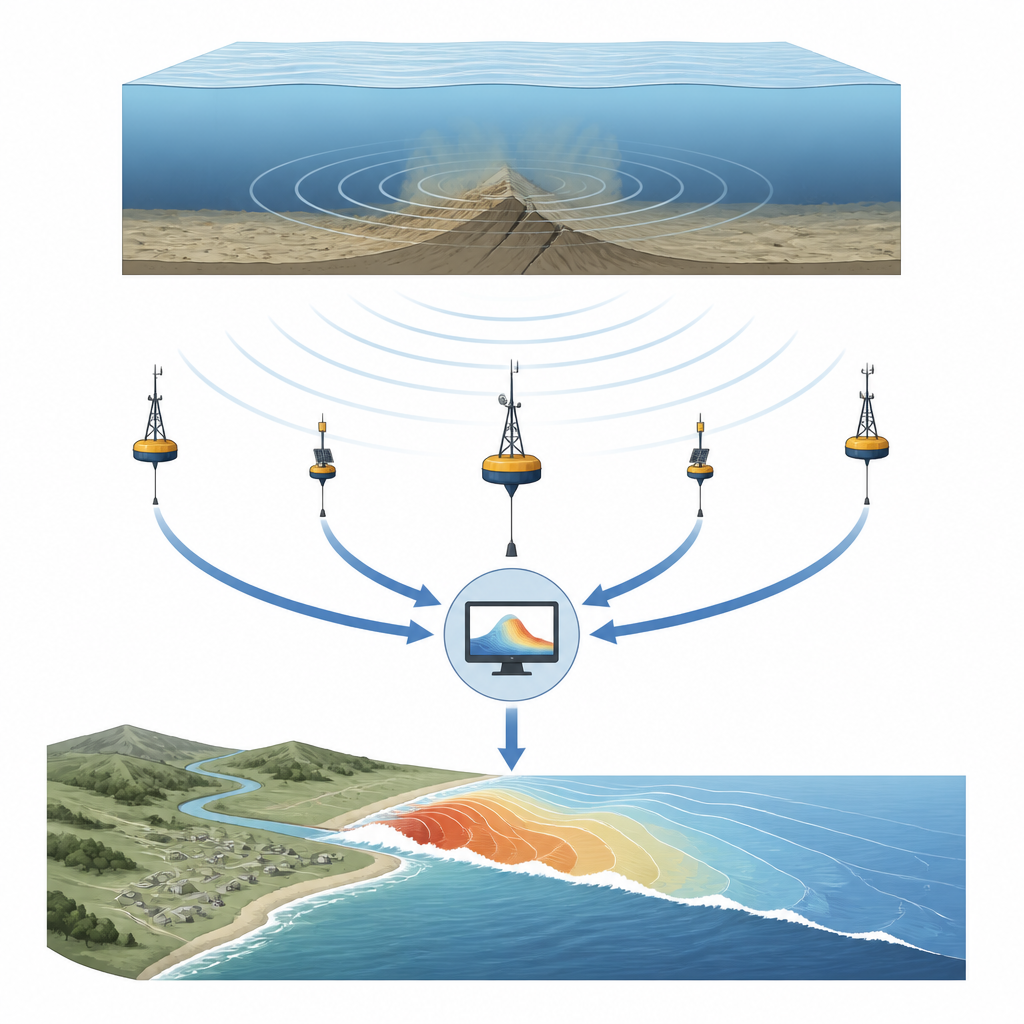
When a large earthquake, landslide, or volcanic blast disturbs the ocean surface, the resulting tsunami can cross entire basins. To forecast where and how hard it will hit, scientists need to know the initial shape of the disturbed water. That “starting picture” is surprisingly hard to reconstruct. It depends on uncertain details of the source, the shape of the seafloor, tides, and even gaps or clipping in the sensor records. Traditional methods often assume a particular type of earthquake fault and precompute huge libraries of scenarios, which demand vast storage and can struggle when the real event does not match expectations.
Listening to the ocean instead of the fault
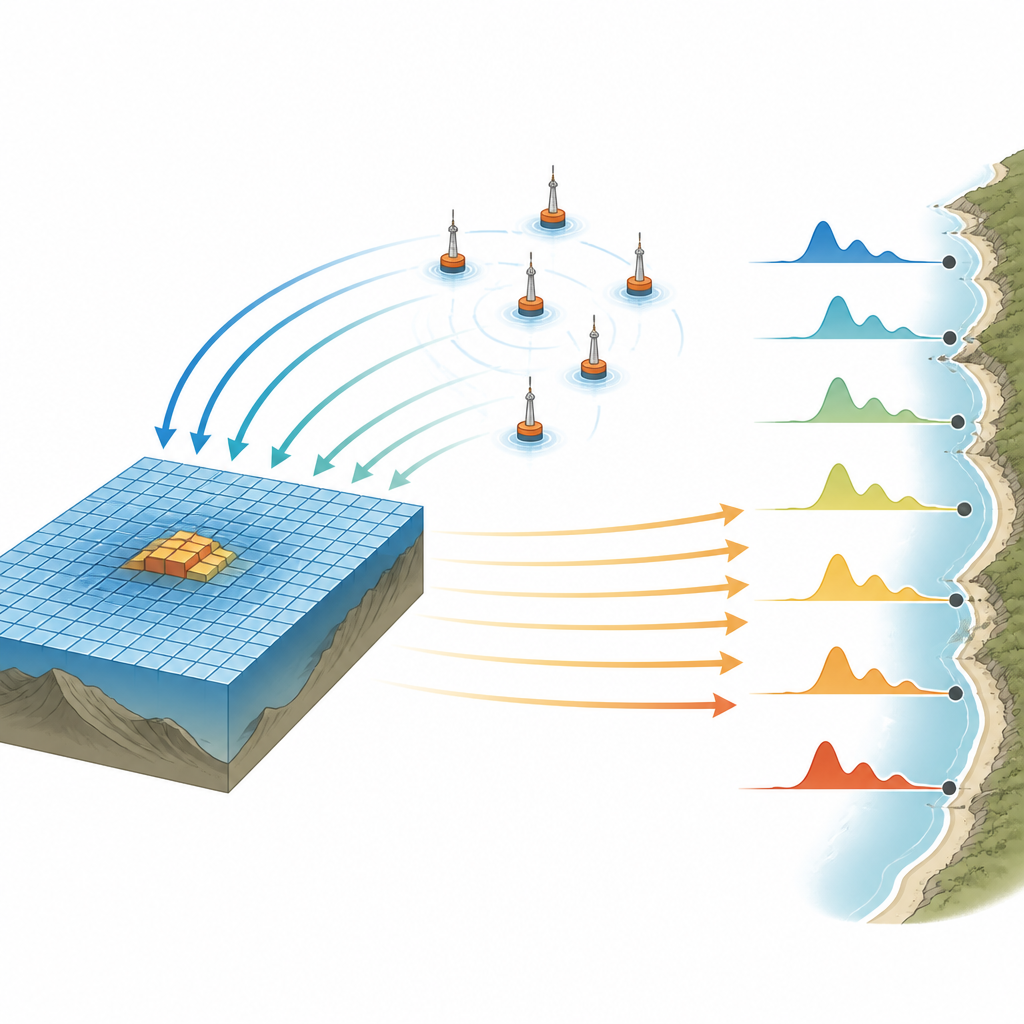
The authors propose a different viewpoint: rather than focusing on how the seafloor slipped, they focus directly on how the ocean responds. They describe the ocean with a tool called a Green’s function, which simply answers the question, “If the water were briefly lifted at this one point, what waves would every sensor see?” In principle, combining the responses from many such points allows one to work backward from measured waves at offshore sensors to the original patch of lifted or lowered water. That patch then serves as the starting point for detailed simulations that predict how the tsunami will evolve toward the coast.
Compressing ocean behavior with neural networks
In practice, covering a realistic ocean region with a fine grid produces an enormous number of possible source points and sensor locations. Storing every Green’s function directly would require hundreds of gigabytes and slow down an urgent forecast. To avoid this, the team uses deep neural networks as compact function “compressors.” These networks take in the positions of a source and a receiver, along with small maps of the nearby seafloor, and output the full wave signal that would travel between them. By training on many computer-simulated tsunamis around Japan, the networks learn to reproduce these signals accurately while replacing massive data tables with a model containing only a few million parameters.
Working backward from sensor data
With this compact ocean model in hand, the researchers tackle the key problem: inferring the initial water disturbance from real or simulated sensor records. They set up an iterative search that adjusts the strength of each grid cell’s uplift until the predicted waves at the sensors match the observed ones as closely as possible. At the same time, the method favors disturbances that are both concentrated in area and smoothly varying, reflecting how real tsunamis tend to start. Because the neural network can generate wave responses for any sensor location on the fly, the same trained model can handle different combinations of working and failed sensors without retraining.
Testing with real and imagined tsunamis
The authors test their approach on numerous events drawn from a widely used database of past earthquakes near Japan. Using data from Japan’s dense S-net seafloor sensors, they show that their method can reconstruct the initial water pattern with high correlation to the simulated truth, even when only a fraction of sensors are available or when sensor noise is added. They then feed the reconstructed pattern into a second neural network to predict offshore wave heights near the coast over several hours. These predictions are as accurate as, or better than, an existing machine-learning method while using far fewer model parameters and not being tied to a fixed sensor layout. Finally, they show that the same framework can handle a hypothetical volcanic tsunami, illustrating that it is not limited to earthquakes.
What this means for future warning systems
The study demonstrates that deep neural networks can serve as efficient surrogates for heavy numerical models, allowing rapid, flexible tsunami inversion that focuses on the ocean’s initial state rather than the details of the fault. By reducing uncertainty in that starting picture and tolerating changing sensor networks, such methods could help future warning centers better judge which stretches of coast are likely to face dangerous waves, buying precious time for evacuation and response.
Citation: Morssy, A., Teal, P.D. & Kleijn, W.B. Tsunami inversion using deep neural representations. Sci Rep 16, 15925 (2026). https://doi.org/10.1038/s41598-026-38002-y
Keywords: tsunami forecasting, offshore sensors, neural networks, ocean waves, early warning