Clear Sky Science · en
The evolutionary history of chelicerate metallothioneins reveals de novo emergence and metal-binding specialization across the subphylum
Why tiny metal handlers in spiders and scorpions matter
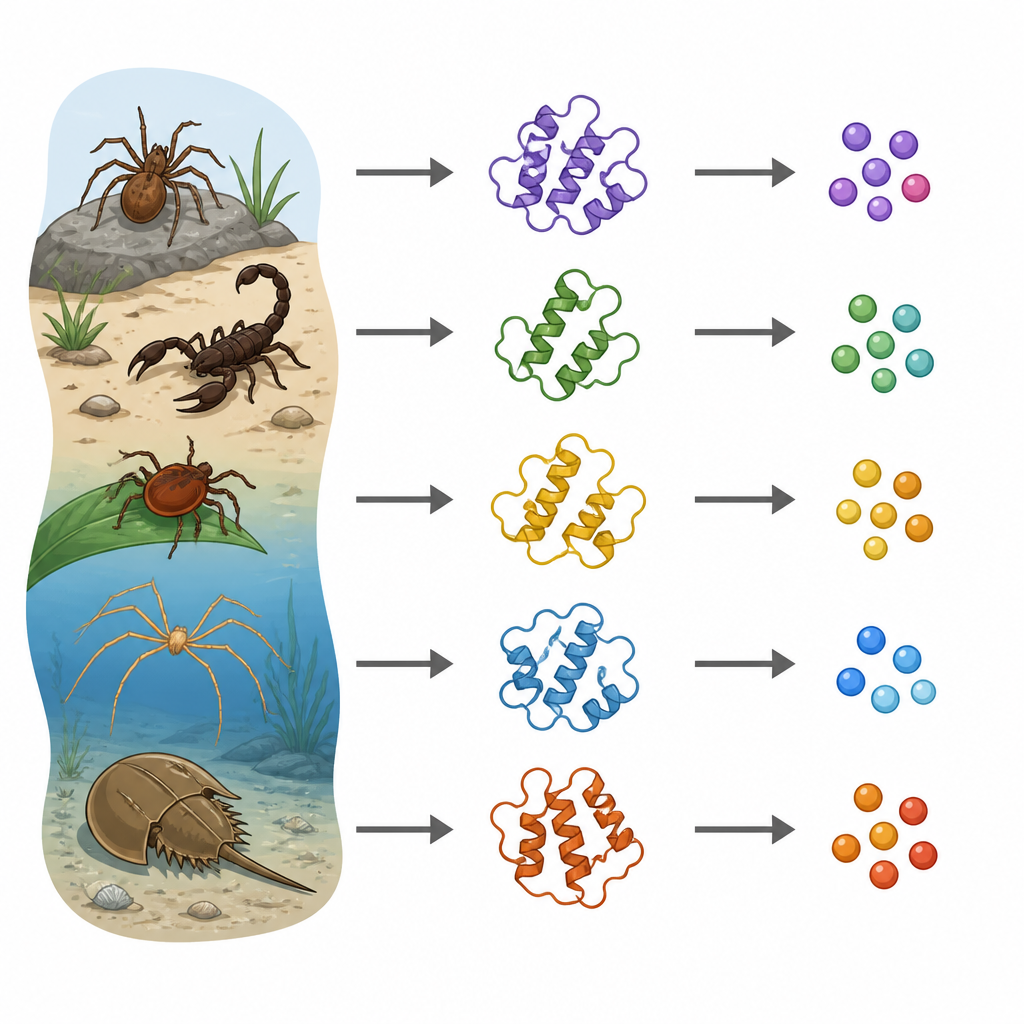
Heavy metals like zinc, copper and cadmium are double edged. In the right amount they help build bodies, but in excess they damage cells. Many animals survive in metal rich soils, sediments and even polluted sites, yet how their bodies cope is often a mystery. This study looks at metallothioneins, small metal grabbing proteins, in chelicerates the group that includes spiders, scorpions, ticks, mites, sea spiders and horseshoe crabs revealing how these creatures have evolved a toolkit of different protein types to fine tune metal use and protection.
Different animals, shared metal challenge
Chelicerates are an ancient branch of the arthropod family tree and occupy nearly every marine and terrestrial habitat. Many species show striking resistance to metal pollution; spiders can thrive on slag heaps and horseshoe crabs tolerate copper levels that would kill other marine animals. Until now, almost nothing was known about metallothioneins in this whole subphylum. The authors trawled public genetic databases for telltale short, cysteine rich sequences that characterize these proteins and reconstructed full protein codes from hundreds of transcriptome and read archives. They uncovered 474 putative metallothioneins from 221 species, giving the first broad picture of how chelicerates handle metals at the molecular level.
Three main protein designs for gripping metals
By examining how cysteine residues are arranged along each sequence, the team grouped chelicerate metallothioneins into three structural types, named MT1, MT2 and MT3. MT1 occurs across sea spiders, horseshoe crabs, scorpions, ticks and many other arachnids, suggesting it is the ancestral design. MT2 appears only in the euchelicerates, the clade that unites horseshoe crabs with land dwelling arachnids. MT3 is found only in spiders and comes in short and long forms built from repeated small units, like beads on a string. Most MT1 and MT2 proteins have two compact segments, or domains, while some tick proteins carry a single small segment and spider MT3 proteins can be unusually large, with up to five repeats, hinting that repetition and trimming of modules has been a key route for innovation.
Testing how strongly these proteins bind different metals
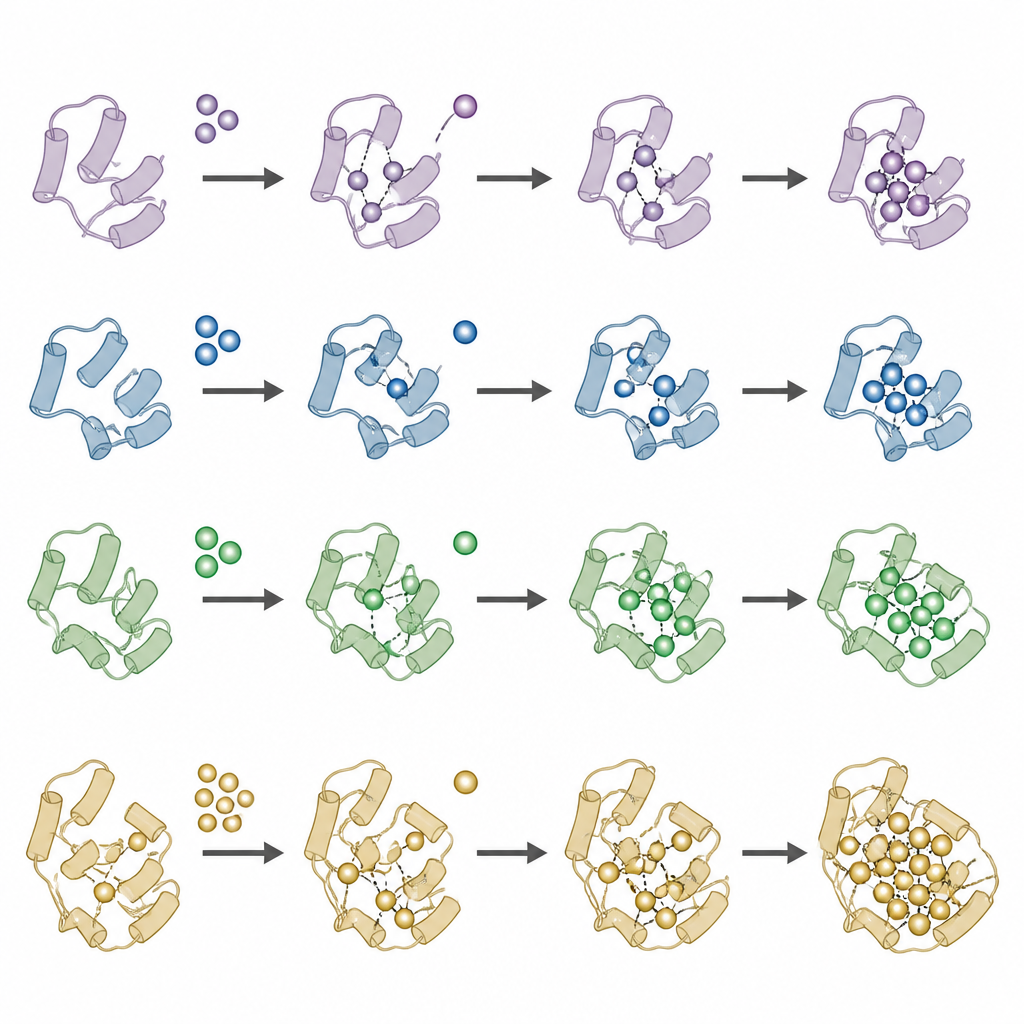
To move from sequence to function, the researchers chose eight representative metallothioneins from sea spiders, horseshoe crabs, ticks, scorpions and a wolf spider. They produced each protein inside bacteria grown in media enriched with zinc, cadmium or copper and then purified the resulting metal protein complexes. Using metal specific spectroscopy and mass spectrometry, they measured how many metal ions each molecule could hold and whether it preferred divalent metals such as zinc and cadmium or monovalent copper. The proteins bound between 3 and about 13 divalent metal ions per molecule, and all formed dense metal cysteine clusters characteristic of genuine metallothioneins. Small single domain forms coordinated fewer ions, while the large, repeat rich spider MT3 proteins bound roughly twice as many, confirming that additional repeats directly boost capacity.
Specialists, generalists and the metal economy
The binding tests also revealed distinct personalities among the proteins. Some behaved as zinc specialists or cadmium specialists, forming well folded, uniform complexes only with their favored metal. Others, particularly from horseshoe crabs and scorpions, strongly preferred copper. In contrast, the spider MT3 proteins acted as multipurpose binders, forming mixed and more flexible complexes with all tested metals. Patterns of sugar attachment in bacterial cells further supported these preferences, because tightly structured metal complexes resisted modification while looser, non preferred complexes did not. Together, these results suggest that chelicerates deploy a mix of specialist and generalist metallothioneins, allowing them to juggle essential metals and detoxify harmful ones under changing environmental conditions.
How these proteins evolved and why it matters
By comparing where each metallothionein type appears across the chelicerate tree, and by looking at similar proteins in other arthropods and animals, the authors infer that an ancestral two domain MT1 design existed before major arthropod groups split. Later, MT2 appears to have arisen within euchelicerates, and spider specific MT3 likely evolved even later through the emergence and multiplication of a short, cysteine rich segment. This kind of de novo evolution from small peptide units may be common, giving rise to new metal handling tools as lineages encounter different habitats and pollution pressures. For a general reader, the key message is that spiders, scorpions, ticks and their relatives carry a surprisingly rich toolkit of tiny proteins that let them survive and even flourish in metal stressed environments, and tracing these proteins across the tree of life helps explain both their resilience and the broader story of how new protein functions arise.
Citation: Palacios, Ò., Capdevila, M. & Albalat, R. The evolutionary history of chelicerate metallothioneins reveals de novo emergence and metal-binding specialization across the subphylum. Sci Rep 16, 14882 (2026). https://doi.org/10.1038/s41598-026-37996-9
Keywords: metallothioneins, chelicerates, heavy metals, spiders, protein evolution