Clear Sky Science · en
Urban agroforestry compositions influence ecosystem multifunctionality and service interactions
Why city farms and forests matter together
As cities grow, we often think of farmland and forests as competing for space. Yet many urban regions actually contain mosaics of both: crop fields threaded with shelterbelts, woodlots, and parks. This study explores how different mixes of fields and trees around Changchun, a major grain-producing city in Northeast China, affect multiple benefits people depend on—food, clean water, healthy soils, and carbon storage—and what combination of land uses best balances these needs.
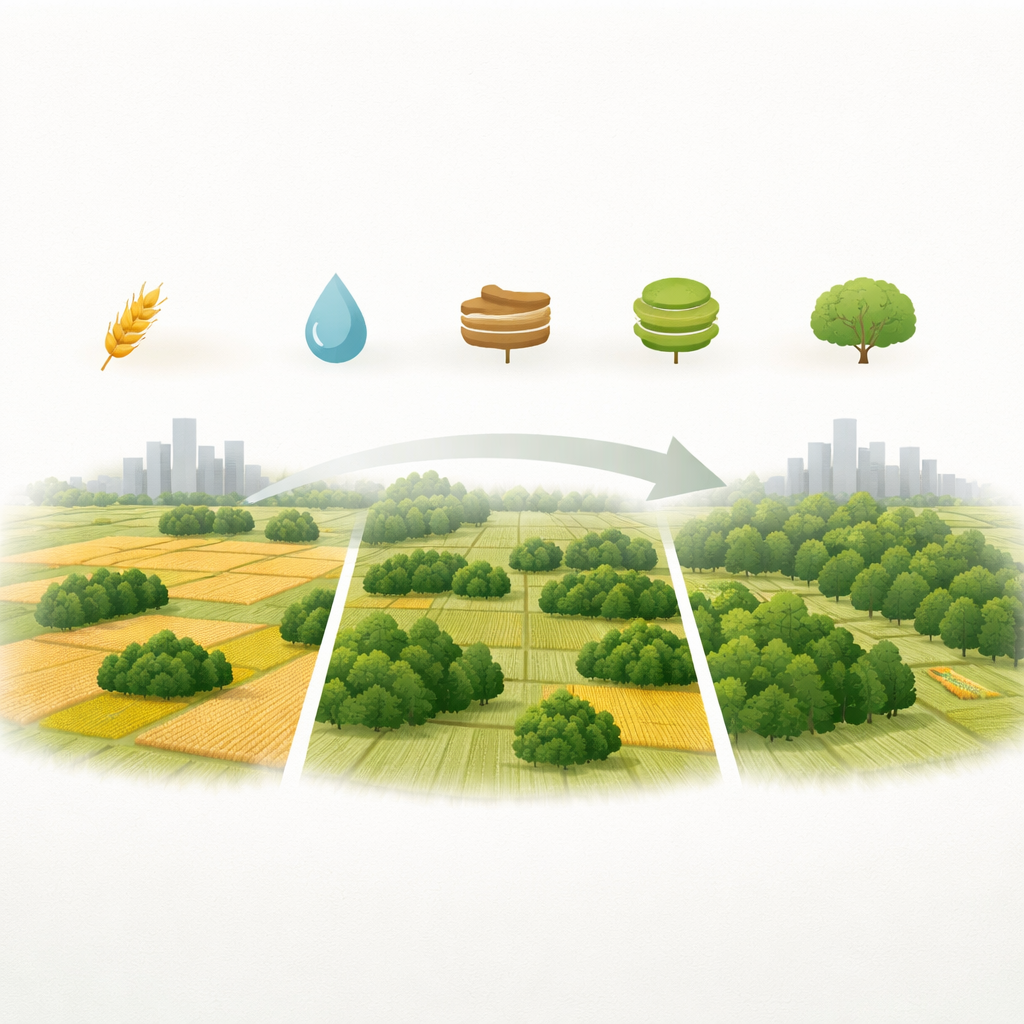
Mixing fields and trees around a growing city
The researchers focused on Changchun, set in one of the world’s great black-soil farming regions and an important corn belt. Using two decades of satellite images and environmental data (from 2000 to 2020), they mapped land use into one-kilometer squares and classified each square by how much farmland and forest it contained. These categories ranged from nearly all cropland, through several mixed agroforestry types with different shares of trees and crops, to nearly all forest. This grid-based approach allowed them to see how the landscape shifted as urban areas expanded and as national restoration programs encouraged planting trees on marginal farmland.
Measuring more than just harvests
To understand how these different land mixes perform, the team estimated four key functions in every grid cell: grain production, water conservation, soil retention, and carbon sequestration. Grain yields were inferred from satellite measures of corn growth calibrated with field plots. Water conservation reflected how much rainfall was held back from running off the land. Soil retention estimated how much erosion was prevented by vegetation and terrain. Carbon sequestration captured how much carbon plants locked away each year. Each function was put on the same 0–1 scale and then added up, giving a simple index of “multifunctionality” that reflects how well a patch of land delivers all four benefits together.
Finding the sweet spot for many benefits
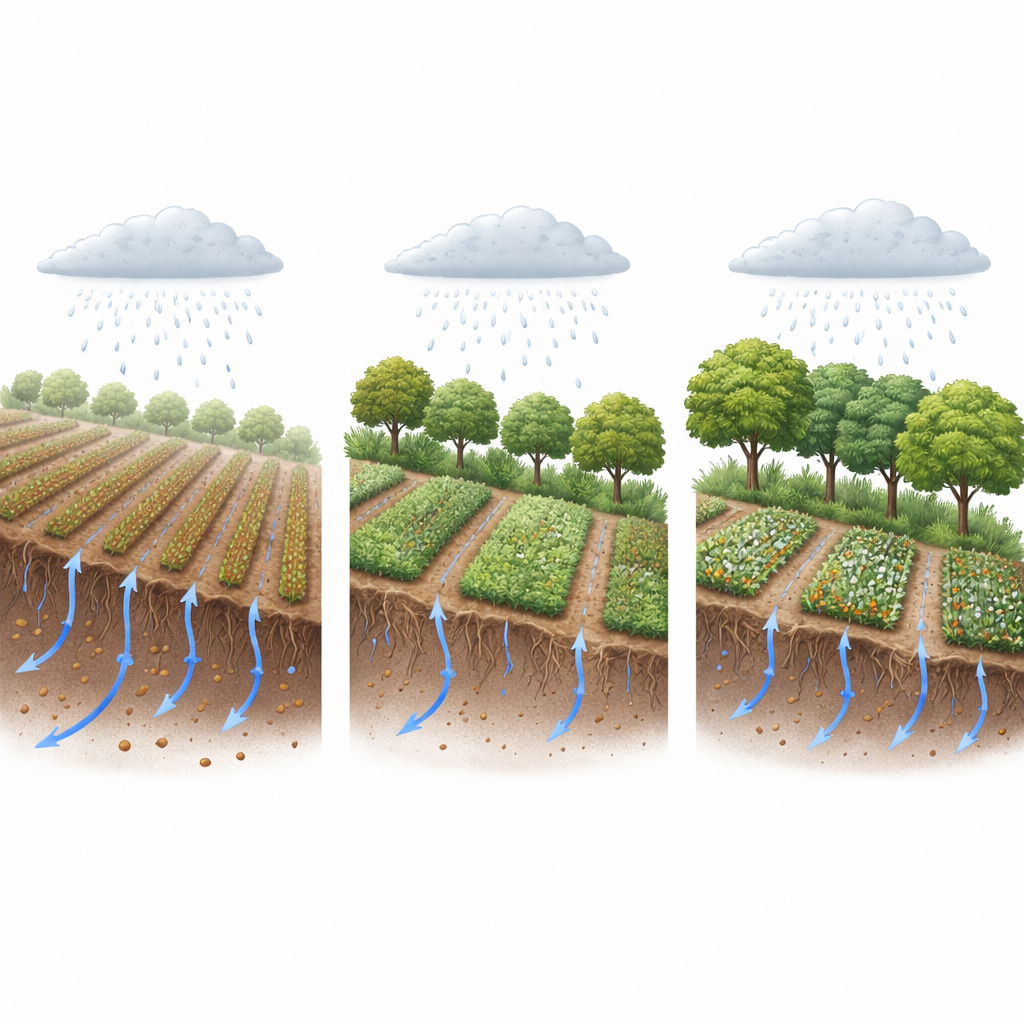
The results show that land devoted almost entirely to crops delivered strong harvests but weak ecological regulation, giving the lowest overall multifunctionality. Surprisingly, areas dominated by forest did not score highest either. While trees greatly improved water conservation, soil retention, and carbon storage, they displaced cropland and reduced grain production. The best overall performance came from mixed agroforestry zones where farmland still dominated but forests covered roughly one-fifth to two-fifths of the area. In these landscapes, shelterbelts and forest patches reduced wind and water erosion, improved soils, and stored more carbon, without yet cutting grain production too sharply.
How services help—or hinder—each other
The study also examined how the four benefits move together. In crop-heavy areas, grain production tended to rise in step with water conservation, likely because healthier crops and better soil cover improve both yield and water use. In more mixed and forest-rich areas, the strongest partnership was between water conservation and soil retention, both boosted by dense vegetation and tree roots that slow runoff and stabilize the ground. However, as forest cover increased further, the relationship between grain production and soil retention shifted from mild synergy to a clear trade-off: where soil was best protected under dense forest, there was simply less land left to grow grain.
Guiding greener cities and farms
For city regions trying to feed people while coping with erosion, flooding, and climate change, this work offers practical guidance. It suggests that neither all fields nor all forests provide the best mix of benefits. Instead, carefully weaving belts and patches of trees into predominantly agricultural landscapes—aiming for a moderate share of forest—can raise overall performance by roughly a tenth to a fifth compared with pure cropland. In forest-dominated zones, adding shade-tolerant crops or forest-based products can recover some food production without sacrificing ecological gains. In simple terms, the study concludes that a well-balanced patchwork of farms and forests around cities is key to protecting soils and water, storing carbon, and keeping grain supplies secure at the same time.
Citation: Zhai, C., Geng, R., Liu, G. et al. Urban agroforestry compositions influence ecosystem multifunctionality and service interactions. Sci Rep 16, 9897 (2026). https://doi.org/10.1038/s41598-026-37986-x
Keywords: urban agroforestry, ecosystem services, landscape planning, multifunctional landscapes, soil and water conservation