Clear Sky Science · en
Gaze dynamics toward familiar and unfamiliar faces in prosopagnosia
Why Some People Struggle With Faces
Most of us can spot a friend across a crowded room in an instant. For people with congenital prosopagnosia, often called face blindness, this everyday skill is a constant struggle: even well-known celebrities or close acquaintances may not be recognizable by sight alone. This study asks a subtle question with big implications: even when these individuals cannot consciously identify a familiar face, does their visual attention still treat it differently from a stranger’s face?
Looking at Faces With and Without Face Blindness
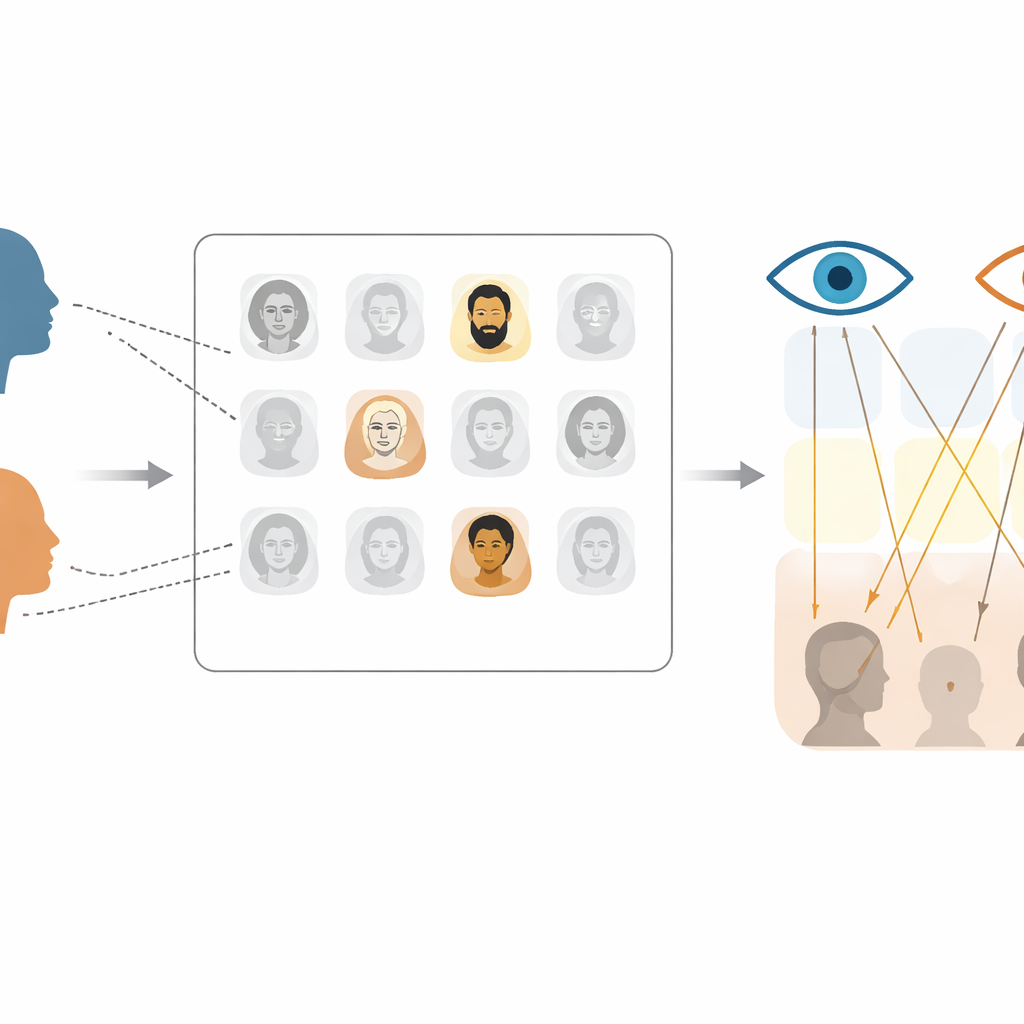
The researchers compared eight adults with congenital prosopagnosia to eight people with typical face recognition. Everyone completed two eye-tracking tasks while viewing arrays of faces containing both familiar celebrities and unfamiliar individuals. In a memorization task, participants studied four faces and later decided whether a single test face had appeared before. In a visual search task, they scanned five faces to find any familiar one as quickly as possible. Crucially, after the tasks, participants filled out questionnaires that distinguished faces they could clearly recognize by both picture and name from those that felt familiar only when the celebrity’s name was shown. This separation allowed the team to probe both conscious and more hidden forms of recognition.
How Familiarity Shapes Where We Look
Eye movements revealed that people with face blindness, like controls, adjusted their gaze depending on what the task required. During memorization, both groups devoted less time and fewer returns to faces they explicitly recognized, concentrating instead on unfamiliar faces that were harder to encode into memory. During search, the pattern flipped: eyes were drawn more often and for longer periods to the familiar face among strangers, helping participants home in on the target. These similarities appeared even though those with prosopagnosia were generally less accurate and, in the search task, slower than the control group. In other words, their performance showed impairment, but their moment‑to‑moment eye movements still reflected a strategic use of familiarity.
Hidden Signals of Recognition
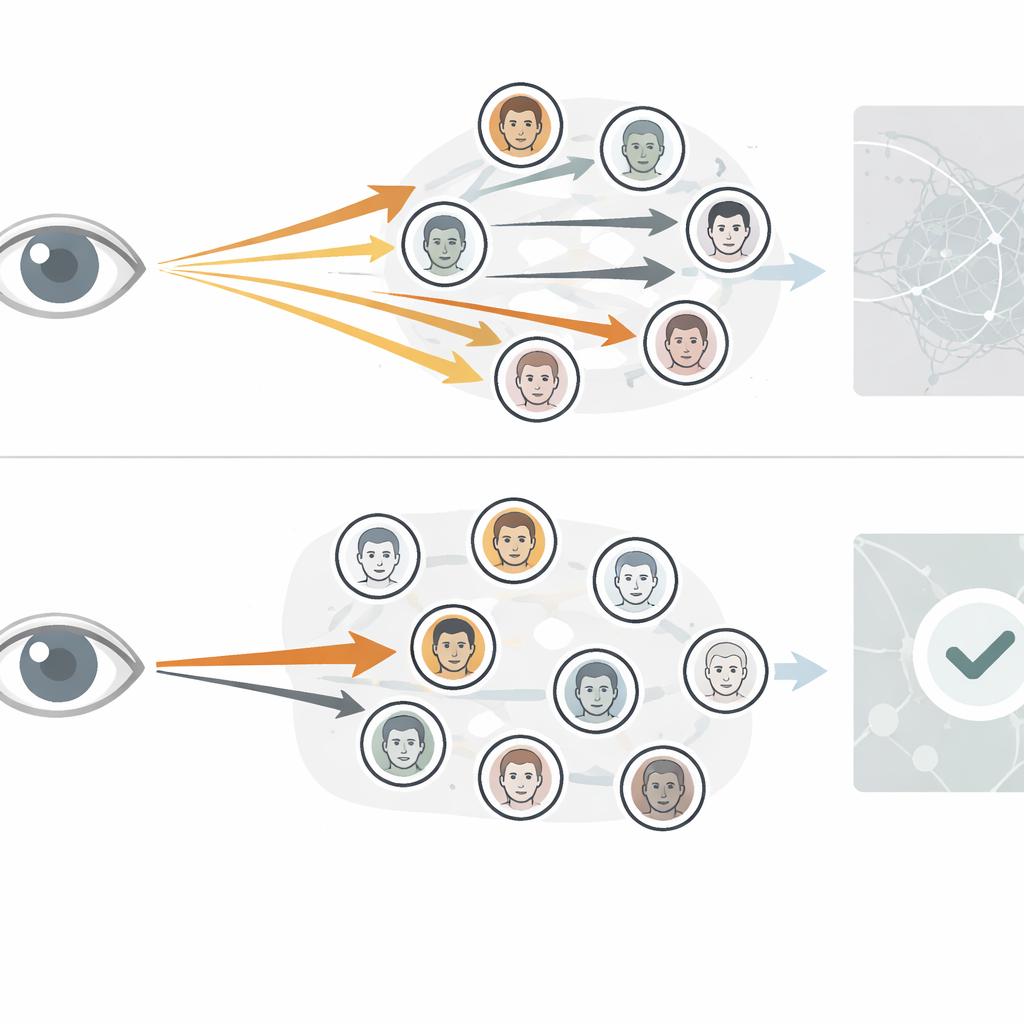
The most intriguing results came from faces that were only implicitly familiar to the prosopagnosic participants—people whose names they knew but whose photos they could not consciously identify. Even for these faces, gaze patterns differed from those directed at truly unfamiliar faces. In the memorization task, implicitly familiar faces were revisited less often than unfamiliar ones, hinting that some sense of familiarity reduced the need to re-check them, even though participants did not consciously know who they were seeing. In the search task, implicitly familiar faces attracted longer looks than unfamiliar faces, suggesting that a subtle feeling of familiarity could still tug at attention in complex scenes, without rising to full awareness.
What Performance Differences Reveal
When the researchers examined accuracy and response times, a more fragile picture emerged. People with prosopagnosia performed worse than controls overall, even when faces were explicitly recognized, consistent with broader difficulties in forming and maintaining stable mental representations of faces. For implicitly familiar faces, their performance often dropped to near chance levels, especially in the memorization task. This created a kind of cognitive trap: the face quietly influenced where they looked, but not enough to support reliable remembering or fast, successful search. The study’s relatively small sample size means subtle effects must be interpreted cautiously, but the main familiarity patterns were strong and consistent.
What This Means for Everyday Life
For a layperson, the key message is that face blindness does not mean faces are processed like anonymous blobs. Even without conscious recognition, familiar faces still leave a trace that can steer the eyes of people with prosopagnosia, helping or sometimes misleading them in tasks that mimic real‑world situations like scanning a crowd. The findings suggest that their brains retain a residual sense of “I’ve seen this person before,” which shapes attention even when they cannot say who the person is. Understanding this hidden layer of familiarity could inform future therapies and technologies aimed at supporting social life for people with face blindness, by harnessing intact attentional mechanisms even when explicit recognition fails.
Citation: Mizrachi, A., Lancry-Dayan, O., Pertzov, Y. et al. Gaze dynamics toward familiar and unfamiliar faces in prosopagnosia. Sci Rep 16, 12540 (2026). https://doi.org/10.1038/s41598-026-37933-w
Keywords: face blindness, eye movements, familiar faces, visual attention, implicit recognition