Clear Sky Science · en
Analytical wave families and stability dynamics in a modified complex Ginzburg–Landau model via the modified extended direct algebraic method
Waves That Refuse to Fall Apart
From laser pulses racing through fiber‑optic cables to ripples in quantum fluids, many of today’s technologies rely on waves that can keep their shape over long distances. This article explores a powerful mathematical model that describes such stubborn waves in real, messy systems where energy can be gained or lost, and shows how a new solution technique reveals an unexpectedly rich zoo of possible wave behaviors and their stability.
A Versatile Recipe for Real‑World Waves
At the heart of the study lies the modified complex Ginzburg–Landau equation, a workhorse of modern physics used to describe wave patterns in nonlinear optics, Bose–Einstein condensates, superfluids, plasmas, and other media where waves interact strongly with their surroundings. Unlike idealized equations that assume no losses, this model explicitly accounts for energy gain and dissipation, as well as higher‑order effects in how waves spread and interact. That makes it a realistic “recipe” for systems far from equilibrium, but also makes it notoriously difficult to solve exactly. Knowing its precise wave solutions and understanding when they are stable is essential for designing devices—from high‑bit‑rate optical links to pattern‑forming lasers—that operate safely and efficiently.
A New Mathematical Lens on Nonlinear Waves
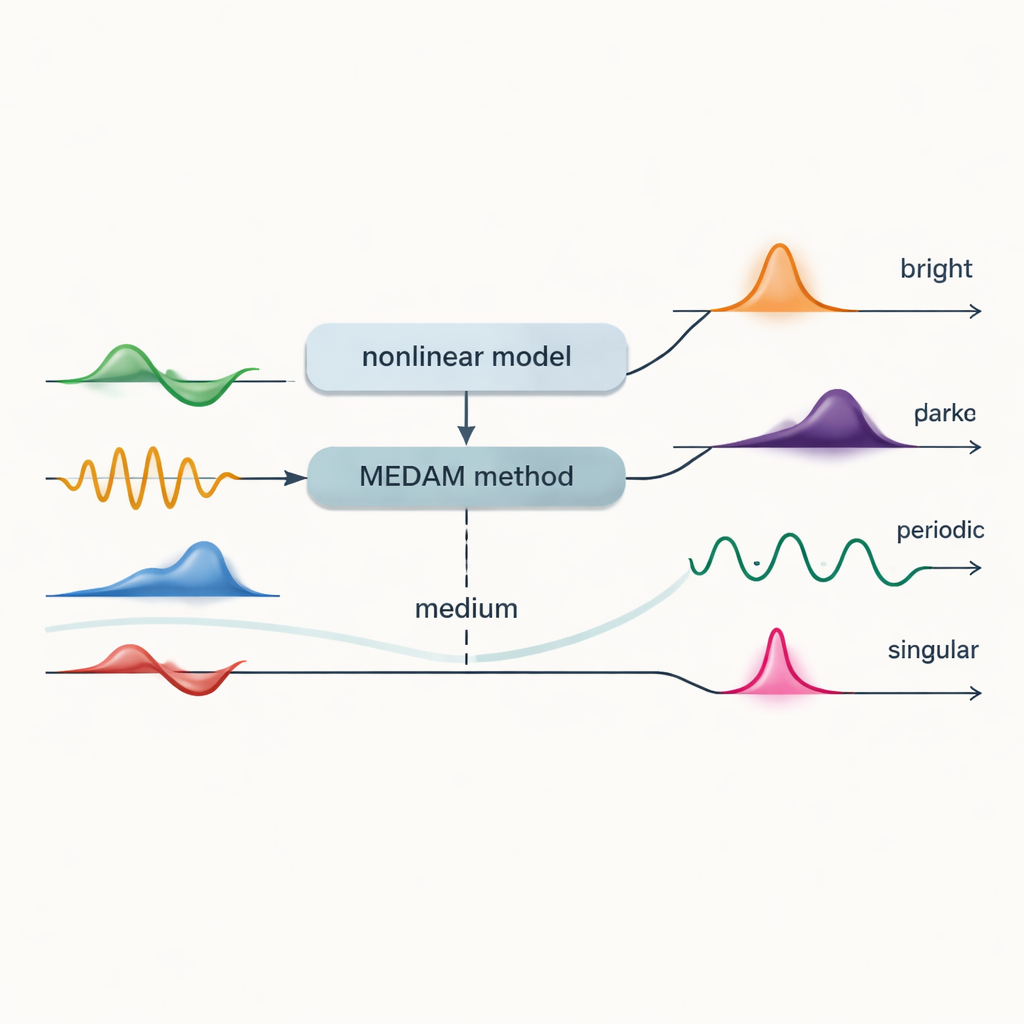
The authors employ a technique called the modified extended direct algebraic method (MEDAM) to tackle this challenging equation. The key idea is to look for traveling waves—patterns that keep their overall shape while moving—and to convert the original partial differential equation into a simpler ordinary differential equation in a single combined space–time variable. MEDAM then assumes the wave profile can be written as a structured series built from an auxiliary function whose behavior is carefully controlled. By choosing this auxiliary function and its parameters in a systematic, algebraic way rather than by guesswork, the method turns a complicated nonlinear problem into a solvable system of algebraic equations. This streamlined approach allows the researchers to explore many more possibilities than earlier, more restricted solution techniques.
A Zoo of Solitary and Periodic Waveforms
Using MEDAM, the study uncovers a broad family of exact analytical wave solutions. These include bright solitons—localized pulses that stand out as peaks against a dark background—and dark solitons, which appear as stable dips carved into a continuous beam. Both forms act like particle‑like wave packets that can travel long distances without changing shape when dispersion and nonlinearity are precisely balanced. Beyond these, the authors find singular solitons where the intensity becomes very sharply peaked, modeling extreme events such as rogue‑like waves or near‑collapse pulses. They also derive a variety of periodic and “singular periodic” waves that resemble regular trains of pulses, as well as more intricate solutions built from Jacobi and Weierstrass elliptic functions. These elliptic solutions are doubly periodic, capturing layered, lattice‑like patterns that can arise in structured optical or condensed‑matter systems.
When Stable Waves Turn Unruly
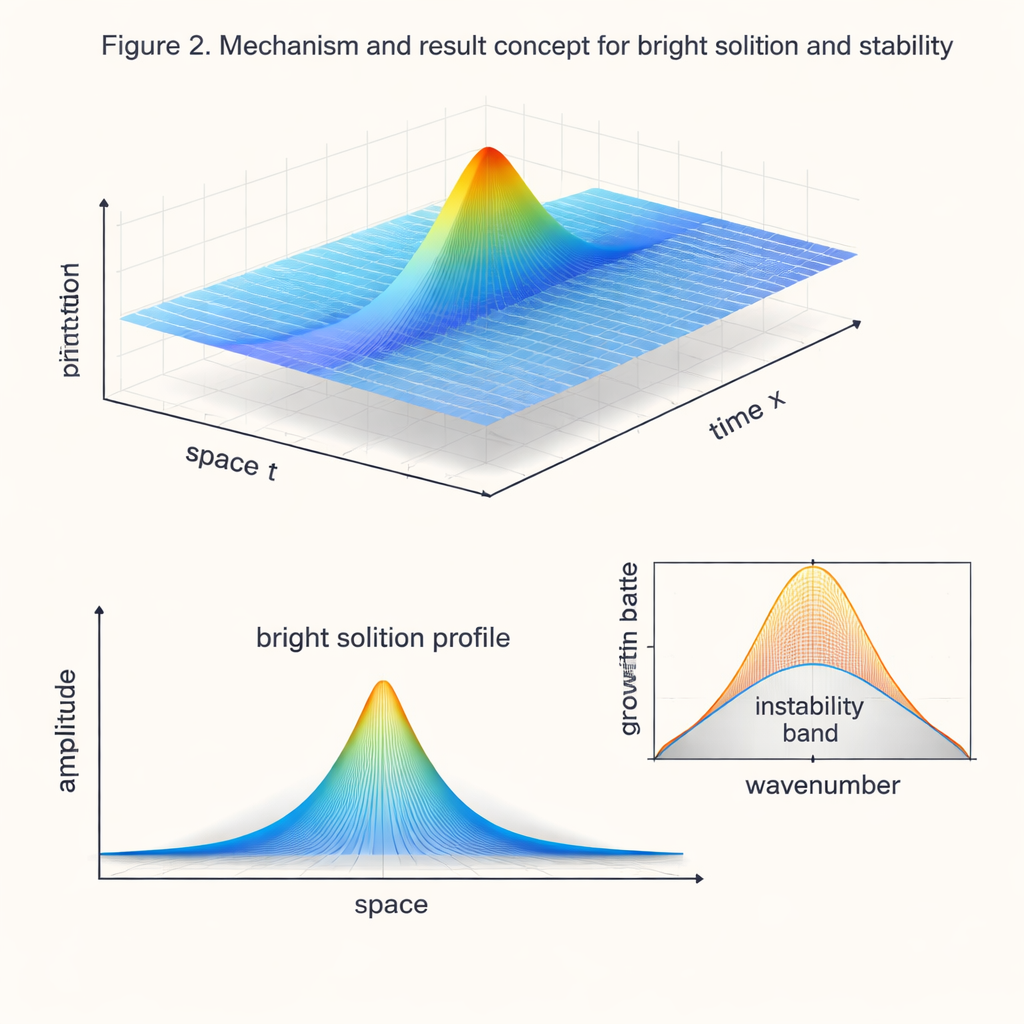
Exact wave shapes are only practically useful if they can survive small disturbances, so the authors carry out a detailed modulational instability analysis. They consider tiny ripples superimposed on a steady background and track whether these ripples grow, decay, or simply oscillate. By expressing the growth rate in terms of the physical parameters that describe dispersion, nonlinearity, gain or loss, and higher‑order effects, they map out regions where the background is stable, and regions where it breaks up into complex patterns. Their results show how tuning a few key parameters can switch the system from calm propagation—ideal for clean signal transmission—to regimes where instabilities amplify, leading to turbulence, pattern formation, or extreme spikes. The accompanying two‑ and three‑dimensional plots illustrate bright, dark, singular, and periodic structures, and how their shapes depend on these underlying controls.
From Abstract Equations to Practical Control
For non‑specialists, the main message is that the modified complex Ginzburg–Landau equation provides a unifying language for a wide range of real‑world wave phenomena, and the MEDAM technique greatly expands our catalogue of exact, interpretable solutions. These solutions act as benchmarks and design templates: engineers and physicists can use them to predict which kinds of pulses or patterns will be robust, which are prone to break up, and how to tune system parameters to favor one behavior over another. In practical terms, the work helps guide the design of stable laser pulses, reliable optical communication schemes, and controlled pattern formation in complex media, demonstrating how sophisticated mathematics can directly inform technologies built on waves that refuse to fall apart.
Citation: Rateb, A.E., Ahmed, H.M., Darwish, A. et al. Analytical wave families and stability dynamics in a modified complex Ginzburg–Landau model via the modified extended direct algebraic method. Sci Rep 16, 7485 (2026). https://doi.org/10.1038/s41598-026-37824-0
Keywords: solitons, nonlinear waves, optical fibers, pattern formation, wave stability