Clear Sky Science · en
Artificial intelligence driven approach for securing backup data and enhancing cyber resilience in sustainable smart infrastructure
Why Keeping City Data Safe Matters
Modern cities are filled with sensors, cameras, and connected devices that quietly keep traffic moving, power flowing, and hospitals running. If criminals manage to lock or corrupt the data behind these services, an entire city’s daily life can be disrupted. This paper explores a new way to make sure that even if attackers strike—especially with ransomware—the city can safely detect the attack and restore clean backup data without wasting energy or time.
How Smart Cities Become Easy Targets
Smart cities rely on thousands of small devices that constantly send information to distant servers. This creates a huge digital surface that cybercriminals can exploit. Ransomware, which scrambles data and demands payment to unlock it, is especially dangerous here: it can freeze traffic systems, water treatment, or medical records. Earlier security systems focused on spotting attacks, but they often overlooked a crucial step—checking whether backup copies of data had also been tampered with before putting them back into service. They could also struggle with new kinds of attacks and consumed a lot of energy, which clashes with sustainability goals.
A Smarter Data Lifeline for the City
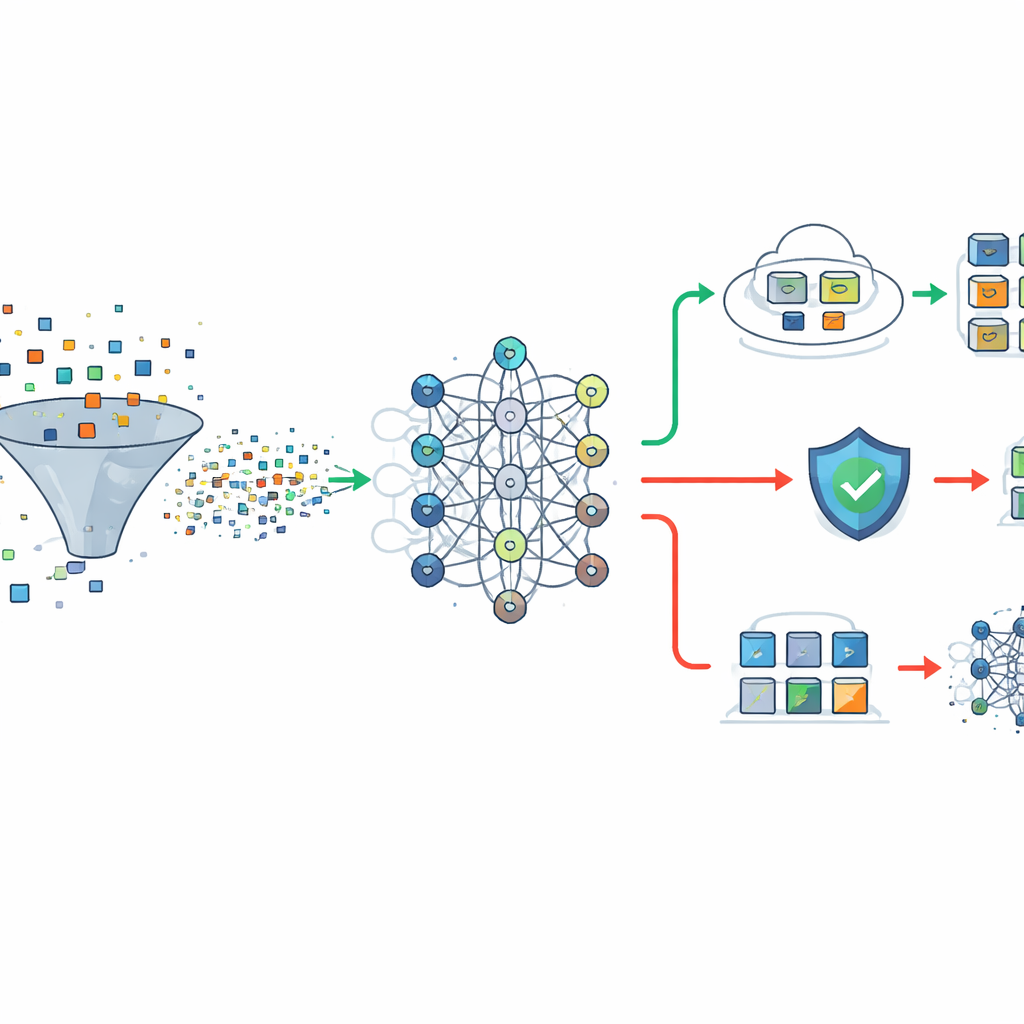
The authors propose an end-to-end safety net for smart city data that combines efficient communication, strong encryption, artificial intelligence, and careful backup checking. Sensor devices across the city are grouped into clusters so that data can be sent and processed in an energy-efficient way. As information travels from these nodes to a central cloud, it is protected using a specialized form of encryption designed to be both secure and less computationally heavy than traditional methods. At the same time, every piece of stored data is paired with a compact digital fingerprint, or hash, that can later prove whether the data has been altered.

Teaching Machines to Spot Ransomware
To catch ransomware early, the framework uses an AI-based detection engine that has been trained on large collections of real-world malicious and normal files. The system first cleans and standardizes incoming data, then groups it by similar behavior to speed up processing. It also creates visual-style summaries called correlation heatmaps, which highlight how different features of a file relate to each other. These features are fed into a custom-built neural network architecture that combines memory-efficient recurrent units, a special “swim” activation that improves learning, and a regularization trick that reduces overfitting. Transfer learning lets the model reuse knowledge from previous threats so it can adapt more quickly to new or rare attack patterns.
Checking Backups Before Trusting Them
When the AI engine suspects an attack, the system does not simply restore the latest backup and hope for the best. Instead, it runs a backup integrity check using a new hashing method called Murmur Polytopes Hash. This method carefully chooses its internal starting values to produce highly random, hard-to-predict fingerprints faster and with fewer collisions than common alternatives. Backups are stored not only in the cloud but also in a decentralized storage network. Both locations maintain hash-based tree structures that make it quick to verify whether a given backup exactly matches what was originally stored. If the hashes from cloud and decentralized storage agree for the same time point, the backup is restored; if not, the suspect data is blocked.
Saving Energy While Staying Resilient
Because smart cities must also be sustainable, the authors design their system to limit energy use. Their clustering method chooses node groupings and cluster centers in a way that reduces wasted communication and balances load, leading to lower energy consumption and latency compared with standard clustering techniques. Tests across several large malware datasets show that the proposed detection model achieves higher accuracy and fewer false alarms than widely used neural network designs, while the new hashing and encryption schemes are both faster and more secure than popular alternatives. The overall framework maintains strong protection during both normal operation and attack–verification–restore scenarios.
What This Means for Everyday Life
In practical terms, this work offers smart cities a more dependable way to bounce back from cyber incidents without blindly trusting possibly infected backups. By combining advanced AI with careful backup verification and energy-aware design, the framework helps ensure that critical services can be restored from clean data, even under sophisticated ransomware attacks. For citizens, that translates into more reliable transport, healthcare, energy, and public safety systems that continue to function—even when attackers are trying to hold the city’s data hostage.
Citation: Kumar, B., Gupta, S.K., Dwivedi, R. et al. Artificial intelligence driven approach for securing backup data and enhancing cyber resilience in sustainable smart infrastructure. Sci Rep 16, 13609 (2026). https://doi.org/10.1038/s41598-026-37802-6
Keywords: smart city cybersecurity, ransomware detection, backup data integrity, artificial intelligence security, cyber resilience