Clear Sky Science · en
Finite element analysis of stress in removable lower complete denture under vertical and oblique occlusal forces
Why denture breaks matter
People who rely on full lower dentures often face an annoying and costly problem: their dentures crack, especially in the front, even though the biting forces there are supposed to be low. This paper tackles that everyday mystery using computer simulations. By virtually “chewing” with a digital denture, the authors ask whether normal chewing forces alone are really enough to snap a well‑made lower denture, or whether other hidden factors must be involved.
A puzzling place for cracks
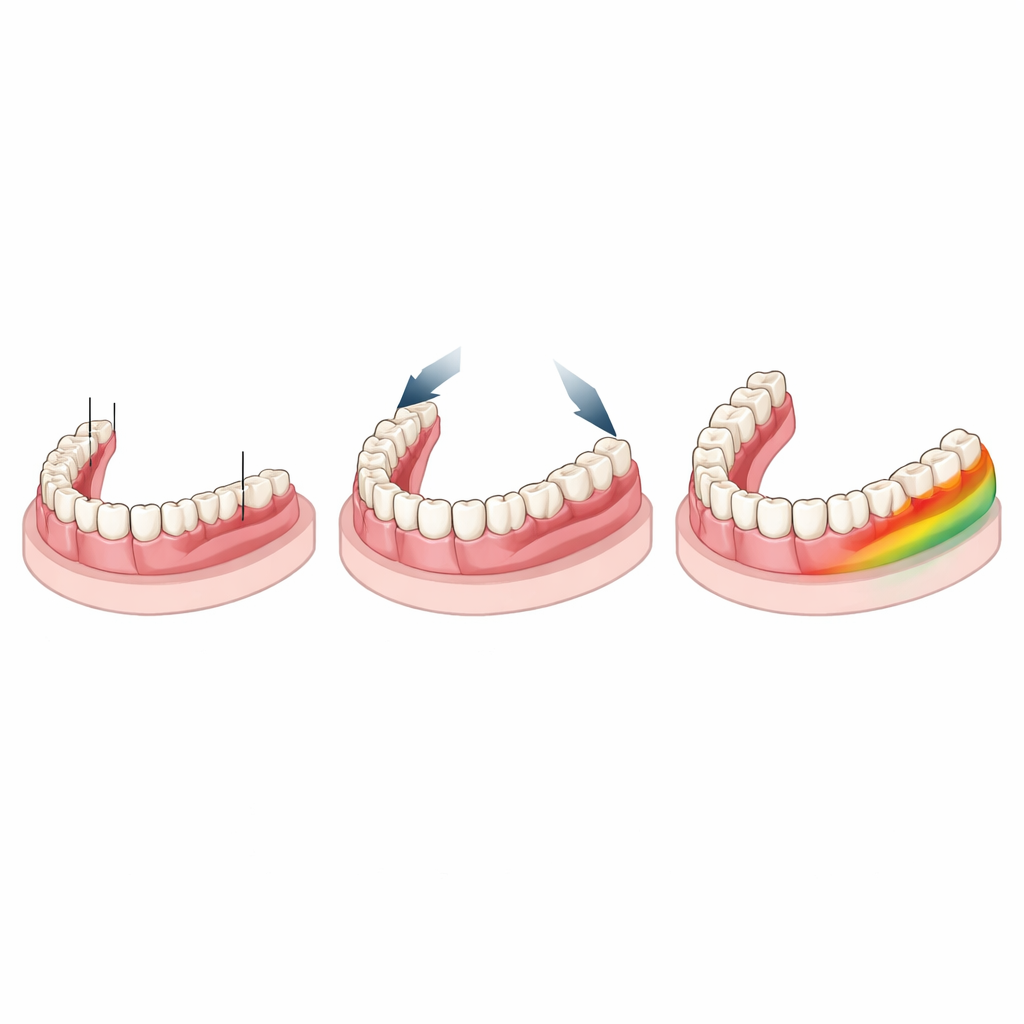
Traditional teaching in dentistry holds that the strongest chewing forces act on the back teeth, while the front teeth of a full lower denture experience much smaller loads. Yet surveys show that 20–30% of complete dentures eventually fracture, and many of those cracks start in the front region. Previous attempts to explain this paradox often pushed the models to unrealistic extremes: using bite forces much higher than real patients can generate, adding oversized defects, or forcing the denture to rest on very sharp bony ridges. The present study asks a simpler, clinically grounded question: if a lower denture is properly supported on soft tissue and made without obvious flaws, can normal chewing still generate stresses in the front region high enough to cause it to break?
Building a virtual lower denture
The authors constructed a detailed three‑dimensional model of a complete lower denture using dental design software, then imported it into engineering software for finite element analysis—a method that divides the denture and supporting tissues into many small elements and calculates how each one deforms under load. The denture base and artificial teeth were modeled as a typical acrylic plastic, while the underlying gum tissue was represented as a soft, slightly elastic layer resting on much stiffer bone. The denture was assumed to fit well and stick firmly to the gums, mimicking an ideally adapted prosthesis. Two chewing scenarios were tested: purely vertical forces of 100 newtons on the back molars, and stronger oblique forces of 140 newtons at a 45‑degree angle to mimic the sideways component of real chewing. The team also varied how fine the computational “mesh” was, to ensure that the calculated stresses were reliable and not just numerical artifacts.
Where the stress really goes
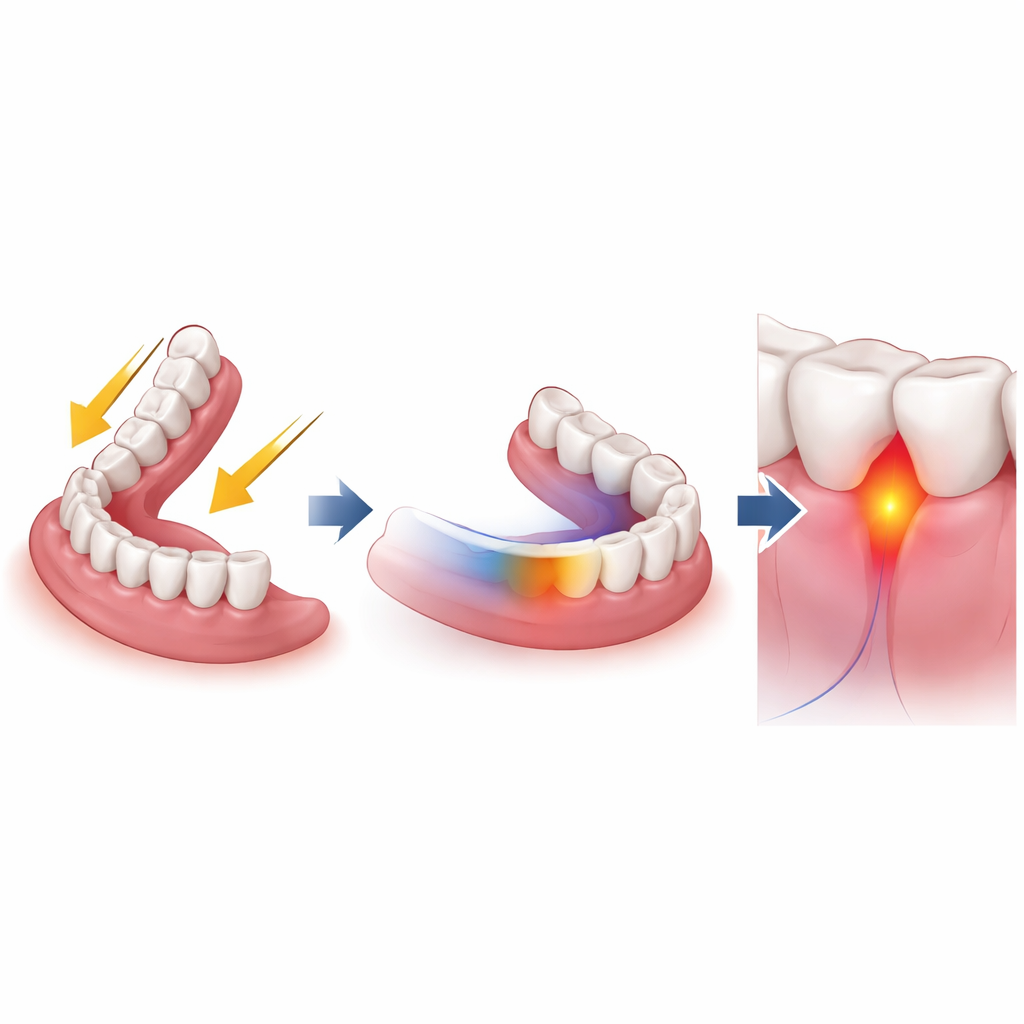
The simulations confirmed that angled chewing loads are far more demanding than straight vertical ones. Under vertical forces, stresses throughout the denture remained very low. When oblique forces were applied, the denture bent and twisted over the soft tissue foundation: the inner (tongue‑side) surface of the front region was placed in tension, while the outer (lip‑side) surface was compressed. However, even in this more severe scenario, the highest reliably calculated stresses occurred in the back molar area, not the front. In the critical front zone between the canine and incisor teeth, tensile stresses in sound material stayed around or below 10 megapascals—well under the typical tensile and bending strengths of modern denture plastics, which are several times higher. Only in tiny, sharp grooves between teeth did stresses locally rise, and even those values were still below the levels normally required to cause immediate fracture.
Fatigue, tiny grooves, and real‑world chewing
The authors compared their stress results with known laboratory data on how denture plastics behave under one‑time loading and under repeated fatigue. Everyday chewing exposes a denture to thousands of load cycles per day, so small stresses can, over many months, still lead to crack growth. In the simulations, stress levels in the canine region overlapped with the lower end of reported fatigue strength values, suggesting that long‑term wear, not a single heavy bite, is the more realistic concern. Importantly, the analysis highlighted how small anatomical details—narrow grooves and sharp transitions near the necks of teeth—can locally amplify tension. Smoothing these features on the tongue side of the denture, where appearance is less critical, could significantly reduce stress and improve durability without major design compromises.
What this means for denture wearers
Overall, the study concludes that, for a well‑fitting lower denture made from modern acrylic and resting on healthy soft tissue, typical chewing forces alone are unlikely to create enough stress in the front region to break it. This finding suggests that many real‑world fractures probably involve a combination of other factors: minor misfits, uneven bite contacts, long‑term fatigue, or unnoticed material defects. For patients, the message is that regular check‑ups, careful denture fabrication, and attention to seemingly small shape details may matter as much as raw material strength. For clinicians and technicians, the work points toward practical strategies—such as smoothing tight grooves and optimizing support on the gums—to make everyday dentures less prone to sudden, inconvenient breaks.
Citation: Madoune, Y., Żmudzki, J. & Lee, H. Finite element analysis of stress in removable lower complete denture under vertical and oblique occlusal forces. Sci Rep 16, 11997 (2026). https://doi.org/10.1038/s41598-026-37756-9
Keywords: complete denture, denture fracture, finite element analysis, masticatory forces, denture design