Clear Sky Science · en
Topographic modulation of soil functional indicators in shaded coffee agroforestry systems: a multivariate and network-based approach
Why Coffee Lovers Should Care About the Ground Beneath the Trees
Coffee drinkers rarely think about what happens under their feet on the farms that supply their daily cup. Yet the way soil behaves on steep tropical hillsides can make or break the long‑term health of coffee plants, nearby streams, and farmers’ livelihoods. This study looks inside the soil of a Brazilian coffee farm where crops grow in the shade of native trees. By tracking how soil properties change from the top of the slope to the bottom, and by using advanced statistical and network tools, the researchers reveal how organic matter acts as the hidden “conductor” that keeps the whole underground system working.
Life on a Steep Coffee Farm
The research took place on a mountainous farm in northeastern Brazil where coffee bushes are planted beneath a canopy of native trees. This shaded approach, called agroforestry, is increasingly promoted as a way to protect soil, cool the microclimate, and support biodiversity compared with conventional, sun‑baked coffee fields. The team compared three parts of the coffee slope—upper, middle, and lower thirds—and also sampled nearby native forest. They collected soil down to 60 centimeters, measuring texture, density, pore space, acidity, nutrients, and several forms of soil organic carbon, then analyzed how all these pieces fit together across the landscape.
How Slope Position Shapes the Underground
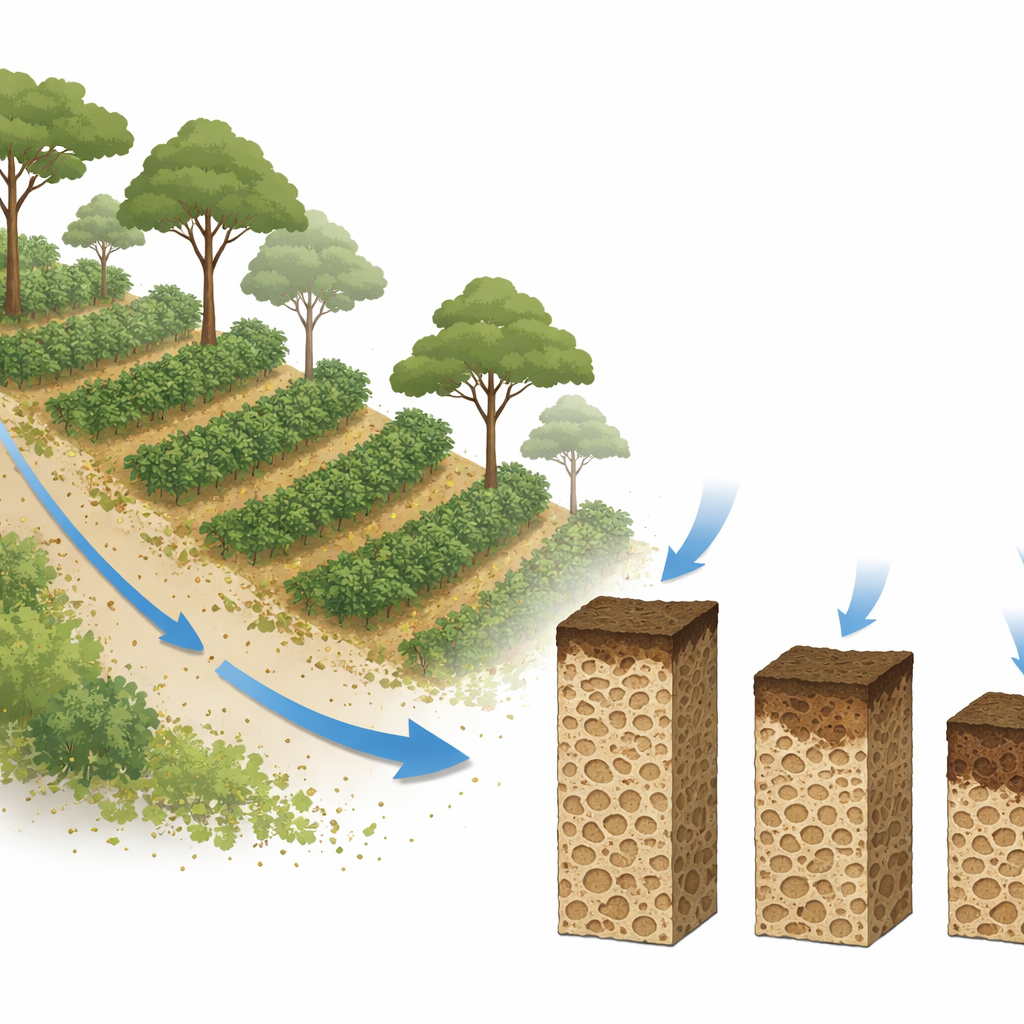
The upper slope, where water drains more easily and the ground is less saturated, showed the best physical structure. Here the soil had more large pores (macroporosity) and lower bulk density, meaning that it was looser, better aerated, and easier for roots to explore. The lower slope, by contrast, held more tiny pores (microporosity) and higher total organic carbon. Fine particles and organic material tend to be carried downhill by runoff and gravity and then settle in these lower areas. While extra organic carbon can help store water, the denser structure and dominance of small pores also raise the risk of compaction and poor oxygen supply for roots.
Chemistry Gradients from Top to Bottom
Chemically, the soil also changed along the slope. Upper positions generally had higher pH, lower levels of harmful aluminum, and a greater share of nutrient‑bearing “base” elements such as calcium and magnesium. These conditions reflect better drainage and less prolonged waterlogging, which reduces the leaching of nutrients and limits the release of aluminum from minerals. Lower positions, more prone to seasonal saturation, tended to accumulate acidity and exchangeable aluminum, which can stress plant roots. However, these same downslope soils also stored more total organic carbon and several nutrients carried with eroded particles, underscoring a trade‑off between fertility gains and structural or chemical stress.
Seeing Soil as a Connected Network
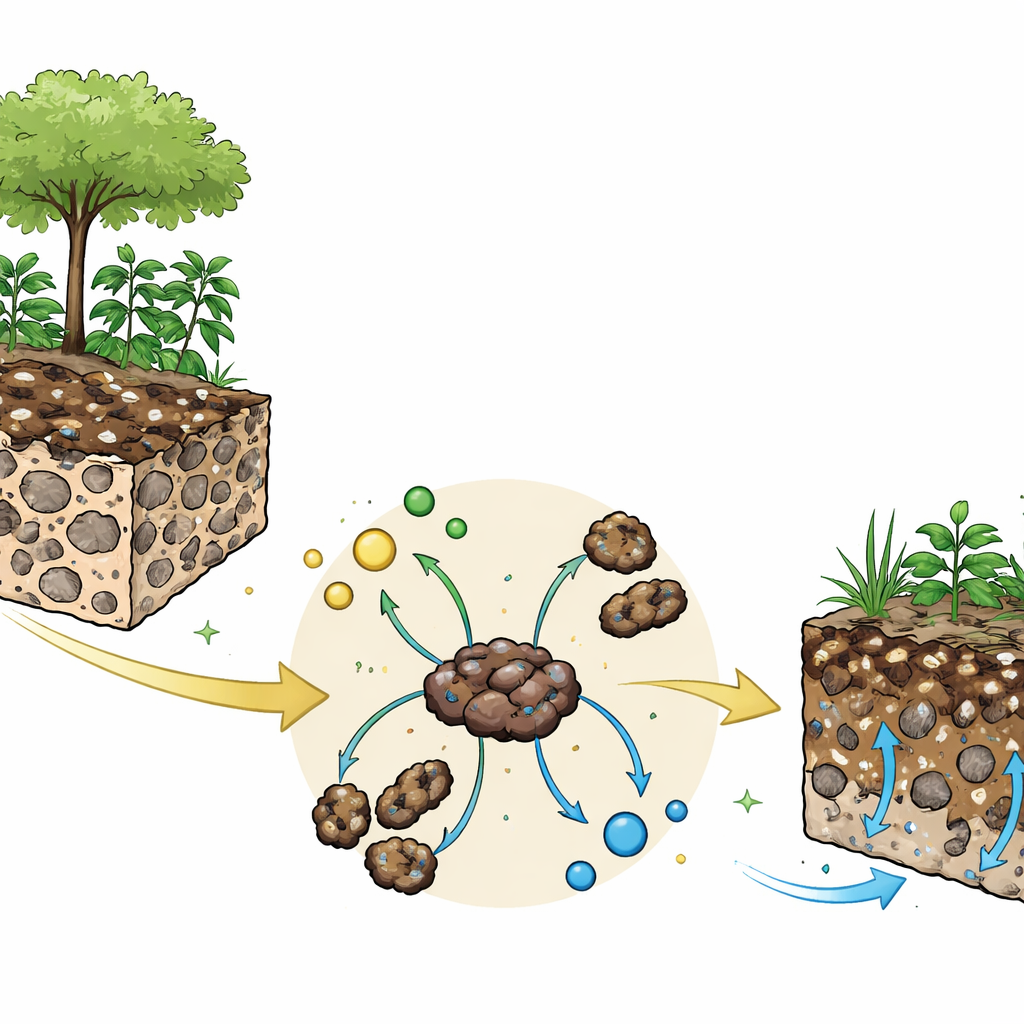
To move beyond one‑by‑one comparisons, the researchers used two integrative approaches. Principal Component Analysis compressed many soil measurements into a few key axes, clearly separating soils from upper and lower slope positions: the lower third clustered where nutrient levels and organic carbon were highest, while the upper third grouped where porosity and structural quality were strongest. A network analysis then mapped each soil property as a node linked by lines representing direct relationships after accounting for all others. In this web, total organic carbon emerged as the main hub. It sat at the center of connections linking pore structure, nutrient availability, and chemical buffering, especially in the upper slope and native forest, where the network was most cohesive.
What It Means for Sustainable Coffee
For non‑specialists, the key message is that organic matter in shaded coffee soils behaves like a central “switchboard” that coordinates how water, air, and nutrients move and interact underground. Steep slopes are not uniform: upper positions benefit most from good structure and balanced chemistry, while lower positions act as sinks for water, fine particles, and carbon, sometimes at the cost of compaction and acidity problems. By recognizing these topographic patterns, farmers and land managers can tailor practices—such as erosion control and residue management on upper slopes, and organic matter care and acidity reduction on lower slopes—to keep the whole hillside functioning. The study shows that shaded agroforestry systems, when managed with the land’s shape in mind, can sustain healthier soils and more resilient coffee production over the long term.
Citation: Crespo, C.M.G., Piscoya, V.C., de Melo, R.C.P. et al. Topographic modulation of soil functional indicators in shaded coffee agroforestry systems: a multivariate and network-based approach. Sci Rep 16, 11455 (2026). https://doi.org/10.1038/s41598-026-37724-3
Keywords: shaded coffee agroforestry, soil organic carbon, hillslope soil variability, tropical soil health, agroecosystem sustainability